
✍️ By Victor J. Rosario — Candidate for Mayor of Miami-Dade County
Your Voice. Your Future. Your Victory.
The Mission
Miami-Dade County doesn’t have a revenue problem — it has a structure problem.
For too long, money moves through systems that feel invisible to residents: contracts, vendors, outside operators, disconnected departments, and budgets that grow while everyday life gets harder. The result is familiar:
- residents pay more and get less,
- services strain under pressure,
- workers feel the instability,
- and the county stays dependent on systems it doesn’t fully control.
That ends with me.
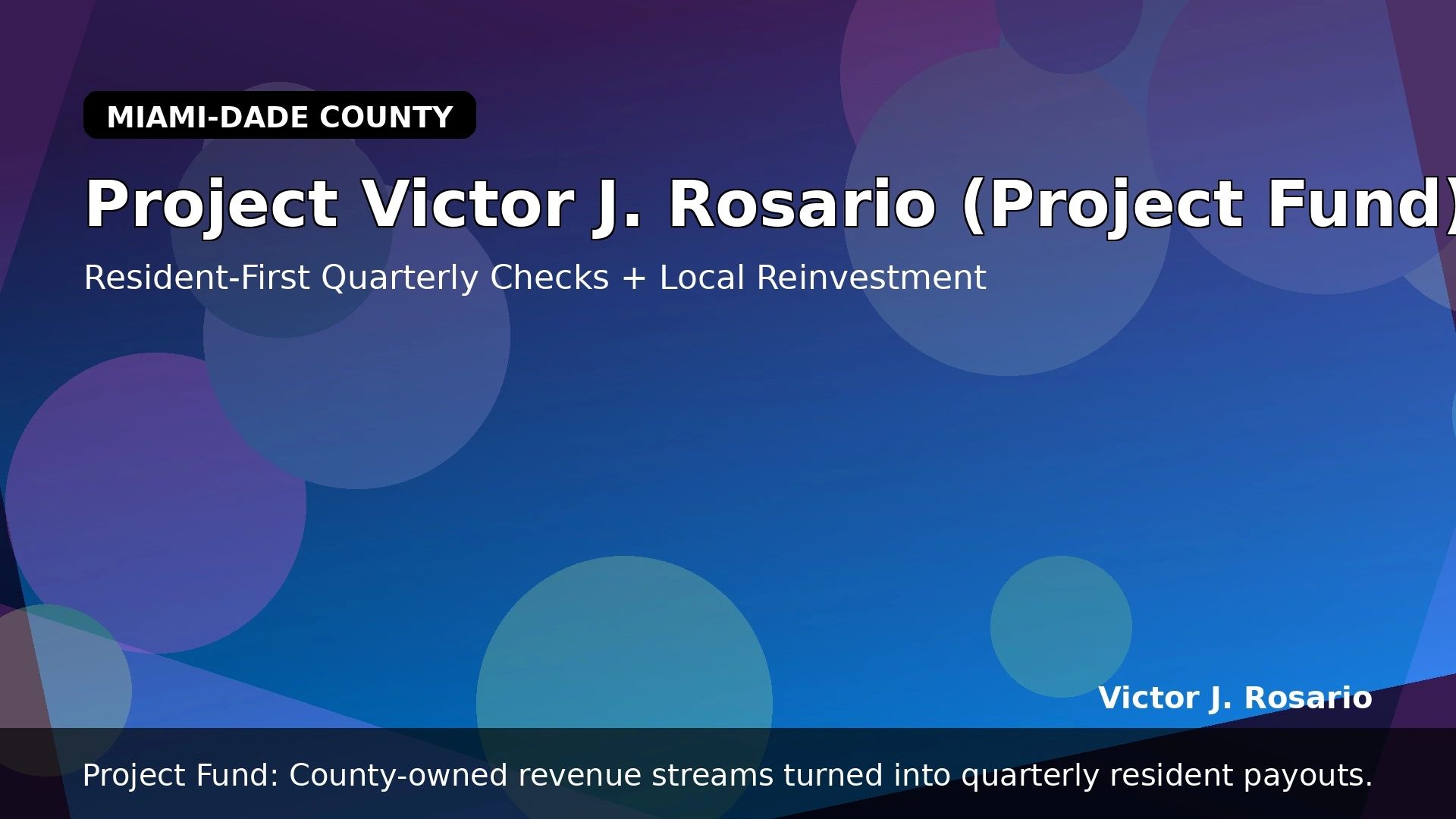
Project Victor J. Rosario — aka Project Fund — is the resident-first wealth engine designed to turn county-controlled revenue into quarterly payouts for eligible residents. It is not charity. It is not a stock. It is not attached to the NYSE. It is a civic revenue model built to make the county pay residents back.
This Project Fund framework expands from earlier city-level thinking into a countywide structure that works across all 34 municipalities—because Miami-Dade County is one ecosystem, and our residents deserve one unified, powerful system that puts them first.
What Project Fund Is (and What It Is NOT)
Project Fund is described as a county-controlled system built from multiple revenue engines—rideshare profits, county-owned fuels, county-controlled event revenue, regulated plant fee frameworks, and county contracts that stay local.
Project Fund IS
- A county-controlled wealth generator
- A resident-benefit distribution system
- A local reinvestment engine
- A transparency-first financial structure
Project Fund is NOT
- Not a stock
- Not an investment product marketed to the public
- Not a security
- Not linked to Wall Street or the NYSE
- Not a “promise” without a mechanism
Project Fund is a working civic model: build revenue locally → lock allocation rules → distribute resident benefits quarterly → publish results transparently.
The Core Promise: Quarterly Checks (How It Works)
This is the part people always ask first:
How do residents actually receive money?
Project Fund revenue is designed to flow back to residents as practical benefits such as quarterly direct deposits and other resident credits (transportation/SunPass, gas and parking discounts, etc.).
In the “Reinventing Miami-Dade” framework, the county-level payout system is described in plain terms: quarterly cash distributions tied to verified residents, with multiple options to receive those benefits (for example direct deposit or printed checks).
The Distribution Channels (Resident Choice)
Project Fund will support a resident-choice delivery system so every eligible person can pick what works best:
- Quarterly direct deposit (bank or verified account rails)
- Printed quarterly check (mailed or picked up through verified county process)
- County credits (optional):
- Transportation + SunPass credits
- Gas and parking discounts
- Hybrid option: split payout (example: 70% cash + 30% credits)
The key point: Project Fund is built to be a real distribution mechanism, not an idea floating in the air.
The New Allocation Model (10/10/10/70)
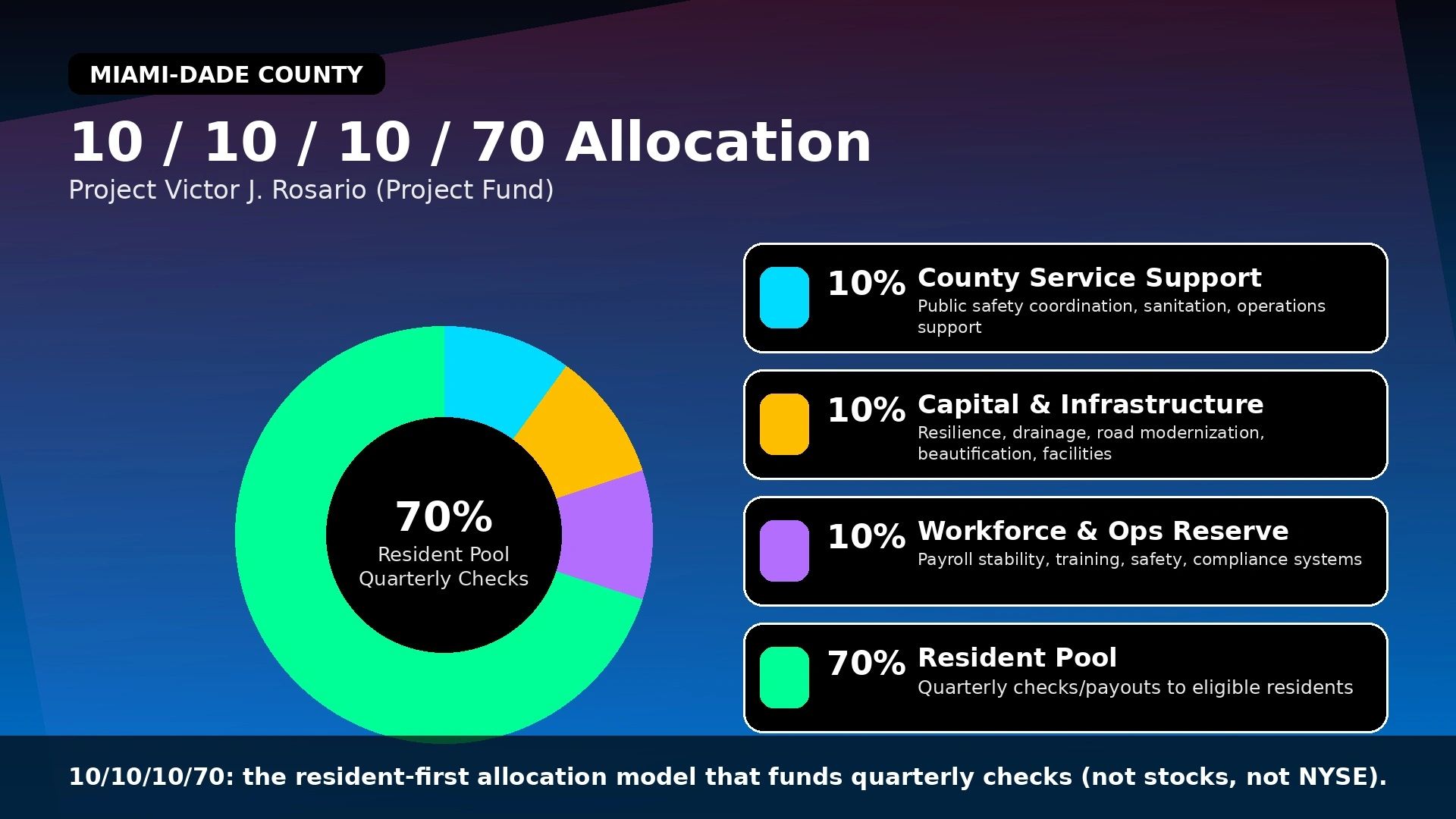
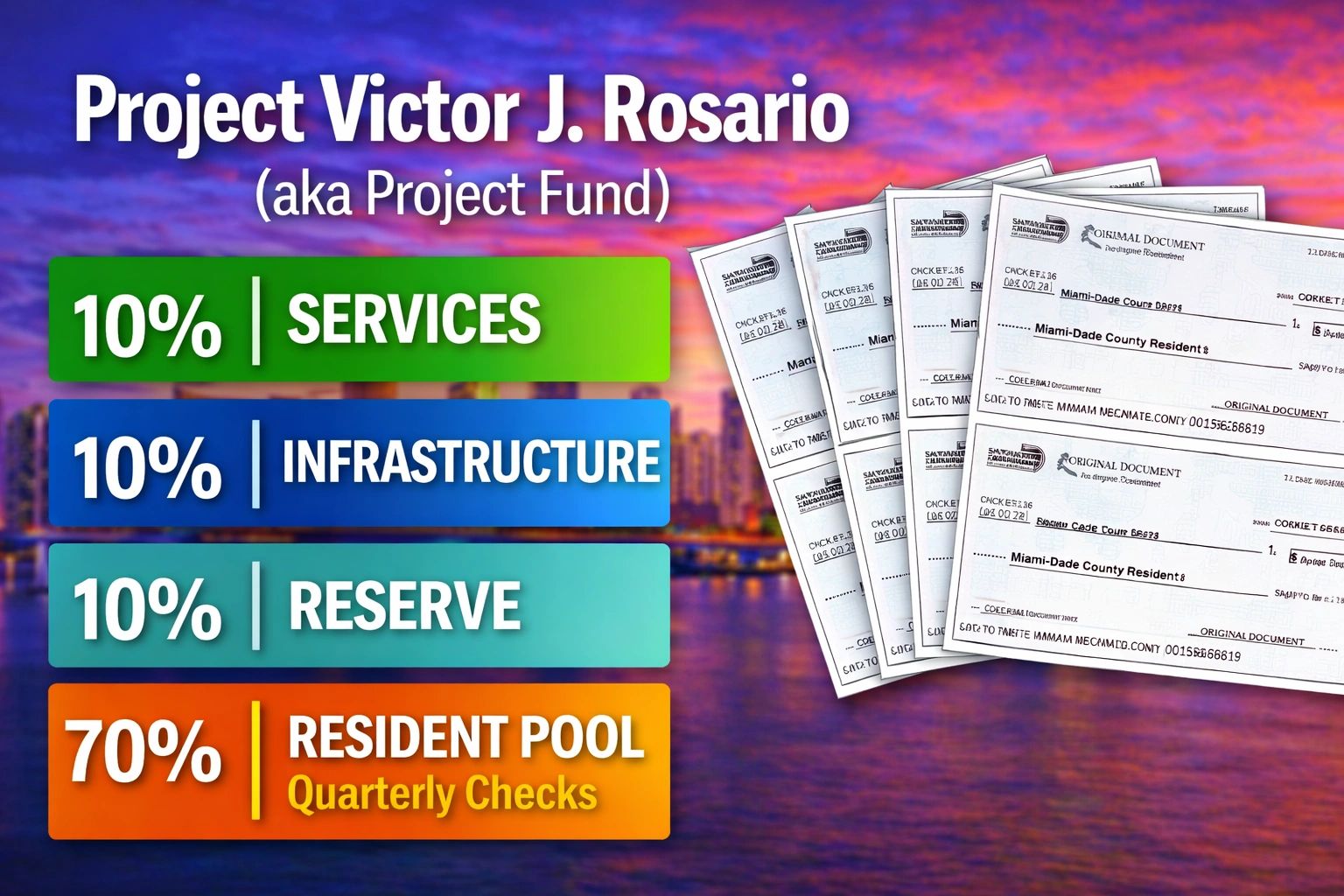
✅ Project Fund Allocation Formula
10% — County Service Support
Public safety coordination, sanitation, operations support
10% — Capital & Infrastructure
Resilience, drainage, road modernization, beautification, facilities
10% — Workforce & Operations Reserve
Payroll stability, training, safety, compliance systems
70% — Resident Pool
Quarterly payouts to eligible residents
This is the difference between politics and engineering: the allocation is the system.
When the public knows the split, leaders can’t quietly redirect funds into the wrong places without getting caught.
Who Is Eligible for Quarterly Checks?
Project Fund is a resident-first program. That means eligibility must be:
- clear,
- verifiable,
- fair,
- and protected from fraud.
Baseline eligibility (working standard)
- Verified Miami-Dade County residency
- Identity verification through a county system
- Participation compliance (no fraud, no abuse, no duplicate claims)
The goal is to make the system simple enough to use but strong enough to protect.
The Engines That Fund Project Fund
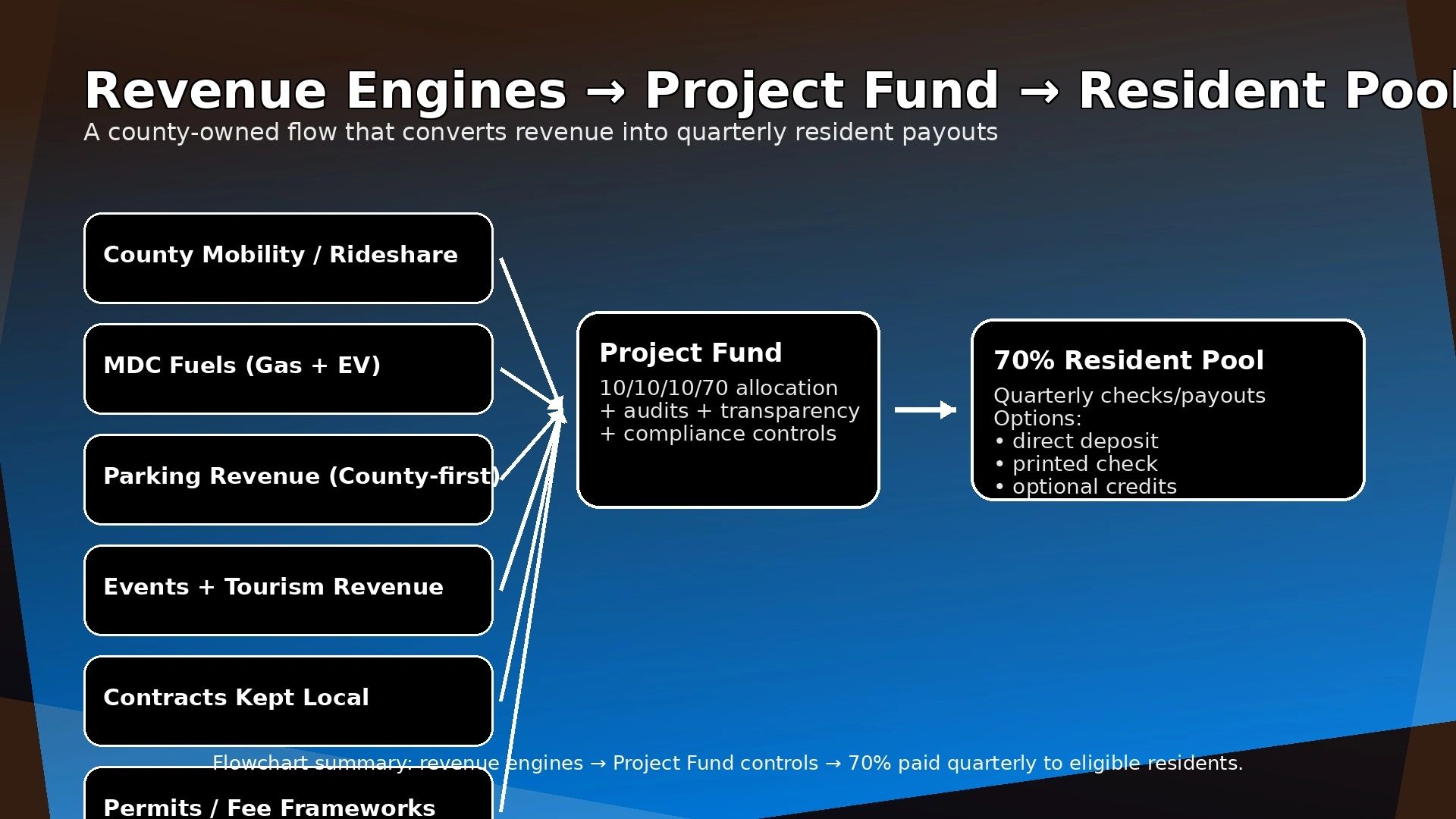
Project Fund isn’t funded by hope. It’s funded by county-owned and county-controlled revenue engines.
In the county framework, revenue sources explicitly include:
- rideshare profits,
- county-owned fuels,
- local contracts and creative/website services through a county media agency,
- county-owned event revenue,
- and regulated plant fee frameworks.
Below is how these engines plug into a unified county system.
Engine 1: County-Owned Mobility Profits (Rideshare)
Miami-Dade residents move every day. That movement is money.
When mobility systems are dominated by outside corporations, profits leave the county. Under Project Fund, the county strategy is to build local mobility revenue and route profits back into resident benefits—positioning residents as the beneficiaries, not the product.
Result: transportation becomes an economic tool that supports residents quarterly.
Engine 2: ⛽ MDC Fuels — Energy Independence That Pays Residents
MDC Fuels is framed as a county-owned fuels and EV strategy—part of the Project Fund revenue backbone.
The core logic is simple:
If the county controls critical supply infrastructure (gas/EV stations), it can:
- stabilize operations,
- keep profits local,
- and channel those profits into the resident pool for quarterly benefits.
This is how you turn everyday spending into a county asset instead of a corporate exit ramp.
Engine 3: County-Controlled Events and Festivals
Miami-Dade has year-round event power: culture, sports, nightlife, tourism, festivals.
In the county framework, event revenue is explicitly named as part of Project Fund.
The rule under Project Fund: events should not be structured so that residents absorb the impact while outsiders absorb the profit. When the county owns the revenue flow, residents get paid back quarterly.
Engine 4: County Contracts That Stay Local
A major leakage point in government is contracts: outside firms, repeat vendors, weak oversight.
The county framework includes bringing website/creative contracts under a local county system.
That creates two benefits at once:
- local jobs (workers inside the county)
- local profit retention (money stays in the county ecosystem)
Engine 5: Regulated Plant Fee Frameworks (Resident-First)
Plant fee and licensing frameworks are explicitly listed among Project Fund revenue sources.
The principle is not chaos. The principle is structure: if a framework exists, its revenue should be designed to benefit residents — and a portion should route into the 70% Resident Pool.
About Entertainment and Nightlife
✅ 1. Municipal Takeover of Nightlife Venues
We will identify qualifying high-traffic, high-revenue clubs and bars currently mismanaged or in violation of zoning or licensing.
The City will either:
- Convert licenses into municipally operated franchises;
- Enforce shutdowns for bad actors and repurpose venues into city-run revenue engines.
How this translates to Miami-Dade County
Miami-Dade County is not one nightlife strip — it’s a network of districts across municipalities. The county version of this concept becomes:
- stronger countywide standards,
- tighter licensing enforcement coordination,
- and county-first revenue capture models where applicable, so profit doesn’t disappear while residents deal with the consequences.
The Security Layer: “Miami-Dade Secure” (Fraud Prevention + Trust)
To run quarterly payouts at county scale, you need identity verification and fraud prevention.
The MDC Fuels strategy references a county verification concept (“Miami-Dade Secure”) that includes in-person verification and biometric-style checks as part of protecting benefits and preventing abuse.
Whether the final system uses biometrics, multi-factor identity verification, or other approved methods, the purpose is the same:
- one person = one verified claim
- no duplicates
- no ghost accounts
- clean payout records
Transparency and Enforcement: Truth Ledger
Project Fund must be auditable by the public, not just “internally reviewed.”
In the county framework, “Truth Ledger” is described as a blockchain-powered compliance and transparency system where vendors and contractors must disclose affiliations and pass verification before receiving county funds.
This is the accountability structure that makes Project Fund durable:
- public-facing tracking,
- vendor certifications,
- contract transparency,
- and a permanent record that’s harder to manipulate than ordinary reporting.
Why This Model Is Bigger Than a Budget
A traditional budget is a plan to spend money.
Project Fund is a plan to generate money, protect it, and return it to residents quarterly—while still funding county operations, workforce stability, and infrastructure through the 10/10/10/70 model.
It’s a resident-first economic constitution.
Implementation Roadmap (Practical Rollout)
Here’s a clean rollout approach that matches county reality:
Phase 1 — Build the rails
- finalize the Project Fund legal structure
- publish the 10/10/10/70 allocation rule
- establish eligibility criteria
- launch the verification rails (Miami-Dade Secure concept)
Phase 2 — Activate revenue engines
- ramp up county-owned fuels strategy (MDC Fuels)
- structure rideshare/mobility revenue capture
- align events and contracts to county-first profit retention
Phase 3 — Begin quarterly payouts
- first distribution cycle
- publish reports
- tune fraud controls and payout options
- expand benefits (cash, credits, discounts)
Call to Action
Project Fund is built for one purpose:
Miami-Dade County residents should benefit from Miami-Dade County prosperity.
If you want a county that pays you back, protects your future, and runs like a high-performance organization—not a leaky bureaucracy—then share this plan, talk about it, and help me build the mandate to implement it.
Prohibited Participation Clause:
Safeguarding the Fund from
Corruption and Abuse
In light of ongoing concerns and allegations of misconduct, technological abuse, and interference in political processes by individuals associated with the U.S. Department of Homeland Security (DHS) and the Federal Bureau of Investigation (FBI), the Project Fund will enforce a strict prohibition on DHS and FBI employees and contractors and all federal employees — current, former, or affiliated — from:
- Holding any vendor, contractor, or consultant role with the Fund.
- Receiving any direct or indirect payment from Fund operations.
- Serving in any administrative or oversight capacity related to Fund governance.
- Participating in or influencing any bidding, procurement, or investment decisions tied to the Fund.
This ban extends to any subsidiary, shell company, or proxy entity used to obscure DHS or FBI affiliation. Any attempt to circumvent this rule will result in immediate disqualification, contract termination, and legal action.
Enforcement & Compliance Measures
To ensure this ban is absolute and enforceable, my administration will implement:
- Mandatory Vendor Disclosures – All applicants for Fund contracts or employment must complete a sworn affidavit attesting they have no DHS or FBI ties.
- Third-Party Background Audits – An independent compliance firm will verify vendor and employee backgrounds before approval.
- Blockchain Transparency Ledger – Every contract, vendor name, and payment from the Fund will be recorded on a public blockchain for total accountability.
- Zero Tolerance Enforcement – Any violation triggers immediate removal from the program and referral to law enforcement.
- Hatch Act Enforcement – My administration will strictly enforce the Hatch Act, ensuring that no federal employee uses their position to influence elections, policymaking, or economic decisions tied to the Project Fund.
Why This Ban Matters
Miami-Dade residents deserve a county economy free from coercion, overreach, abuse of power, and politically motivated interference. By formally excluding All federal employees thanks to DHS and FBI -affiliated individuals from the Project Fund—and by actively enforcing the Hatch Act—we protect our economic sovereignty, secure resident earnings, and send a clear message:
✍️ Victor J. Rosario
Candidate for Mayor of Miami-Dade County
Your Voice. Your Future. Your Victory.
Miami-Dade’s future will be decided by its people Rosario — Candidate for Mayor of Miami-Dade County
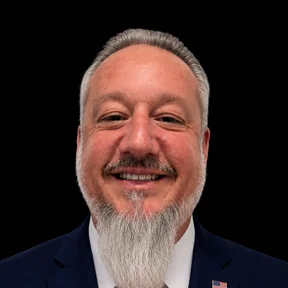
About Victor J. Rosario
Victor J. Rosario is the Residents-First candidate for Miami-Dade County Mayor 2028. A U.S. Coast Guard veteran, entrepreneur, technologist, and artist, Victor brings a track record of building real solutions — from AI tools to campaign policy — that serve Miami-Dade's 2.8 million residents.
Learn More About Victor