
By Victor J. Rosario
Candidate, Mayor of Miami-Dade County 2028
Your Future Mayor of Miami-Dade County
Building a Resident-First Transportation System Under Project Victor J. Rosario (Project Fund)
Building the Future of Miami-Dade County
I am building the future of Miami-Dade County with one clear intention:
Project Victor J. Rosario (Project Fund) will own, manage, and control airport transportation and logistics operations on county property.
That sentence is the foundation of Clean Skies. It is not a slogan. It is a governing standard.
It means airport mobility will no longer function as a patchwork of private territories competing for control over a public asset. It means that when the public pays for infrastructure, the public deserves direct benefit, direct accountability, and direct transparency. It means the county sets the rules, the county enforces the rules, the county owns the operational system, and the county routes verified outcomes back to residents.
There will be no space for outside networks to dominate public infrastructure.
There will be no private empires operating on land paid for by residents.
There will be no system where public value is extracted and residents are left behind.
Clean Skies represents a new model:
- County-owned
- Resident-first
- Professionally managed (MDC Workforce No Outsiders)
- Fully accountable
- Publicly transparent
This is not about symbolism.
This is about ownership, control, and long-term prosperity.
This is about ensuring that when Miami-Dade County wins, Miami-Dade residents win first.
Miami-Dade’s Airport: A Public Economic Engine
Miami-Dade International Airport is one of the most powerful economic engines in our region. It is not only a transportation hub—it is an economic machine that drives jobs, hospitality, trade, events, and global connectivity.
Every single day:
- Airline pilots and crew members
- Professional athletes
- Government officials
- Medical specialists
- International visitors
- Business leaders
- Event organizers
move through county infrastructure.
Each movement requires:
- Transportation
- Scheduling
- Security coordination
- Logistics planning
- Support services
This creates enormous demand.
That demand creates revenue.
That revenue is generated on public land.
That value belongs to residents.
Clean Skies makes sure the county stops acting like a landlord while others harvest the benefits. The county becomes the operator. The county becomes the standard-setter. The county becomes the accountability engine. And residents become the beneficiaries.
When Residents Built the System
For many years, Miami-Dade residents were the backbone of airport transportation.
Local drivers.
Local dispatchers.
Local companies.
Local families.
They built stable livelihoods moving crews and visitors safely between the airport and their destinations.
These were not temporary jobs.
They were careers.
They supported mortgages, education, healthcare, and community stability.
They kept money circulating inside the county.
That matters because local circulation is how a county stays strong. When resident workers earn stable income, they spend locally, support small businesses, pay into housing stability, and strengthen neighborhood economies. When public infrastructure creates resident careers, the entire county becomes more resilient—especially during economic downturns.
Clean Skies is designed to restore that stability and multiply it.
How the Resident-First System Was Eroded
Over time, that resident-first reality weakened.
Residents began raising serious concerns:
- Contracts shifting away from local operators
- Decision-making becoming less transparent
- Networks forming that discouraged competition
- “Security” language being used to limit access
- Ownership structures becoming harder to verify
Many of these changes happened quietly.
Little by little.
Without clear public explanation.
Without meaningful resident input.
Without transparent justification.
This eroded trust.
When trust erodes, residents stop believing the system is fair—even if some parts of it are functioning. That is why Clean Skies does not rely on reassurance. It relies on structure and proof.
Clean Skies is built to answer the most important questions:
- Who controls the operations?
- Who benefits financially?
- Who is accountable for performance failures?
- Who has access to compete?
- Who enforces the rules?
Under Clean Skies, the answer becomes clear:
The county controls it. The county reports it. Residents benefit from it.
Under My Administration, That Changes
I am not interested in managing decline.
I am interested in restoring control.
Under my administration:
- County infrastructure will serve county residents
- Public systems will operate in public view
- Contracts will be accountable
- Opportunities will be accessible
- Benefits will be shared
Clean Skies is how we do that.
And when I say shared, I mean shared by the people who live here and make this county function—not shared by outside entities whose interest is extracting value and leaving.
What “Clean Skies” Means
Clean Skies is not anti-aviation.
It is not anti-business.
It is not anti-innovation.
It is:
- Pro-resident
- Pro-transparency
- Pro-accountability
- Pro-professionalism
- Pro-modernization
Clean Skies ensures that transportation on county property is:
Transparent
- County-owned operations
- Clear reporting
- Open oversight
- Verifiable ownership
Resident-First
- Local jobs
- Local opportunity
- Local reinvestment
- Local benefit
Secure
- Trained staff
- Audited systems
- Documented procedures
- Professional standards
Modern
- Smart fleets
- EV integration
- Data-driven maintenance
- Unmanned capability where lawful
- Human oversight always
The Core Issues Residents Keep Reporting
Across neighborhoods and communities, residents describe similar patterns:
- Longtime local operators pushed out
- Bidding processes that feel closed
- Contracts that appear predetermined
- Ownership that is difficult to trace
- Networks that discourage participation
These are not isolated complaints.
They represent systemic concerns.
They deserve serious response.
My Approach: Verify, Audit, Disclose, Correct, Restore
I will not pretend problems do not exist.
I will not publish conclusions without evidence.
My approach is simple and lawful:
- Verify facts
- Audit operations
- Disclose findings
- Correct failures
- Restore fairness
No politics.
No speculation.
No shortcuts.
Only proof.
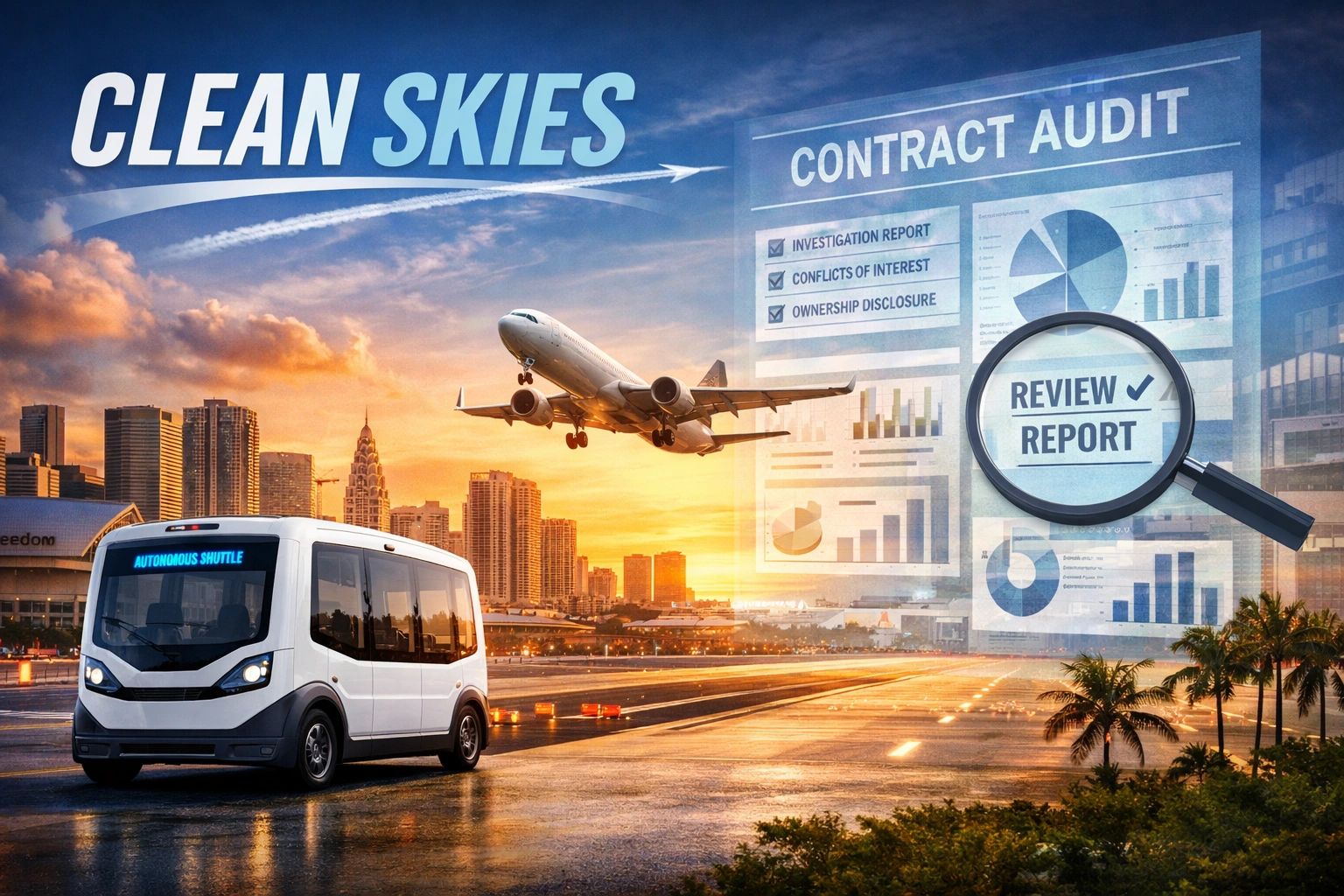
Contract Integrity Audit: The Accountability Engine
Under Clean Skies, Miami-Dade will conduct a comprehensive:
Contract Integrity & Beneficial Ownership Audit
This audit will examine:
- Crew transportation operations
- Shuttle providers
- Subcontractors
- Ownership structures
- Control relationships
- Bid histories
- Renewals
- Amendments
- Insurance records
- Licensing
- Compliance history
- Conflict indicators
Every layer will be examined.
No shell companies.
No hidden controllers.
No undisclosed affiliates.
This audit is not just a paper review. It includes operational verification—who dispatches, who controls staffing, who manages routes, who receives payments, and whether public records match reality.
When Integrity Failures Are Found
If evidence shows:
- Undisclosed conflicts
- Improper influence
- Bid manipulation
- Ethics violations
- Coercion
- Misrepresentation
The county will act.
No Excuses. No Loopholes.
Let me be clear.
There will be no excuse.
There will be no loophole.
There will be no special treatment.
Corrective action may include:
- Termination or non-renewal (primary option)
- Transparent rebidding
- Mandatory disclosures
- Subcontract limits
- Performance controls
- Continuous monitoring
This is how you rebuild trust.
Routing Operations Into Project Fund
All recovered and restructured operations will be routed into:
Project Victor J. Rosario (Project Fund)
This ensures:
- Public ownership
- Public accounting
- Public oversight
- Public benefit
Operations on county property must serve the people who own that property.
County-Run Logistics for Crews and Pilots
Under my administration, the county will manage standardized logistics for:
- Airport → Hotel
- Airport → Lodging
- Airport → Staging Areas
These systems will operate under:
- Ownership transparency
- Compliance rules
- Resident staffing
- Performance accountability
No fragmented vendors.
One public system.
Smart Fleets and Unmanned Capability (With Oversight)
Miami-Dade must modernize.
Clean Skies deploys:
- Smart shuttles
- Monitored vans
- EV units
- Advanced routing
- Predictive maintenance
Where legal and safe:
- Controlled autonomous pilots
- Human supervisors
- Emergency overrides
- Public reporting
Technology supports accountability.
It never replaces it.
Resident Certification Program
Only vetted Miami-Dade residents should operate these systems.
Certification includes:
- Background screening
- Ethics training
- Safety protocols
- Privacy compliance
- Professional standards
- Service training
- Law Enforcement compliance
This creates:
- Career pathways
- Workforce stability
- Public confidence
- Higher service quality
Sports, Events, and Delegations
Miami-Dade is a global destination.
Clean Skies supports:
- Visiting teams
- Tournament officials
- Delegations
- International events
- Major conferences
Always under one rule:
County infrastructure → Resident benefit → Public oversight
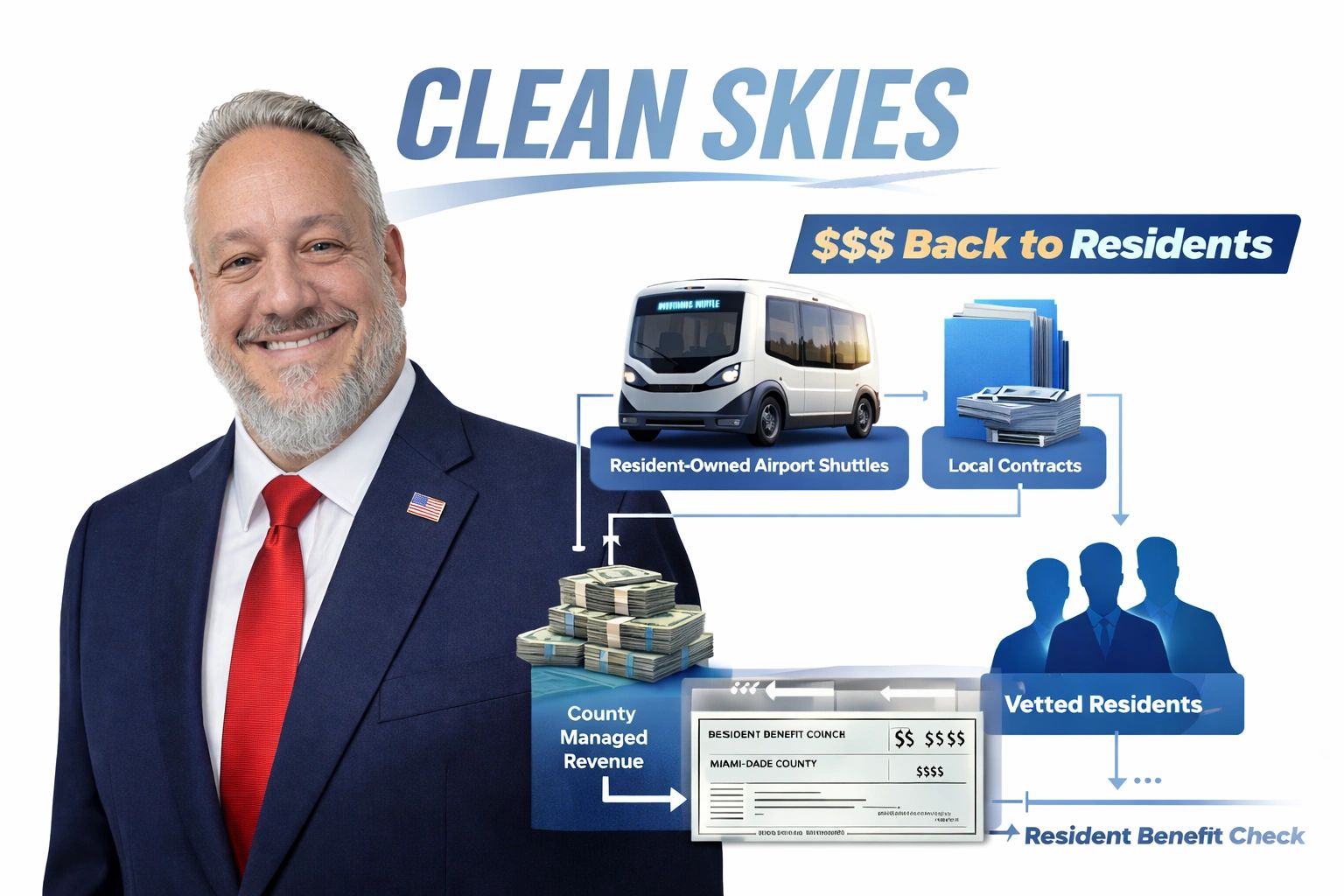
Resident Benefit Checks Every Three Months
When operations perform well, residents should see results.
Clean Skies routes verified net proceeds into Project Fund for:
- Job creation
- System upgrades
- Community reinvestment
- Resident benefit checks every three months
No vague promises.
No guessing.
Only verified results.
Governance That Cannot Be Captured
Clean Skies establishes permanent oversight:
- Compliance monitoring
- Contract reviews
- Public dashboards
- Investigation referrals
- Continuous audits
Oversight is structural.
Not political.
What Success Looks Like
Success means:
- Fair compensation
- Transparent ownership
- Accountable contracts
- Safe operations
- Public visibility
- Local opportunity
Success is measurable.
Economic Impact on Residents
Clean Skies strengthens:
- Household stability
- Local spending
- Housing security
- Small business growth
- Workforce mobility
Money stays in Miami-Dade.
That multiplies opportunity.
Workforce Protection and Labor Standards
Clean Skies includes:
- Stable scheduling
- Fair discipline
- Grievance procedures
- Training investment
- Career progression
Public systems should protect workers.
Risk Management and Emergency Preparedness
Clean Skies integrates:
- Hurricane response plans
- Disaster mobility protocols
- Medical transport coordination
- Emergency rerouting
- Continuity operations
Public systems must function in crisis.
Environmental Responsibility
Clean Skies prioritizes:
- EV fleets
- Reduced emissions
- Noise management
- Energy efficiency
- Sustainable procurement
Modernization protects the future.
Legal Authority and Compliance
Clean Skies operates within:
- County charter authority
- Transportation statutes
- Procurement law
- Audit standards
- Public finance rules
It strengthens compliance.
It does not weaken it.
Frequently Asked Questions About
Clean Skies
What Is Clean Skies in Miami-Dade County?
Clean Skies is a comprehensive, resident-first public infrastructure initiative designed to restore transparency, accountability, and local control over airport transportation and crew logistics on county property.
Under Clean Skies, Miami-Dade County will transition core airport mobility operations into county ownership and management under Project Victor J. Rosario (Project Fund).
This means:
- The county controls operations
- The county controls finances
- The county controls oversight
- Residents receive the benefits
Clean Skies replaces fragmented private contracting with a unified, publicly accountable system that ensures public assets serve the public.
Is Clean Skies Anti-Business or Anti-Private Enterprise?
No. Clean Skies is not anti-business.
It is pro-public ownership where public property is involved.
Private companies remain free to operate in the private market. Clean Skies simply establishes that core transportation functions occurring on county land must be controlled by the county for the benefit of residents.
This is the same principle used for:
- Public transit systems
- Port authorities
- Water utilities
- Airports themselves
Public assets require public stewardship.
Does Clean Skies Target Pilots, Airline Employees, or Airlines?
Absolutely not.
Clean Skies does not target:
- Pilots
- Flight attendants
- Airline staff
- Airline management
- Lawful airline operations
Clean Skies focuses exclusively on:
- Contracts
- Procurement integrity
- Ownership structures
- Operational control
- Financial transparency
Airlines remain valued partners operating under clear, professional county standards.
Why Is County Ownership Necessary? Why Not Just Improve Oversight?
Oversight alone is not enough when control remains private.
When private entities control operations:
- Information becomes limited
- Accountability weakens
- Influence concentrates
- Enforcement becomes harder
County ownership solves these problems structurally.
It ensures:
- Direct accountability
- Transparent records
- Public audits
- Consistent standards
- Long-term stability
Ownership creates responsibility.
How Will Clean Skies Reclaim and Restructure Existing Contracts?
Clean Skies will use a lawful, evidence-based process.
This includes:
1) Contract Integrity & Beneficial Ownership Audit
All relevant contracts will be reviewed for:
- Compliance
- Disclosure accuracy
- Conflicts of interest
- Improper influence
- Procurement irregularities
2) Corrective Action
Where issues are found, the county may pursue:
- Non-renewal (primary option)
- Re-bidding
- Contract restructuring
- Enhanced disclosure requirements
- Performance enforcement
No contracts are terminated arbitrarily.
All actions follow due process.
What Is the Contract Integrity & Beneficial Ownership Audit?
It is a comprehensive review system that examines:
- Who actually controls vendors
- Who financially benefits
- How bids were awarded
- How renewals occurred
- How subcontracting is structured
- Whether conflicts exist
The goal is to eliminate hidden control and restore transparency.
What Is Project Victor J. Rosario (Project Fund)?
Project Fund is the financial and governance framework that supports Clean Skies and other resident-first initiatives.
It functions as:
- A transparent public accounting system
- An independent verification structure
- A resident reinvestment mechanism
All verified net proceeds from eligible county-owned and controlled operations flow into Project Fund.
From there, funds support: 10/70 Rule
- Job creation
- Infrastructure upgrades
- Community reinvestment
- Resident benefit checks every three months
How Are Resident Benefit Checks Funded?
Resident benefit checks are funded through:
- Revenue generated by county-owned Clean Skies operations
- Crew mobility agreements
- Standardized shuttle services
- Event and logistics contracts
After operating costs are paid and results are verified, remaining net proceeds are distributed.
No borrowing.
No speculation.
No unsustainable promises.
Only documented performance.
Who Qualifies to Receive Resident Benefit Checks?
Only verified Miami-Dade County residents qualify.
Eligibility includes:
- Primary residence in Miami-Dade
- Verification through county records
- Anti-fraud safeguards
- One-person-one-record standard
Non-residents do not qualify.
This ensures benefits stay local.
Will Clean Skies Improve Security at the Airport?
Yes. Clean Skies improves real security.
It strengthens:
- Background screening
- Training standards
- Incident reporting
- Access controls
- Documentation
- Accountability
Because the county controls the system, security standards are consistent and enforceable.
This reduces risk rather than increasing it.
How Does Clean Skies Protect Privacy and Civil Liberties?
Clean Skies establishes strong privacy protections:
- Data minimization
- Limited retention
- No commercial resale
- Restricted third-party access
- Independent privacy audits
Technology is used for safety and operations — not surveillance.
Residents and workers retain dignity.
Will This Create Stable Jobs for Local Workers?
Yes. Job stability is a core goal.
Clean Skies creates:
- County-controlled employment pathways
- Predictable schedules
- Professional training
- Career advancement
- Long-term benefits
This replaces unstable gig-style work with dignified public-sector careers.
What Happens to Current Workers and Operators?
Clean Skies prioritizes:
- Workforce transition
- Retraining opportunities
- Certification pathways
- Fair evaluation
- Resident preference
Qualified workers are not discarded.
They are integrated into the public system where possible.
How Will Corruption and Favoritism Be Prevented?
Clean Skies embeds anti-corruption safeguards:
- Mandatory disclosures
- Independent audits
- Conflict-of-interest rules
- Public dashboards
- Automatic review triggers
- Inspector General referrals
The system is designed to prevent capture structurally.
Is Clean Skies Legal Under Florida and County Law?
Yes.
Counties have authority to:
- Operate transportation systems
- Manage airport logistics
- Control public property
- Collect service fees
- Reinvest surpluses
Clean Skies operates within existing legal frameworks and strengthens compliance.
Will Clean Skies Increase Taxes?
No.
Clean Skies is funded through operational revenue.
It does not rely on:
- New taxes
- Special assessments
- General fund diversion
It is designed to be self-sustaining.
How Will Residents Track Performance?
Residents will have access to:
- Quarterly financial reports
- Audit summaries
- Performance dashboards
- Distribution records
- Compliance ratings
- Blockchain TRUTH LEDGER
Transparency is mandatory.
What Happens If Clean Skies Underperforms?
If performance declines:
- Automatic reviews are triggered
- Management is evaluated
- Corrective actions are taken
- Public explanations are issued
Failure is addressed openly.
Will This Program Continue After One Administration?
Yes.
Clean Skies is designed as an institutional system, not a political project.
It is embedded through:
- Ordinances
- Operating standards
- Financial structures
- Oversight mechanisms
It is built to last.
How Does Clean Skies Benefit the Entire Community?
Clean Skies strengthens:
- Household stability
- Local spending
- Workforce development
- Public trust
- Long-term growth
When money stays local, communities thrive.
Why Is This Better Than the Old Model?
The old model relied on:
- Fragmented vendors
- Limited transparency
- Weak accountability
- Uneven access
Clean Skies delivers:
- Unified public control
- Open records
- Fair opportunity
- Verified benefits
It is a structural upgrade.
How Can Residents Get Involved?
Residents can:
- Review public reports
- Attend oversight meetings
- Submit feedback
- Apply for certification
- Join workforce programs
- Participate in community forums
Clean Skies belongs to the people.
What Is the Bottom Line of Clean Skies?
The bottom line is simple:
County property should benefit county residents.
Clean Skies ensures:
- Public ownership
- Public accountability
- Public benefit
- Shared prosperity
No private capture.
No hidden deals.
No closed systems.
Residents first — always.
MIAMI-DADE COUNTY OFFICE OF
THE MAYOR
EXECUTIVE ORDER NO. 2028-XX(DRAFT)
**“CLEAN SKIES” — EXCLUSIVE COUNTY OWNERSHIP AND OPERATION OF AIRPORT MOBILITY & CREW LOGISTICS ON COUNTY PROPERTY;
TERMINATION/NON-RENEWAL OF PRIVATE OPERATIONS;
COUNTY WORKFORCE AND COUNTY FLEET;
PROJECT VICTOR J. ROSARIO (PROJECT FUND) REVENUE ROUTING;
RESIDENT BENEFIT CHECKS EVERY THREE MONTHS**
WHEREAS, Miami-Dade County owns and controls critical public infrastructure and property that supports aviation, commerce, emergency response, and regional mobility; and
WHEREAS, transportation, shuttle services, crew movement, and airport-adjacent logistics conducted on County property are inherently public-facing operational systems that directly impact residents’ safety, economic opportunity, and trust in government; and
WHEREAS, County property and County operations must be governed in a manner that protects residents’ interests, prevents contract capture, ensures full transparency, and guarantees public accountability; and
WHEREAS, residents have raised persistent concerns regarding reduced transparency, unclear ownership structures, closed access, and the displacement of Miami-Dade residents from opportunities linked to County property; and
WHEREAS, the County’s duty is to restore resident-first governance through exclusive County ownership and exclusive County operation, with results that are measurable, auditable, and directly returned to Miami-Dade residents; and
WHEREAS, the County shall route verified eligible net proceeds from Clean Skies operations into Project Victor J. Rosario (Project Fund) to support County workforce stability, system modernization, and resident benefit checks every three months, based on documented performance and transparent reporting;
NOW, THEREFORE, I, Victor J. Rosario, Mayor of Miami-Dade County, by virtue of the authority vested in me, do hereby issue the following Executive Order:
SECTION 1. TITLE; PURPOSE; GOVERNING STANDARD
1.1 Title. This Executive Order shall be known as the “Clean Skies Executive Order”.
1.2 Purpose. The purpose of this Executive Order is to establish and enforce exclusive County ownership and exclusive County operation of airport mobility and crew logistics on County property, to eliminate private operational control, to prevent contract capture, and to ensure that Miami-Dade residents are the sole beneficiaries through transparent resident-first programs including resident benefit checks every three months through Project Victor J. Rosario (Project Fund).
1.3 Governing Standard. Clean Skies shall operate under the following mandatory standard:
County-Owned + County-Operated → Verified Results → Resident Benefit Checks Every Three Months
SECTION 2. DEFINITIONS
2.1 “County Property” means all real property, facilities, terminals, curbside zones, staging areas, roadways, lots, and operational areas owned, leased, managed, or controlled by Miami-Dade County, including airport property and any County-designated transportation zones.
2.2 “Clean Skies Operations” means all transportation, shuttle operations, crew movement, dispatch, scheduling, staging transfers, and airport-adjacent logistics services occurring on County property for airline crews, pilots, visitors, delegations, events, and authorized operational needs.
2.3 “Private Operator” means any non-County entity or person, including any vendor, contractor, subcontractor, affiliate, concessionaire, or third party, that provides, manages, staffs, dispatches, controls, coordinates, or receives revenue from transportation or crew logistics services on County property.
2.4 “Project Victor J. Rosario (Project Fund)” means the County resident-first accounting and reinvestment framework through which verified eligible net proceeds from Clean Skies Operations are routed for County system support and resident benefit checks every three months, based on documented results and transparent reporting.
2.5 “Eligible Net Proceeds” means revenues derived from Clean Skies Operations minus documented County operational costs, required reserves, and maintenance obligations, as verified through audit and reported publicly.
2.6 “Resident” means an individual whose primary residence is within Miami-Dade County and who satisfies residency verification standards established by the County for eligibility in resident benefit checks.
SECTION 3. EXCLUSIVE COUNTY OWNERSHIP AND EXCLUSIVE COUNTY OPERATION
3.1 Exclusive County Operation Required. Effective upon implementation, all Clean Skies Operations on County property shall be performed exclusively by Miami-Dade County, using County workforce, County management, and County-controlled dispatch and operational command.
3.2 No Private Operators Permitted. No Private Operator shall be permitted to operate, manage, dispatch, staff, coordinate, or receive revenue from Clean Skies Operations on County property.
3.3 No Subcontracting; No Delegation of Control. The County shall not subcontract, delegate, franchise, concession, license, or otherwise transfer Clean Skies operational control to any Private Operator. Operational control shall remain entirely within County governance.
3.4 County Fleet and County Systems. Clean Skies Operations shall be executed using County-owned or County-controlled fleet assets and County-owned or County-controlled dispatch, scheduling, route management, and incident reporting systems.
SECTION 4. CONTRACT INTEGRITY & BENEFICIAL OWNERSHIP AUDIT; TRANSITION ENFORCEMENT
4.1 Audit Ordered. The County Mayor orders an immediate Contract Integrity & Beneficial Ownership Audit of all arrangements related to transportation and crew logistics operations occurring on County property.
4.2 Transition Enforcement Plan. The Mayor or designee shall issue a transition enforcement plan establishing the sequence of steps to transition all Clean Skies Operations into exclusive County operation.
4.3 Non-Renewal and Termination as Primary Remedy. Where legally permissible, the County’s primary remedy shall be termination or non-renewal of private arrangements and immediate transition to County operation.
4.4 Prohibition on Recapture. The County shall enforce structural safeguards to prevent any private re-entry through rebranding, proxy ownership, affiliates, or layered relationships, since no private operation is permitted under Clean Skies.
SECTION 5. COUNTY WORKFORCE; RESIDENT-FIRST EMPLOYMENT; CERTIFICATION
5.1 County Staffing. Clean Skies Operations shall be staffed by County employees or County-controlled personnel under County governance.
5.2 Resident-First Hiring. The County shall prioritize Miami-Dade residents for Clean Skies workforce roles consistent with applicable law and shall establish clear hiring pipelines.
5.3 Certification Program. The County shall establish a County certification program for Clean Skies roles including:
- background screening consistent with law;
- professionalism and ethics training;
- safety and operational procedures;
- privacy protections and data minimization;
- documented compliance and renewals.
5.4 Worker Protections. Clean Skies workforce standards shall include stable scheduling, safety standards, training investment, clear discipline procedures, and career development pathways.
SECTION 6. SAFETY, SECURITY, PRIVACY, AND MODERNIZATION
6.1 Safety and Security Coordination. Clean Skies shall maintain professional safety coordination including incident reporting, inspections, emergency procedures, and readiness.
6.2 Privacy and Data Minimization. The County shall implement privacy protections including data minimization, limited retention, restricted access, and prohibition on commercial resale of operational data.
6.3 Modern Fleet Standards. The County shall deploy modern mobility systems including smart shuttles, monitored vans, EV transport units, and predictive maintenance.
6.4 Unmanned Capability With Human Oversight. Where legally permitted, the County may implement unmanned capability pilots, provided that County human oversight, override procedures, route logging, and public reporting are mandatory.
SECTION 7. FINANCIAL TRANSPARENCY; PROJECT FUND ROUTING; QUARTERLY RESIDENT BENEFIT CHECKS
7.1 Transparent Accounting. The County shall maintain transparent accounting for Clean Skies Operations including revenues, costs, reserves, and performance metrics, subject to audit.
7.2 Project Fund Routing. Verified eligible net proceeds from Clean Skies Operations shall be routed into Project Victor J. Rosario (Project Fund).
7.3 Resident Benefit Checks Every Three Months. The County shall establish a quarterly cycle to verify eligible net proceeds and, subject to legal requirements and adopted standards, issue resident benefit checks every three months to verified Miami-Dade residents based on documented results and transparent reporting.
7.4 Residency Verification; Anti-Fraud Controls. The County shall implement residency verification and anti-fraud safeguards to ensure only verified Miami-Dade residents are eligible for resident benefit checks.
7.5 No Speculation. Distributions shall be based solely on documented, verified results, not estimates.
SECTION 8. GOVERNANCE; OVERSIGHT THAT CANNOT BE CAPTURED; PUBLIC REPORTING
8.1 Oversight Structure. The Mayor shall designate an oversight structure to monitor compliance, audit results, performance outcomes, and quarterly distribution integrity.
8.2 Public Reporting. The County shall issue public quarterly reporting on:
- operational performance;
- safety and compliance results;
- financial transparency metrics;
- verified net proceeds determinations;
- resident benefit checks cycle status.
8.3 Independent Review. The County shall utilize independent audit or review mechanisms consistent with law to validate financial and compliance outcomes.
SECTION 9. SEVERABILITY; IMPLEMENTATION; EFFECTIVE DATE
9.1 Implementation. The Mayor or designee shall issue implementing memoranda as required to execute the intent of this Executive Order.
9.2 Severability. If any provision is held invalid, the remainder shall remain in effect to the fullest extent permitted by law.
9.3 Effective Date. This Executive Order shall take effect immediately upon signature.
DONE AND ORDERED this _____ day of ____________, 2028.
Victor J. Rosario
Mayor, Miami-Dade County
Date: ____________
Future Mayor of Miami-Dade County.
Conclusion: Clean Skies Means
Residents First — Always
Clean Skies is about restoring what should never have been taken from the people of Miami-Dade County: control, transparency, and opportunity over public property built with public resources.
For too long, residents have watched as systems they paid for were managed behind closed doors, influenced by networks they could not see, and operated in ways they could not easily verify. That is not how democracy works. That is not how public infrastructure should function. And that is not how I intend to govern.
Clean Skies represents a permanent shift away from secrecy, fragmentation, and private capture. It replaces confusion with clarity. It replaces closed systems with open accountability. It replaces extraction with reinvestment.
We can support real security without sacrificing fairness.
We can demand professionalism without surrendering local opportunity.
We can modernize transportation without allowing intimidation, favoritism, or backroom control to decide who succeeds and who is pushed aside.
Under my administration, airport transportation and logistics will no longer operate as disconnected private territories on public land. They will operate as a unified, county-owned system—managed under Project Victor J. Rosario (Project Fund)—with transparent standards, documented performance, and public oversight.
That means:
- Contracts that serve residents, not special interests
- Jobs that build careers, not instability
- Oversight that prevents capture, not excuses it
- Financial systems that return value to the community
- Benefits that stay in Miami-Dade
As these county-controlled operations generate verified net proceeds, residents will see the results—not in vague promises, but in documented, transparent resident benefit checks every three months, supported by strict accounting and independent review.
This is not about politics.
This is about stewardship.
This is about responsibility.
This is about respecting the people who built this county.
Clean Skies is how we protect public assets.
Clean Skies is how we restore confidence in government.
Clean Skies is how we prove that public systems can work for the public.
It is how we build a Miami-Dade County where opportunity is not controlled by insiders, where success is not decided in private rooms, and where every resident knows that their government works for them—not around them.
That is my commitment.
That is my standard.
That is my promise.
Victor J. Rosario
Candidate, Mayor of Miami-Dade County
Future Mayor of Miami-Dade County
About Victor J. Rosario
Victor J. Rosario is the Residents-First candidate for Miami-Dade County Mayor 2028. A U.S. Coast Guard veteran, entrepreneur, technologist, and artist, Victor brings a track record of building real solutions — from AI tools to campaign policy — that serve Miami-Dade's 2.8 million residents.
Learn More About Victor