By Victor J. Rosario, candidate for Miami-Dade County Mayor · September 30, 2026
Why this lawsuit deserves a closer look
On Monday, September 28, 2026, Miami-Dade County asked a jury to make Reworld, the company formerly known as Covanta, pay more than $750 million for the fire that destroyed the county's Doral trash incinerator in February 2023. It is an enormous number, and the announcement was built to make it land: a mayor saying the county is acting to protect taxpayers, an operator accused of gross mismanagement, and a plant reduced to ruins. But a lawsuit is a claim, not a finding. Reworld told the county in writing last November that the losses are the county's own responsibility, and it has its own claim against the county.
This post walks through the public record from start to finish: the plant, the 2022 contract that governed it, the fire, the fight that followed, the lawsuit itself, and the politics around a replacement plant that now carries a $3 billion price tag. It separates what each side alleges from what the documents actually show, and it says plainly where I could not find an answer.
One ground rule. Everything the county says about Reworld's conduct is an allegation, and everything Reworld says about the county's conduct is an allegation too. Nothing in this post is a court finding. Where I am giving an opinion, I say so.
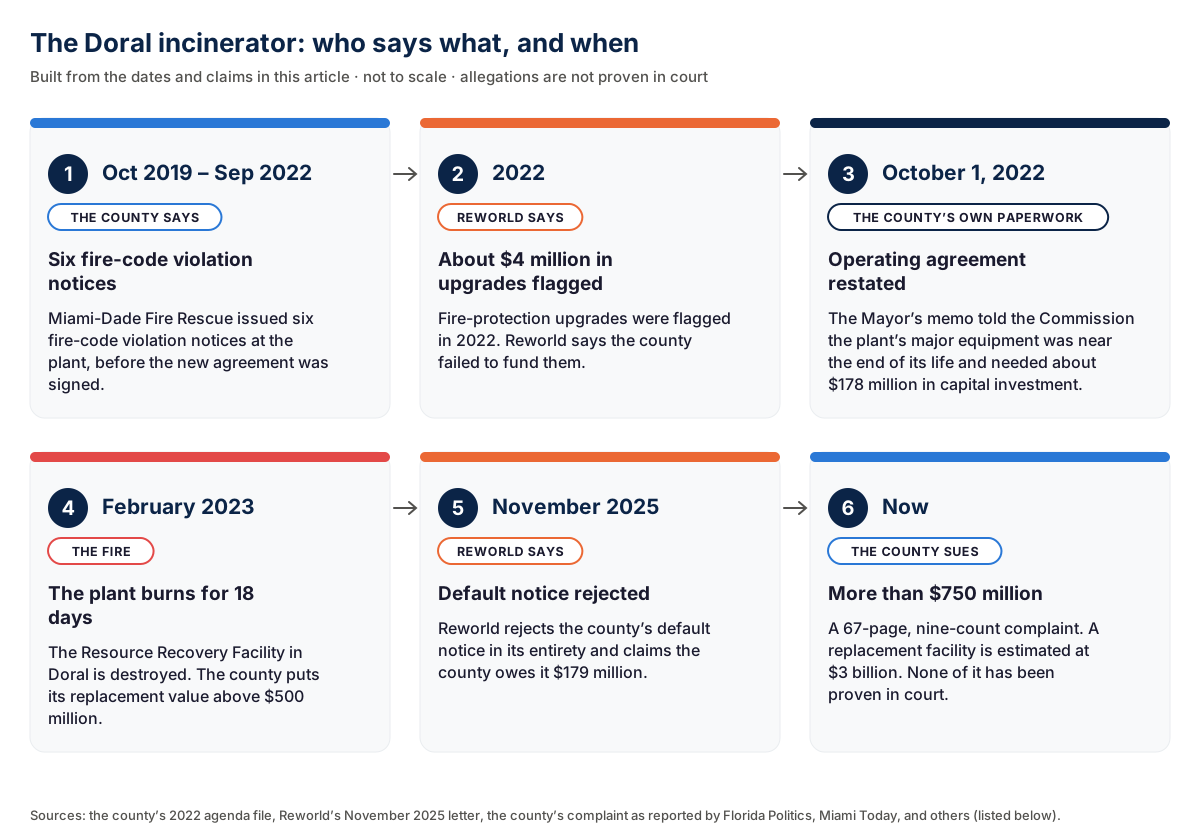
The numbers at a glance
| Figure | What it is | Who says so |
|---|---|---|
| More than $750 million | Damages the county seeks | County lawsuit |
| More than $500 million | Claimed replacement value of the plant | County |
| About $60 million a year | What Reworld was paid to operate and maintain the plant | County complaint |
| $178 million | Capital investment projected over the contract term | County consultant HDR, in the Mayor's October 2022 memo |
| $4 million | Fire-protection improvements Reworld says the county never funded | Reworld |
| $7.8 million | The county's first demand, November 2025 | County |
| $179 million | Reworld's own claim against the county for unpaid fees and costs | Reworld |
| $3.158 billion | Estimated cost of a replacement plant, July 2026 | Mayor's memo |
The plant, the county and the operator
The Resources Recovery Facility in Doral was owned by Miami-Dade County and operated by a private company under contract. It opened in the early 1980s (county documents and press reports give slightly different start years), burned household garbage and trash to make electricity, and recovered metals along the way. At its peak it handled an average of about 3,150 tons of waste a day, roughly half of the county's municipal solid waste, and could generate up to 77 megawatts of power.
Its reach was countywide. According to the county's own 2022 memo, the plant served unincorporated Miami-Dade, ten municipalities where the county collects garbage, and fifteen more that had long-term disposal agreements with the county, including Coral Gables, Miami, Miami Beach and North Miami. When it went down, that whole system lost its main outlet.
Covanta operated the plant from February 2010, according to the same memo. Before that, earlier operators ran it under a chain of agreements that dates back to 1985. The agreement has been rewritten and restated five times. In April 2024, Covanta rebranded as Reworld, which is why documents from before and after that date use different names. The operating company is Reworld Dade LLC, formerly Covanta Dade Renewable Energy, and its corporate parent, Reworld Holding Corp., guaranteed its performance to the county.
The important point for this story is who owned what. The county owned the plant. The operator ran it, staffed it and maintained it, and got paid a fee to do so. The contract split responsibility for money and upkeep between the two, and the question of where that split fell, and who honored it, is at the center of the current lawsuit.
A plant everyone knew was old
By 2022, nobody in county government was pretending the plant was young. On May 3, 2022, the Board of County Commissioners adopted a resolution, sponsored by then-Chairman Jose "Pepe" Diaz, directing the Mayor to begin work on a replacement plant on the same site. The resolution's own findings describe the facility as roughly 40 years old and approaching the end of its useful life. It also noted that Covanta estimated the plant might run another ten years, but only with selective capital investment short of a complete refurbishment.
That is the county's own record, adopted by the Commission months before the operating agreement was rewritten and about nine months before the fire. Keep it in mind as you read what follows, because both sides lean on it.
February 12, 2023: the fire
The fire started on Super Bowl Sunday. Miami-Dade Fire Rescue was called to the plant at about 2:15 p.m., according to a letter Congressman Mario Diaz-Balart sent to the EPA the next day. The county's new complaint, as reported by Florida Politics, gives a tighter sequence: a conveyor stopped at about 1:33 p.m. without its motion alarm sounding, and flames appeared around 2:10 p.m. and engulfed the conveyor within minutes.
What followed was a major multi-alarm fire. By that night it had grown from a three-alarm to a four-alarm fire, with around 200 firefighters on scene. Congressman Diaz-Balart's letter, citing early reports, described a blaze the size of two football fields spread across four buildings, in a city of about 76,000 people with some 40 schools. Crews knocked down walls to reach the burning waste at the center. Residents were told to stay indoors with their windows closed. The county says it took 18 days to fully extinguish, and Mayor Daniella Levine Cava later described it as a Super Bowl Sunday inferno of garbage.
What caused it
The official answer is less dramatic than the fire. Fire investigators concluded it was accidental and most likely mechanical or electrical, according to NBC 6, but they could not pinpoint the exact cause. That matters for the lawsuit, because the county is not really arguing about the spark. It is arguing about why a fire that started on a conveyor became a fire that destroyed the plant.
The county's theory, laid out in its November 2025 default notice and repeated in its complaint, is that a small fire was allowed to smolder and spread because Reworld had let housekeeping, maintenance and fire protection slide. The notice named poor housekeeping and combustible buildup, fire suppression systems that were not fully working, poorly maintained conveyors and electrical systems, no fire watches, and sprinkler systems that had lost their water supply. Reworld's theory is that this was a four-decade-old plant whose owner had not paid for the upgrades it needed.
The 2022 agreement: what the Mayor told commissioners
The contract at the center of this dispute is the Fifth Amended and Restated Operations and Management Agreement, effective October 1, 2022. The county's own agenda file for it is public, and it is the best window we have into what elected officials were told when they signed off. I could not find the executed contract itself. What I read is the Mayor's cover memo and the redlined draft attached to it, which the county posted with its agenda materials. Treat what follows as the county's own description of the deal, not the final signed text.
Why it was rushed
The memo is dated October 18, 2022, addressed to then-Chairman Jose "Pepe" Diaz and the Board, signed by Chief Operating Officer Jimmy Morales on behalf of Mayor Levine Cava, and it asked commissioners to approve a five-year "bridge" agreement to keep the plant running until a replacement was built. The clock was tight. The old agreement was set to renew automatically for another five years, with more renewals possible after that, unless either side gave notice by October 31, 2022. The memo says Covanta did not want to renew on the old terms and would only keep operating the plant under a restructured deal. If the contract ended, the county said, it would have to landfill more than a million extra tons of trash a year starting October 1, 2023.
What the deal said
- Term: October 1, 2022 through September 30, 2027, renewing automatically for five more years unless either side gave a year's notice, meaning by September 30, 2026.
- Fees: an annual service fee of about $59.7 million ($61.45 per ton on 972,000 tons), plus roughly $14 million in pass-through costs. The pass-throughs include chemicals, hauling, fuel, utilities, insurance, permits and certain taxes.
- Electricity: all of the plant's power revenue, about $13 million a year, would go to the county. Under the old deal it was split evenly.
- New penalties: liquidated damages for missed tonnage, energy and residue guarantees, and for uncured environmental violations. None of the summary items I read addressed fire protection.
- Parent guarantee: the contract kept a guarantee from the corporate parent, with an option to swap it for a letter of credit starting at $5 million and rising to $10 million.
The capital clause
The most consequential change is one line in the memo. Under the Fifth Amendment, any improvement, equipment or part costing more than $75,000 with a useful life of three years or more would be paid for by the county. Under the old contract, the operator had to submit a five-year capital replacement plan and pay for items above $250,000 at its own expense. Under the new one, the operator's plan would be reviewed and approved in consultation with the county's bond engineer.
The memo also reported what the county's consultant, HDR Engineering, had found. Much of the plant's major equipment had reached or was nearing the end of its expected life. Keeping the plant reliable would require a large, front-loaded refurbishment, and the total capital investment over the term was projected at about $178 million. The examples HDR gave included conveyor belts, trommels, electrical components, instrumentation and controls, and building repairs. The memo's own history of improvements lists an upgrade to the fire protection system in 2008 and does not single out fire protection as a needed item now. I draw no conclusion from the fact that the fire began on a conveyor, but it is worth noting.
Who paid for what
| Item | Responsibility under the 2022 draft | What is disputed |
|---|---|---|
| Routine repair and maintenance | Operator (the table of contents lists a section titled Company's Responsibility to Repair and Maintain Facility) | Whether fire-protection upkeep counted as routine maintenance |
| Capital items over $75,000 with a life of three years or more | County | Whether the $4 million in fire-protection work Reworld cites was capital, and whether the county approved it |
| Electricity revenue | County, 100% | Not disputed in what I found |
| Insurance | Operator's insurance costs were pass-through expenses; the county also had its own insurance obligations (Article VIII) | Reworld says the county under-insured the plant; the county says the loss was Reworld's fault |
| Inspections | County had inspection rights, including for insurance inspectors (Sections 3.16 to 3.18) | Whether the county used them |
This table is my reading of the memo and the draft's table of contents, not the contract text. The full text of those sections is what a lawyer would need. But it shows where the fight is likely to be: on the line between routine maintenance that the operator owed, and capital work that the county was obligated to fund.
After the fire: a closed plant, a paused payment and a default notice
The plant never reopened. Within months the county and its operator were on opposite sides of a question that would take three years to reach a courtroom: whose plant was it to rebuild, and who was responsible for what happened to it.
The decision not to rebuild
In September 2023 the Board of County Commissioners voted to close the fire-damaged facility for good and let the Mayor's office negotiate the closure of Covanta's operations there, according to Waste Dive. The trade publication reported that Covanta had urged the county to partially reopen the plant to provide disposal capacity while a new one was built, and that Chief Operating Officer Jimmy Morales said the county had been meeting with Covanta's senior leadership and was ready to move forward with shutting the site. Two weeks earlier, commissioners had voted to raise the residential disposal fee by $38, and the county still faced a shortfall.
Reworld describes the decision differently, as covered in the next section. The county says losing the plant forced it to pay significant extra costs to dispose of the waste elsewhere. It is burying some garbage in its own landfills and sending the rest by train and truck to landfills farther north in Florida.
The default notice
Nearly three years after the fire, on November 20, 2025, Roy Coley, the county's Chief Utilities and Regulatory Services Officer, sent Reworld a Notice of Default and Demand for Letter of Credit Draw. It accused the company of more than 20 breaches of the operating agreement. It said the spark on a conveyor was allowed to smolder and burn without any action by Covanta and blamed the company's housekeeping and maintenance failures. And it demanded $7.8 million toward the county's losses, which Reworld's response says were invoked under Section 10.10.1 of the agreement and described as "qualifying costs" of alternative disposal after a facility shutdown. Coverage describes the demand as covering alternative disposal costs, lost electricity revenue and cleanup.
The timing became its own story. The letter went out days before updated bids were due for the county's proposed new incinerator, and Reworld was then part of a consortium led by Florida Power & Light that was competing for that contract. A Reworld spokesperson said the letter was sent four business days before bids were due and seemed designed to interfere with the county's own process. Coley told the Miami Herald it is common for a county to be in conflict with a vendor on one job while working with it on another, and that the timing reflected the failure of both sides to agree on costs. The blog Political Cortadito concluded the timing was not a coincidence.
Whatever the motive, the effect was clear. After the letter, Reworld says FPL told it that it would no longer be listed as the consortium's operator. FPL confirmed a rival operator, Switzerland's Kanadevia Inova, would be its partner. By mid-December 2025 Reworld was out of the bidding for what could be a $2 billion project.
Reworld's side of the story
Reworld's November 25, 2025 letter rejected the county's notice in its entirety. I could not open the full letter, which is hosted on Scribd, so what follows comes from the excerpts and press summaries of it. Read the original before you rely on any of this. Its main arguments are these.
The county knew the plant was at the end of its life. Reworld says the county has long known that the nearly four-decade-old facility and its major components were at the end of their useful lives and needed significant and prompt capital investment. It says the county's situation is entirely of its own making. That echoes what the county's own consultant and the Commission's own May 2022 resolution said.
The county never paid for the fire protection work. Reworld says the county knew of about $4 million in needed fire-protection improvements. It says Reworld, as the operator and not the owner, would not agree to extend the operating agreement unless the county accepted responsibility for those improvements, and that the county delayed authorizing the Fifth Amendment until the last possible moment. The dates fit: the Mayor's memo is dated October 18, 2022, thirteen days before the October 31 notice deadline. Whether the county actually accepted responsibility for that work, in writing, is exactly what a lawyer would look for in the contract.
The county failed to insure itself. Reworld's letter says the agreement specifically addressed the risks and the insurance required, and that the county, knowing the plant's age and condition, failed to protect itself. The Political Cortadito summary of the letter adds that Reworld claims the county was underinsured, did not name Reworld as an additional insured, and did not carry full replacement-cost coverage. Reworld's bottom line is that the county's losses are, factually, legally and contractually, solely the county's responsibility.
The $7.8 million demand has no basis. Reworld says the section the county invoked, 10.10.1, deals with alternative-disposal costs after a facility shutdown, that the county's claim of qualifying costs above $7.8 million is vague, and that the county has no right to recover such costs from Reworld at all.
The county walked away. Reworld says the county stopped paying the service fee right after the fire and unilaterally chose not to repair the plant in September 2023. It says that choice ended any chance for Reworld to operate the plant again.
Reworld has its own claim. Reworld issued its own notice of county breaches, claiming about $179 million in unpaid service fees, inventory losses and post-fire support costs.
In a December 2025 statement, a company spokesperson denied operating improperly and accused the county of trying to shift blame and recover damages from Reworld.
Where Reworld is strong, and where it is exposed
Reworld's strongest ground is the money. The 2022 deal moved the cost of capital improvements to the county, the county's consultant said the plant needed about $178 million of them, and the fire started on the kind of equipment, a conveyor, that the consultant's list included. If the county did not fund fire-protection work Reworld says it asked for, that is a real problem for the county's story. So is the county's own inspection and enforcement record. Fire Rescue is the county's own department, and if it issued six violation notices over three years, a jury may ask why the plant stayed in service.
Reworld is exposed on the facts the county has chosen to plead. The complaint does not merely say the plant was old. It says Reworld employees closed the valves that supplied water to sprinklers around the conveyor where the fire began, when no repair work required it, and that one system stayed closed for about a year. Valves are not capital improvements. If a jury believes that, the argument that the county never paid for upgrades answers only part of the problem. The county also has the contract's own language on its side in one respect: the draft I read excludes fires inside the facility from the events that excuse performance (subject to a cross-referenced section I could not read), so Reworld cannot easily call this an act of God.
The lawsuit: nine counts and what the county alleges
The county filed suit on Monday, September 28, 2026, against Reworld Dade LLC and its parent, Reworld Holding Corp. The complaint runs 67 pages, according to Florida Politics, and pleads nine counts. Those include breach of contract, breach of the parent company's guarantees, gross negligence, fraud in the inducement, and violations of the county's own False Claims Ordinance. The county asked for a jury trial. I did not find the court or case number in the coverage I read, and I did not review the complaint itself, so the details below come from the county's announcement and press accounts of the filing.
What the county wants
The county seeks more than $750 million. Its claimed losses, according to Florida Politics, include the plant's replacement value, which the county puts above $500 million, plus forgone electricity revenue, alternative disposal costs, demolition, cleanup and environmental monitoring. For scale, the county's first formal money demand ten months earlier was $7.8 million. The lawsuit is nearly a hundred times that.
What the county alleges
According to the complaint as reported, Reworld received about $60 million a year to operate and maintain the plant and failed to correct problems with sprinkler systems, pumps and shut-off valves despite years of documented warnings. The specifics:
- Reworld employees closed the valves that supplied water to sprinklers around the conveyor where the fire started, even though no repair work required the water to be shut off, and one affected system stayed closed for about a year.
- Miami-Dade Fire Rescue issued six notices of violation for fire-code problems between October 2019 and September 2022.
- The county's bond engineer and other inspectors repeatedly warned Reworld.
- At least five fire-protection systems in the garbage-processing area were impaired when the fire began.
- An inspection for the plant's property insurers, five weeks before the fire, warned that impaired systems near combustible material could let a fire spread rapidly.
- A conveyor stopped at about 1:33 p.m. on the day of the fire without its motion alarm sounding, and flames appeared around 2:10 p.m.
- Reworld concealed the extent of these safety problems while it obtained the new operating agreement in October 2022 and while it sought payment for its services. That is the basis of the fraud in the inducement count.
Mayor Levine Cava said in a statement that Reworld was responsible for operating and maintaining the plant and that the allegations point to serious failures to meet those responsibilities. She said the county is acting to recover its damages and protect taxpayers.
Which parts are hard to argue with
Some of this is documentary. Notices of violation are records, and either they were issued or they were not. Inspection reports and the bond engineer's warnings are documents too. If the valves were closed, maintenance logs and witnesses will show it. Those are the county's best facts, and they are the kind of facts a jury can follow.
Some of it is harder. The county must show not only that the systems were impaired but that the impairment was Reworld's contractual responsibility, that it caused the plant to be destroyed, and that the county's own conduct, including what it funded, inspected and insured, did not share the blame. The fraud count requires proof of what Reworld knew when it signed in 2022 and what it told the county. And on the big number, the county must justify claiming replacement value, above $500 million, for a 40-year-old plant that its own records describe as near the end of its useful life. Reworld may argue that the plant's actual value, not the cost to replace it, is the right measure.
As of this writing, I could not find a public response from Reworld to the lawsuit. The county's announcement did not include one.
The legal terrain: what could decide this case
No one outside the two legal teams can say how this ends, and I am not offering a prediction. What I can do is point to the parts of the record that are likely to matter most, and to be clear about what I have and have not seen. Here is what to watch.
1. Does the contract limit what the county can collect?
This is the question that matters most for a $750 million claim, and I do not have the answer. The draft agreement's table of contents includes a section called Consequential or Other Damages (10.8), one on Liquidated Damages (10.9), one on the Letter of Credit and Other Remedies (10.10), and a Release (15.19). Clauses like these commonly define what kinds of losses one side can recover from the other, and sometimes set ceilings. I could not read their text. I found no public report of a dollar cap on Reworld's liability, and I would not assume one exists. The county's claimed losses include lost electricity revenue and alternative disposal costs, which are the kinds of losses such clauses often address.
Two cautions. First, the county pleaded gross negligence and fraud. As a general matter, claims like those are pleaded in part because contractual limits do not always reach them, so even a clear limit might not end the argument. Whether that holds here depends on the contract's text and Florida law. Second, the contract's built-in security is measured in millions, not hundreds of millions: the parent guarantee could be swapped for a $5 million letter of credit that rises to $10 million, and the county's November 2025 notice demanded a letter-of-credit draw and put its first claim at $7.8 million. But security is not a cap on liability. It is the amount the county can reach quickly, not necessarily the most it can win.
2. Jury or arbitration?
The county asked for a jury. Many commercial contracts send disputes to arbitration instead, so it is a fair question to ask. The draft's table of contents lists no arbitration or dispute-resolution article, though a clause can sit inside another section, such as Governing Law (15.10). The first sign will be procedural: if Reworld moves to send the case to arbitration or to change the venue, that tells you what the contract says.
3. Who was supposed to insure the plant, and did they?
Article VIII of the draft covers insurance the operator must carry (8.1), insurance the county must carry (8.2), a deductible to be paid by the operator (8.3), what happens to insurance proceeds if the plant is rebuilt (8.5), and what happens if either side fails to maintain coverage (8.6). Reworld says the county failed its insurance obligations. The county says the plant's replacement value exceeded $500 million and that a property insurer's inspection warned of impaired fire protection five weeks before the fire.
The public record does not answer three basic questions: what coverage the county actually carried, whether it collected on any claim, and how much. Those answers matter. An insurer that paid a claim may have its own right to recover from the party responsible, and a plant left uninsured would put the county's own decisions on trial.
4. Shared fault
Even if a jury finds Reworld failed to maintain fire protection, Reworld will argue the county shares the blame. It has real material to work with: the county paid for capital items under the 2022 deal, its consultant flagged a large capital need, its own Fire Rescue issued the violation notices, and the draft agreement gave the county rights to inspect and, per its table of contents, to repair. The county will answer that closed sprinkler valves are an operating failure, not a funding one, and that Reworld hid the true condition of the systems, as its fraud count alleges.
5. The counterclaim and the money trail
Reworld claims about $179 million in unpaid service fees, inventory losses and post-fire support costs, and says the county stopped paying its fee right after the fire. The draft includes a set-off provision, so any award could be netted against what each side says the other owes. The final number, if it comes to that, may look very different from either side's headline.
What I could not confirm
| Question | Why it matters | What I found |
|---|---|---|
| Text of Sections 10.8 to 10.10 and 15.19 | May limit or exclude categories of damages | Only section titles in the draft's table of contents |
| Any arbitration or forum clause | Decides jury versus arbitration | None listed; text not read |
| What the county insured, and any payout | Bears on loss, offset and blame | Not found in public reporting |
| Whether the $4 million in fire work was ever approved | Central to Reworld's defense | Reworld's claim only |
| Whether the contract was formally terminated, and when | Affects which obligations survive | Not found |
| The court and case number | Needed to read the complaint | Not in the coverage I read |
The politics: a $3 billion plant with no site
The lawsuit does not exist in a vacuum. It lands in the middle of the longest-running failure in county government: more than three and a half years after the fire, Miami-Dade still has no replacement plant, no chosen site, and no settled plan to pay for one.
A replacement that keeps getting more expensive
In April 2022, before the fire, a preliminary estimate for a modern 4,000-ton-a-day plant ran $900 million to $1.5 billion, according to the county's own resolution. By late 2025, proposals were pegged at around $2 billion. On July 13, 2026, the Mayor's memo to commissioners said the projected cost had jumped to $3.158 billion, based on a county consultant's estimate and a financial model the two bidders had submitted. The bidders, a consortium of Florida Power & Light and FCC Environmental Services, had earlier told the county they were pausing their work until Miami-Dade was ready to proceed in what they called a decisive and coordinated manner, and they said it was hard to plan a plant without knowing where it would go. The Mayor recommended commissioners pause negotiations with the consortium and said the county could reopen the bidding. FPL disputed her characterization of the project costs.
The site problem
Where to put it has been the hardest question. For years the plan was to rebuild in Doral. In late 2024, Mayor Levine Cava recommended Doral because of cost, then backed a delay after public pushback. After the 2024 election, Eric Trump lobbied county officials and vowed to fight an incinerator near the family's Doral golf resort, and Doral's mayor said the Trump Organization's lobbyists contacted the county. In July 2025 commissioners voted unanimously to take Doral, Medley, the 58th Street site, Sweetwater and the old Opa-locka West airport off the table, and to require any new plant to sit at least half a mile from homes.
Doral has been pulled back into the picture anyway. In 2023 the county passed legislation seeking a fee from Doral to help pay for relocating the plant. Doral offered $40 million in 2024, which was rejected. Doral's leaders have accused the county of bad faith. And just this month, according to Miami Today, commissioners set new rules for Doral: negotiate a figure and pay it within three months, or the county will again consider sites there.
Who is paying while all this happens
Residents. The county hauls garbage by train and truck to landfills farther north in Florida. Commissioners raised the residential disposal fee by $38 in 2023, and Waste Dive reported at the time that the county still faced a shortfall. FPL's proposal, as reported by Waste Dive, would have carried a starting tipping fee of about $105 a ton, rising 2.5% a year. In April 2026, Commissioner Danielle Cohen Higgins said the consortium had missed its deadline to bring a negotiated agreement to the Board and that the pace of negotiations worried her.
The 2022 decision belongs to two branches of government
The 2022 agreement was negotiated by the Mayor's administration, recommended to the Board in the Mayor's own memo, and taken up by the Commission. The Commission had also passed its own resolution in May 2022 acknowledging that the plant was approaching the end of its useful life. I could not confirm how individual commissioners voted on the Fifth Amendment. But whatever the vote, the decision to keep a 40-year-old plant running on a bridge contract was made jointly, and both branches now share the responsibility for what the record shows they knew.
How to read the timing
Supporters of the lawsuit say a county that lost a public asset has a duty to try to recover its losses, and that it sent a default notice first. Critics note that the notice arrived days before bids were due and helped push Reworld out of the running, and that the suit followed the Mayor's own memo showing the replacement had ballooned by about a billion dollars. Those are competing readings, not findings.
Questions the public should ask the Mayor and commissioners
The record leaves a set of questions that only the county can answer. Every one of them can be answered with documents that already exist, and the county could publish them tomorrow.
- The violation notices. What happened after each of the six fire-code violation notices issued between October 2019 and September 2022? Which were corrected, which were not, and who signed off on that?
- The $4 million. Did Reworld ever ask the county in writing to fund about $4 million in fire-protection improvements in 2022? If so, who reviewed the request, and what was the answer?
- The capital plans. What did the operator's capital replacement plans, reviewed with the county's bond engineer, say about fire protection, and what did the county approve, defer or reject?
- The engineer's report. What did HDR's assessment say about fire-protection and life-safety systems, not only conveyors, trommels and electrical equipment?
- The insurance. What property and liability coverage did the county carry on the plant, at what limits, and what has it collected since the fire?
- The contract limits. What do Section 10.8 and the rest of Article X say about consequential damages and other limits, and has the county's outside counsel told commissioners how much of the $750 million is realistically recoverable?
- The 2022 vote. What were commissioners told about the plant's violation history and its insurers' warnings before they approved the Fifth Amendment, and how did each one vote?
- The timing. Why did the county wait until November 2025, nearly three years after the fire, to send a default notice, and why days before bids were due on the replacement plant?
- The service fee. Did the county keep paying Reworld's service fee after the fire, and until when? Reworld says it stopped immediately.
- The cost of the suit. How much will outside counsel and experts cost taxpayers, and what is the plan if recovery is limited or the case is lost?
- The recovery. Is any expected recovery baked into the financing for the replacement plant or into future disposal fees?
- The documents. Will the county post the complaint, the executed 2022 agreement, the notices of violation and the inspection records online in full?
My view
This paragraph is opinion. The record supports skepticism about the headline number. It does not support declaring anyone guilty of the fire, and I am not doing that. What it supports is accountability. The county's own documents show it was told in writing that the plant needed roughly $178 million in capital investment, that it agreed to pay for capital items, and that its own fire department issued violation notices for years. A lawsuit does not answer what the county did with those warnings. In my opinion, leadership is judged by what was done before the fire, not by the size of the claim filed after it. A county that wants the public to trust a $750 million number should be willing to show the public every document that bears on it, starting with the ones that are unhelpful.
Timeline, disclosure and sources
The short version of a long story: a county-owned plant that officials called old in 2022 burned in 2023, and the county waited until 2025 to declare its operator in default and until 2026 to sue. Here is the sequence, newest first.
| Date | What happened |
|---|---|
| September 28, 2026 | County sues Reworld Dade LLC and Reworld Holding Corp. for more than $750 million |
| September 2026 | Commissioners set new terms for Doral: negotiate a fee within three months or sites there return to consideration |
| July 13, 2026 | Mayor's memo puts replacement plant cost at $3.158 billion and recommends pausing negotiations |
| June 10, 2026 | FPL and FCC consortium pauses work on its proposal |
| December 2025 | Reworld exits the FPL-led bid; commissioners urge a joint FPL and FCC proposal |
| November 25, 2025 | Reworld rejects the default notice and issues its own notice of county breaches, about $179 million |
| November 20, 2025 | County sends a Notice of Default and demands $7.8 million |
| July 2025 | Commissioners take Doral and other sites off the table for a new plant |
| November 2024 | Doral's $40 million offer to move the plant is rejected |
| September 2023 | Commissioners vote to close the burned plant |
| February 12, 2023 | Fire begins; it takes 18 days to extinguish |
| October 18, 2022 | Mayor's memo asks the Board to approve the Fifth Amendment; the agreement is effective October 1, 2022 |
| May 3, 2022 | Commission resolution describes the plant as about 40 years old and near the end of its life |
| October 2019 to September 2022 | Six fire-code violation notices issued by Miami-Dade Fire Rescue, according to the county |
Disclosure
The author is a candidate for Miami-Dade County Mayor in the November 2028 election, and this post is written from that position. Everything about Reworld's and the county's conduct above is an allegation by one side or the other, unless it comes from a county document that says so directly. The post states opinions only where it says so. Figures and dates are as of September 30, 2026. If the county or Reworld disputes any fact here, or if a document I could not read changes a point, corrections will be published.
What I read in full
- County agenda memo and redlined Fifth Amendment, October 18, 2022 (opens in a new tab)
- County resolution directing planning for a replacement plant, May 3, 2022 (opens in a new tab)
- Miami Today: Miami-Dade sues for $750 million damages in incinerator blaze (opens in a new tab)
- Islander News: Miami-Dade seeks $750 million over fire that destroyed Doral incinerator (opens in a new tab)
- Political Cortadito: Garbage Wars, county and operator trade blame (opens in a new tab)
- Miami Herald via the Union-Bulletin: Miami-Dade mayor blames operator for incinerator fire (opens in a new tab)
What I read only as search excerpts
These pages could not be opened in full, so treat the details I took from them as less certain and check them yourself.
- Florida Politics: Miami-Dade sues Doral incinerator operator for $750M (opens in a new tab) (the 67-page complaint, the minute-by-minute account, the insurer inspection)
- Reworld's response letter, November 25, 2025 (Scribd) (opens in a new tab) (the primary source for Reworld's arguments; read it in full)
- Waste Dive: With Reworld out, Miami-Dade seeks compromise (opens in a new tab) and Waste Dive: county advances plans and closure of the Covanta site (opens in a new tab)
- NBC 6: aftermath photos and fire investigation findings (opens in a new tab)
- Earthjustice and Florida Rising report on the fire (opens in a new tab)
- Miami New Times: Covanta loses bid to trash lawsuit (opens in a new tab)
- Local 10: cost of new incinerator balloons to $3.16 billion (opens in a new tab)
- Congressman Diaz-Balart's February 13, 2023 letter to the EPA (opens in a new tab)
- CBS Miami: commissioners vote to build a new plant, location undecided (opens in a new tab)
About Victor J. Rosario
Victor J. Rosario is the Residents-First candidate for Miami-Dade County Mayor 2028. A U.S. Coast Guard veteran, entrepreneur, technologist, and artist, Victor brings a track record of building real solutions — from AI tools to campaign policy — that serve Miami-Dade's 2.8 million residents.
Learn More About Victor