
By Victor J. Rosario — Future Mayor of Miami-Dade County
Starting 2028 (Right After I Am Elected By You)
Miami-Dade County is ready for a new model—one that is simple, fair, transparent, and unbreakable for generations to come.
This is not a policy designed to divide residents into categories. It is designed to unify us.
No favoritism. No “special lists.” No political carve-outs. No games.
Just one question:
Are you a verified Miami-Dade resident?
If the answer is yes, you qualify.
That’s the entire philosophy.
And that philosophy becomes a system: Project Victor J. Rosario (Project Fund)—powered by legal, tightly regulated cannabis revenue that stays inside Miami-Dade County.
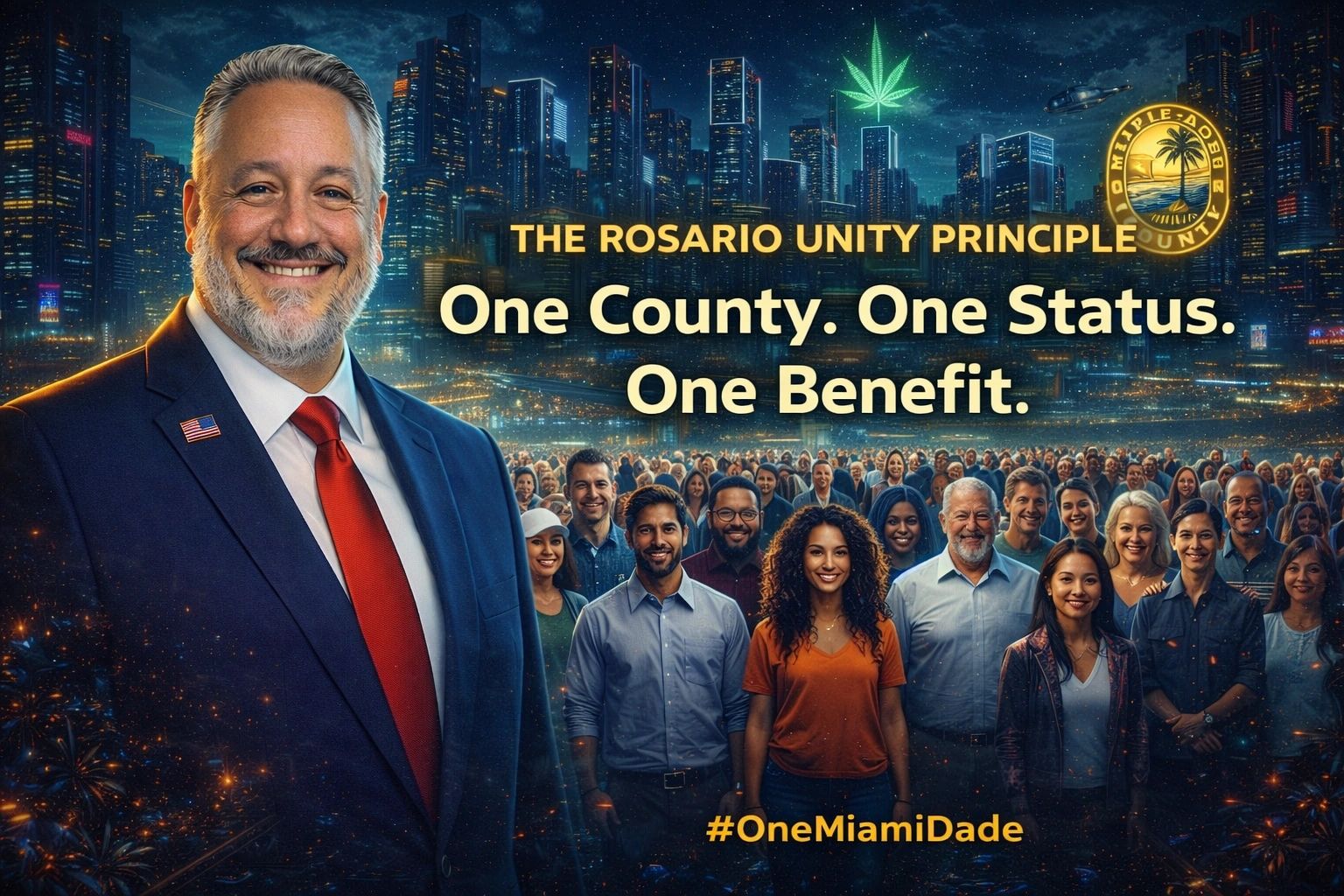
The Rosario Unity Principle
One County. One Status. One Benefit.
I want residents standing together—not talking against each other.
The fastest way to destroy unity is to build a benefits system that treats people differently. The moment government starts ranking residents—by income, age, job title, or politics—people start arguing, resentment grows, and unity collapses.
So we do the opposite.
In my administration, residents are not separated into competing categories.
We are unified by one common truth:
We are residents of Miami-Dade County.
The 80/20 Rule
80% to Residents. 20% to the County.
Here is the core economic engine:
All legal cannabis permit revenue and per-plant fees collected by Miami-Dade County will be distributed using a permanent formula:
- 80% → Returned directly to residents through equal resident checks
- 20% → Used by the county for operations, enforcement, audits, and system administration
No hidden percentage. No vague promises. No future “adjustments” by quiet committees.
This is written into the policy because this is the point:
This system exists to serve residents first.
Equal Means Equal
Everyone is treated the same—by design.
Let me be direct:
Yes, I care about low-income households.
Yes, I care about seniors.
Yes, I care about disabled residents.
Yes, I care about veterans.
Yes, I care about essential workers.
Yes, I care about long-term residents.
But for benefit purposes, I will not politicize people’s lives. I will not create “preferred classes” and “less preferred classes.” That’s how residents get divided and turned against each other.
So the rule is:
Equal resident payout. No preference. No categories. No favoritism.
That’s how you keep unity strong—because everyone knows:
- nobody is ahead
- nobody is behind
- everyone is together
And when everyone is together, the residents will defend the policy from anyone who tries to twist it later.
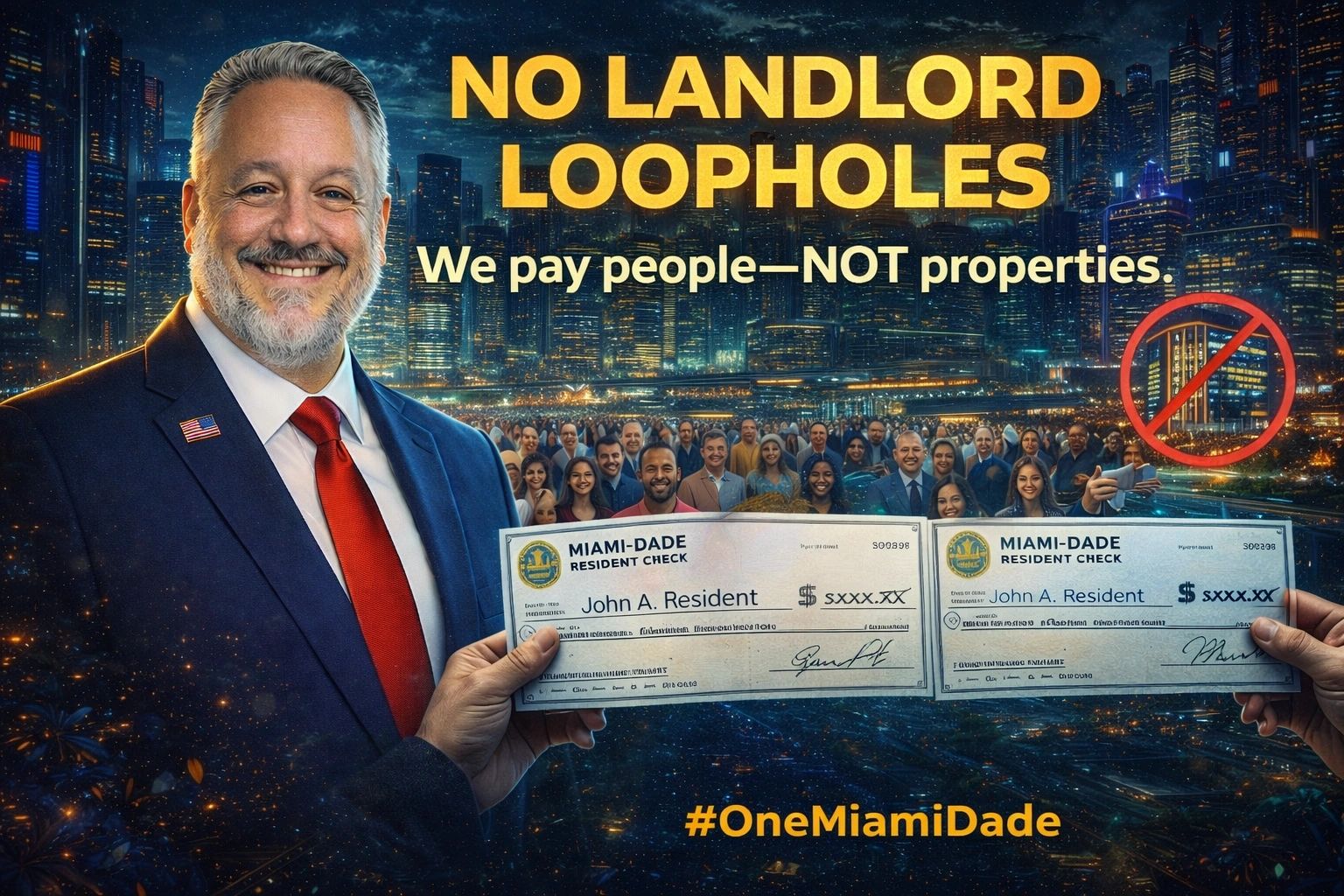
No Landlord Loopholes
We pay people—not properties.
I am not interested in creating a system where:
- someone with 20 rental properties gets 20 checks
- someone with 100 properties gets 100 checks
- corporations “scale” the benefits by owning buildings
That is not resident-first. That is landlord-first.
So Project Fund is person-based, not property-based.
- No household checks
- No property-based payouts
- No “per address” benefits
This prevents exploitation and protects renters.
Because in Miami-Dade County, many residents rent. A property-based model would reward landlords, not the people living inside the units.
We will not build a system that accidentally funnels resident money into real estate empires.
Who Gets Paid
The distribution is simple and enforceable.
1) Adults (Grandfathered)
If you are already an adult resident when the system begins, you are grandfathered in.
- No retroactive education requirement
- No punishment
- No disruption
If you are an adult resident and verified, you qualify under the Phase 1 rules.
2) New Generation Adult Payout (21+)
For the new generations, the full adult resident payout starts at:
21+, not 18.
Why?
Because we are building a county that stays ahead of the future.
And the future is already here:
- automation
- AI
- robotics
- advanced logistics
- next-gen medicine
- next-gen cybersecurity
- next-gen infrastructure
So we tie full adult payout eligibility for new generations to training and preparation.
The Education & Training Standard
Not “a degree requirement”—a preparation requirement.
This does not mean everyone needs a bachelor’s degree.
It means:
To activate the full adult payout at 21+, new-generation residents must show credible proof of education or accredited training, such as:
- community college coursework
- university enrollment or degree
- trade school certification
- licensed apprenticeship
- accredited technical certificate
- recognized workforce training
- industry certification (tech, health, operations, etc.)
No discrimination by field.
If you want:
- computer science
- medicine
- engineering
- business
- trades
- public safety
- aviation
- hospitality
- entrepreneurship
That’s your choice.
The point is to prove you’re not opting out of life and opting into dependency.
The 16–21 Incentive Bridge
Education starts early—so the payout becomes a goal.
Here is how we develop a stronger generation without forcing people into a narrow lane:
- Minors receive a child supplement benefit (explained below)
- The incentive to “graduate” into the adult benefit is education/training completion
- By 21, you show your credential and you activate your adult payout
This is how we raise standards without dividing people.
This is how we build a smart county.
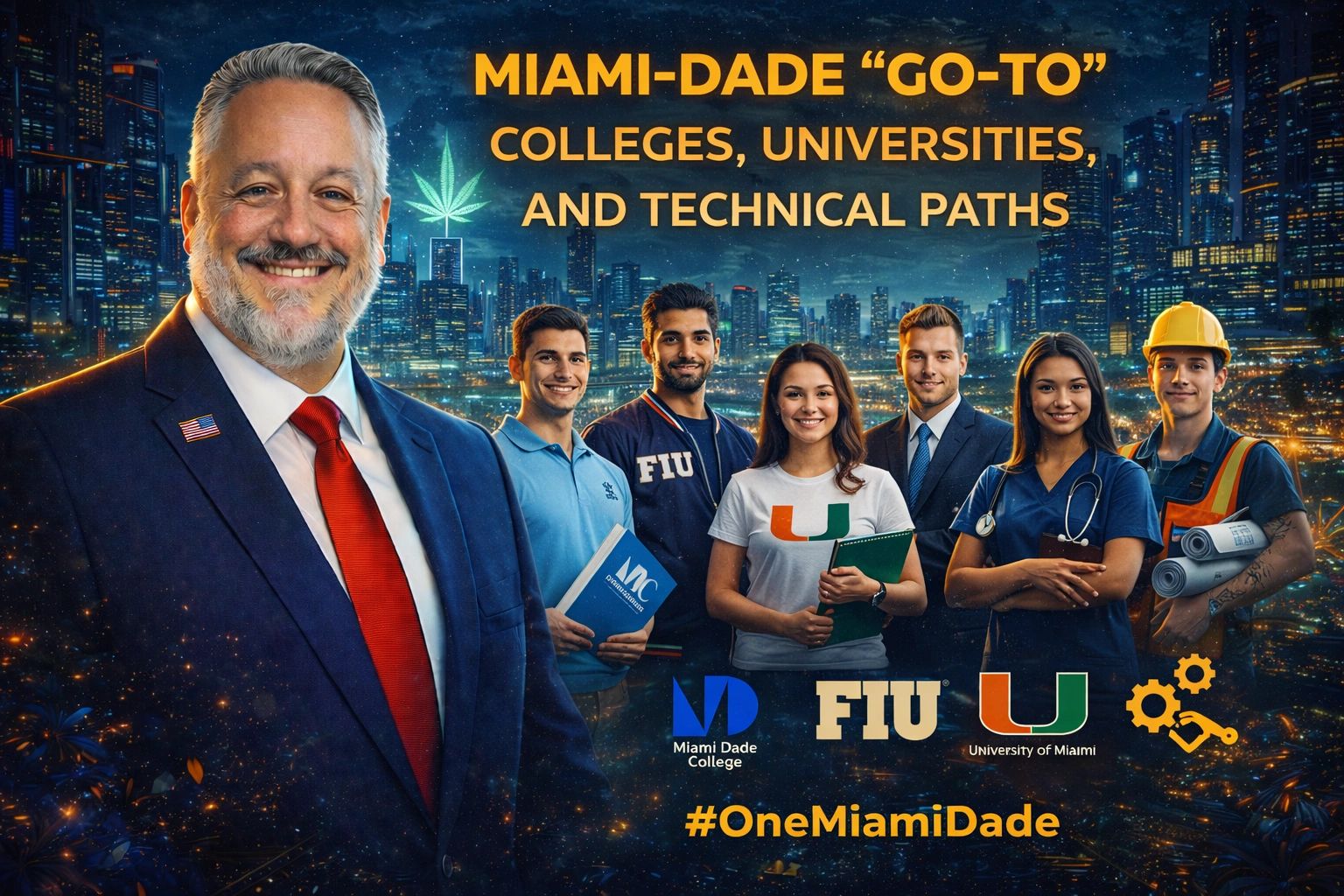
Miami-Dade “Go-To” Colleges, Universities, and Technical Paths
Residents can choose education anywhere in the world (U.S. or international). The options below are simply the go-to local pathways inside Miami-Dade County for residents who want to train, earn credentials, and qualify under the education/training standard.
Major Public College Pathway
- Miami Dade College (MDC) — community college + bachelor pathways, multiple campuses, broad career programs.
Major Public University Pathway
- Florida International University (FIU) — major public university and local pathway for 4-year degrees and advanced study.
Major Private University Pathway
- University of Miami (UM) — major private university option in Miami-Dade County.
Additional Local Universities & Colleges (Miami-Dade)
- Florida Memorial University (FMU)
- St. Thomas University (STU) (including College of Law)
- Keiser University — Miami Campus
- Larkin University
- Miami Regional University (MRU)
- Southeastern College — Miami Lakes Area Campus
- Saint John Vianney College Seminary (Miami)
Technical Colleges (Fast, Accredited Career Training in Miami-Dade)
Official M-DCPS hub: M-DCPS Career & Technical Education — Technical Colleges
- D.A. Dorsey Technical College
- George T. Baker Aviation Technical College
- Lindsey Hopkins Technical College
- Miami Lakes Educational Center & Technical College
- Robert Morgan Educational Center & Technical College
- South Dade Technical College
Career-Focused Institute (Example Option)
- CBT Technology Institute — career programs in tech, construction trades, and workforce preparation.
Important Rule
Residents may complete education anywhere in the world. Miami-Dade options are recommended “go-to” pathways — not exclusive requirements.
Global Education Acceptance Clause
For purposes of eligibility under the education and training standard, Miami-Dade County will accept accredited education and recognized workforce credentials completed anywhere in the world—including programs completed inside Miami-Dade, elsewhere in Florida, anywhere in the United States, or internationally. Qualifying proof may include official transcripts, diplomas, licenses, apprenticeships, or industry certifications from legitimate institutions or credentialing bodies. The purpose of this standard is preparation—not restriction: residents may choose any field and any location to gain skills, and Miami-Dade will recognize those credentials so long as they are valid, verifiable, and professionally recognized.
Child Supplement
Support children—without creating a system that can be abused.
We will start with a child supplement of:
- 20% to 25% per child
- Cap: 2 children
This cap exists for one reason:
To keep the program sustainable and protected against exploitation.
So the structure becomes:
- Adult payout is per verified person
- Child supplement is limited and controlled
- No “infinite multiplication” of benefits
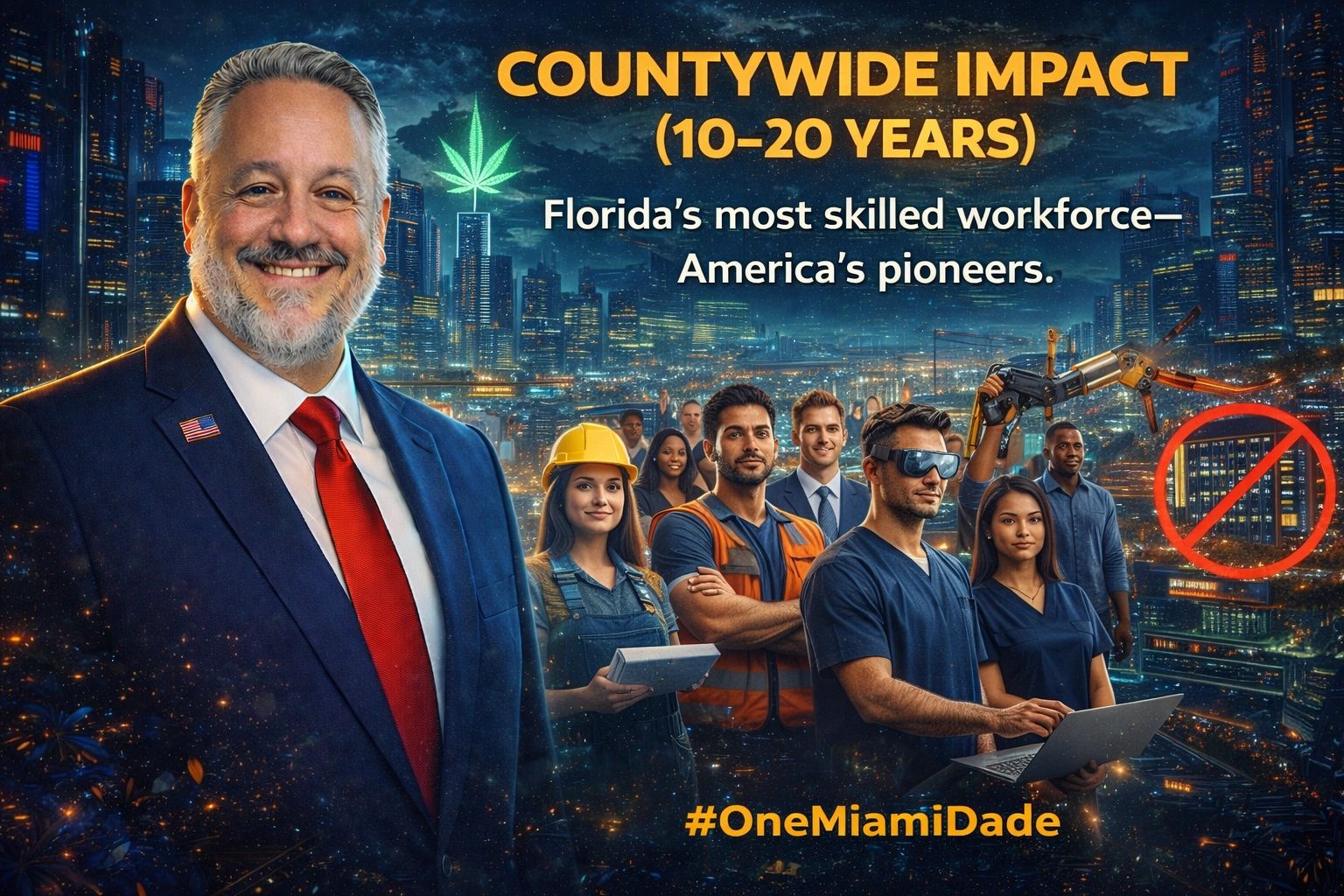
Countywide Impact (10–20 Years)
Florida’s most skilled workforce—America’s pioneers.
Over the next 10 to 20 years, this initiative will build the most skilled county workforce not just in Florida—but in the United States of America.
Miami-Dade County will be the pioneers.
We will be the leaders.
We will prove that a county can unify its residents, raise education and training standards, and create real economic security at scale—while preparing every new generation to dominate the future of technology, medicine, engineering, public service, and entrepreneurship.
This is how Miami-Dade becomes the model.
Not by talking.
By building.
Why Legal Cannabis Funds This
Because it keeps money inside the county.
When a county creates new revenue streams, the first question should be:
Does the wealth stay here—or does it leak out?
Project Fund is designed to keep revenue local and transparent. Legal cannabis, structured correctly, can produce:
- permit revenue
- per-plant fees
- compliance fees
- enforcement-backed fines for violations
And then—by rule—return the majority of that money right back to residents.
The Funding Structure
Simple math. Clear accountability.
Every year, total net revenue is split:
- 80% paid out as equal resident checks
- 20% retained for county operations, enforcement, audits, secure verification, and administration
This is not an “estimate.”
This is the policy.
Verification & Same-Day Service
People shouldn’t beg for what is theirs.
When a new-generation resident hits 21 and qualifies:
- they come to a Project Fund office
- present their credential or accredited training record
- we verify it
- and we process their enrollment
No endless paperwork.
No slow bureaucracy.
A resident-first system means service—not punishment.
Built-In Legal Protections
Designed to stop future sabotage.
This policy is written to prevent future administrations from twisting it into:
- favoritism
- category-based payouts
- property-based exploitation
- political gatekeeping
- residency discrimination
- bureaucratic slow-walking
The more equal the system is, the stronger it becomes—because the people will protect what they share equally.
Miami-Dade County Office of the
Mayor
Executive Order No. 2028-XX(DRAFT)
ESTABLISHING THE PROJECT FUND RESIDENT BENEFIT SYSTEM, LEGAL CANNABIS REVENUE DISTRIBUTION FRAMEWORK, AND EDUCATION-BASED YOUTH TRANSITION STANDARD
BY THE MAYOR OF MIAMI-DADE COUNTY
WHEREAS
Miami-Dade County exists to serve its residents and to protect their economic security, dignity, and long-term prosperity; and
WHEREAS, residents have historically seen public revenue extracted from their communities without proportional reinvestment in their households; and
WHEREAS, sustainable governance requires transparent, resident-first systems that cannot be manipulated by political interests, special classes, or private entities; and
WHEREAS, legal and regulated cannabis cultivation presents an opportunity to generate local revenue that remains within Miami-Dade County; and
WHEREAS, equal treatment of residents strengthens social unity, reduces political division, and ensures public trust in government institutions; and
WHEREAS, automation, artificial intelligence, robotics, and emerging technologies will transform employment and economic structures in coming decades; and
WHEREAS, Miami-Dade County must proactively prepare future generations through education, workforce training, and skills development; and
WHEREAS, this Administration seeks to build, within one generation, the most skilled county workforce in the State of Florida and in the United States of America, establishing Miami-Dade County as a national model for resident empowerment and workforce leadership;
NOW, THEREFORE, I, Victor J. Rosario, Mayor of Miami-Dade County, hereby order:
SECTION 1. ESTABLISHMENT OF
PROJECT FUND
1.1. The Project Victor J. Rosario Resident Benefit System (“Project Fund”) is hereby established as a permanent countywide resident benefit framework.
1.2. Project Fund shall operate as a resident-first economic system designed to return locally generated revenue directly to verified residents.
1.3. Project Fund shall be administered by the Miami-Dade County Office of Resident Services in coordination with the Department of Finance.
SECTION 2. LEGAL CANNABIS
REVENUE AUTHORIZATION
2.1. Miami-Dade County shall establish a legal permit and fee system for personal cannabis cultivation consistent with state and federal law.
2.2. Authorized revenue sources include:
a. Annual cultivation permits
b. Per-plant fees
c. Compliance fees
d. Enforcement penalties
2.3. All such revenue shall be deposited into the Project Fund Trust Account.
SECTION 3. MANDATORY 80/20
REVENUE DISTRIBUTION
3.1. All net Project Fund revenue shall be distributed as follows:
- Eighty percent (80%) → Direct resident payments
- No more than twenty percent (20%) → County administration and enforcement
3.2. No future administration may reduce the resident allocation below eighty percent (80%).
3.3. This distribution formula shall be permanent unless amended by countywide referendum.
SECTION 4. EQUAL RESIDENT
PAYMENT PRINCIPLE
4.1. All resident payments shall be equal in amount.
4.2. No distribution shall be conditioned upon:
- Income
- Age
- Disability status
- Veteran status
- Profession
- Ethnicity
- National origin
- Length of residency
- Political affiliation
- Any classification
4.3. No preference, tier, or bonus structure shall be permitted.
SECTION 5. PERSON-BASED
DISTRIBUTION; PROHIBITION ON
PROPERTY-BASED PAYMENTS
5.1. All benefits shall be issued on a per-person basis.
5.2. No distribution shall be based on:
- Property ownership
- Tenancy
- Number of dwellings
- Corporate control
- Real estate holdings
5.3. No household-based, address-based, or property-based payments are permitted.
SECTION 6. ADULT RESIDENT
ELIGIBILITY
6.1. Grandfathered Adults
All verified adult residents aged twenty-two (22) or older as of January 1, 2029, shall qualify for full adult benefits without educational requirements.
6.2. New Generation Adult Eligibility
For residents reaching adulthood after January 1, 2029:
Full adult benefits shall activate at:
- Age twenty-one (21) or older, and
- Completion of accredited education or workforce training.
SECTION 7. EDUCATION AND
TRAINING STANDARD
7.1. Qualifying credentials include, but are not limited to:
- Community college coursework
- University enrollment or degree
- Trade school certification
- Apprenticeship programs
- Technical certifications
- Medical or health licensing
- Industry-recognized credentials
- Accredited workforce training
7.2. No specific field of study is required.
7.3. Degrees are not mandatory; verified skills and training are sufficient.
SECTION 8. GLOBAL EDUCATION
ACCEPTANCE
8.1. Miami-Dade County shall accept accredited and recognized education and workforce credentials completed anywhere in the world.
8.2. Acceptable documentation includes:
- Transcripts
- Diplomas
- Licenses
- Certificates
- Apprenticeship records
- Industry credentials
8.3. The purpose of this standard is preparation, not restriction.
SECTION 9. YOUTH TRANSITION
INCENTIVE (AGES 16–21)
9.1. Residents aged sixteen (16) through twenty (20) shall remain eligible for child supplement benefits.
9.2. Continued eligibility requires active participation in education or training.
9.3. This period serves as a transition toward adult qualification.
SECTION 10. CHILD SUPPLEMENT
STRUCTURE
10.1. Each dependent child shall receive a supplement equal to twenty to twenty-five percent (20–25%) of the adult benefit.
10.2. Child supplements are capped at two (2) children per household.
10.3. No additional supplements beyond the cap are permitted.
SECTION 11. VERIFICATION AND
SERVICE DELIVERY
11.1. The County shall establish Project Fund Verification Centers.
11.2. Eligible residents may present credentials in person or digitally.
11.3. Verification and enrollment shall be processed without unreasonable delay.
11.4. Same-day activation shall be prioritized.
SECTION 12. ANTI-FRAUD AND
Compliance
12.1. The County shall implement secure identity verification.
12.2. False claims, document fraud, or manipulation shall result in:
- Repayment
- Disqualification
- Civil penalties
- Criminal referral
SECTION 13. TRANSPARENCY AND
AUDIT
13.1. The County shall maintain a public financial dashboard.
13.2. Annual independent audits are mandatory.
13.3. All revenue and distributions shall be publicly reported.
SECTION 14. LONG-TERM
WORKFORCE DEVELOPMENT
14.1. This policy is intended to produce, within 10–20 years, the most skilled county workforce in Florida and in the United States.
14.2. Miami-Dade County shall serve as a national model for education-linked resident empowerment.
SECTION 15. NON-DISCRIMINATION
15.1. No resident shall be denied benefits based on protected characteristics.
15.2. Equal treatment is mandatory.
SECTION 16. NON-DELEGATION
16.1. No private entity may administer Project Fund payments.
16.2. All authority remains with Miami-Dade County.
SECTION 17. SEVERABILITY
If any portion of this Order is held invalid, the remainder shall remain in full force.
SECTION 18. EFFECTIVE DATE
This Executive Order shall take effect upon inauguration of the Mayor in 2028 and full implementation shall commence immediately thereafter.
SIGNED:(DRAFT)
Victor J. Rosario
Mayor, Miami-Dade County
Date: ____________________
Future Mayor of Miami-Dade County
Call to Action
This is what I need from you:
- Share this policy with your family and neighbors
- Tell people to read it for themselves
- Ask every candidate one simple question:
Do you support equal resident checks with an 80/20 resident-first split—yes or no
Frequently Asked Questions
What is Project Fund?
Project Fund is a resident-first county initiative designed to return a large portion of locally generated revenue back to verified residents through equal resident checks—while keeping county operations funded and transparent.
Why 80% to residents?
Because residents come first. This model is built to unify the public by ensuring everyone shares equally in the outcome.
Will landlords get multiple checks for multiple properties?
No. This is a person-based system, not a property-based system. We pay residents, not buildings.
Is this payment based on income, age, or job title?
No. Equal means equal. No categories. No favoritism.
What age qualifies for the adult payout?
For new generations, full adult payout activates at 21+ with education/training proof. Existing adults are grandfathered in under Phase 1.
Is a bachelor’s degree required?
No. Any accredited education or training pathway qualifies—community college, trade programs, certifications, apprenticeships, and more.
Will children receive anything?
Yes. A child supplement is included at 20–25% per child, capped at two children.
What happens if a young adult does not pursue training?
They do not activate the full adult payout at 21+. The system is designed to incentivize education and preparation, not dependency.
Can someone study outside Miami-Dade?
Yes. The program accepts legitimate accredited education and credentialing regardless of where it is completed.
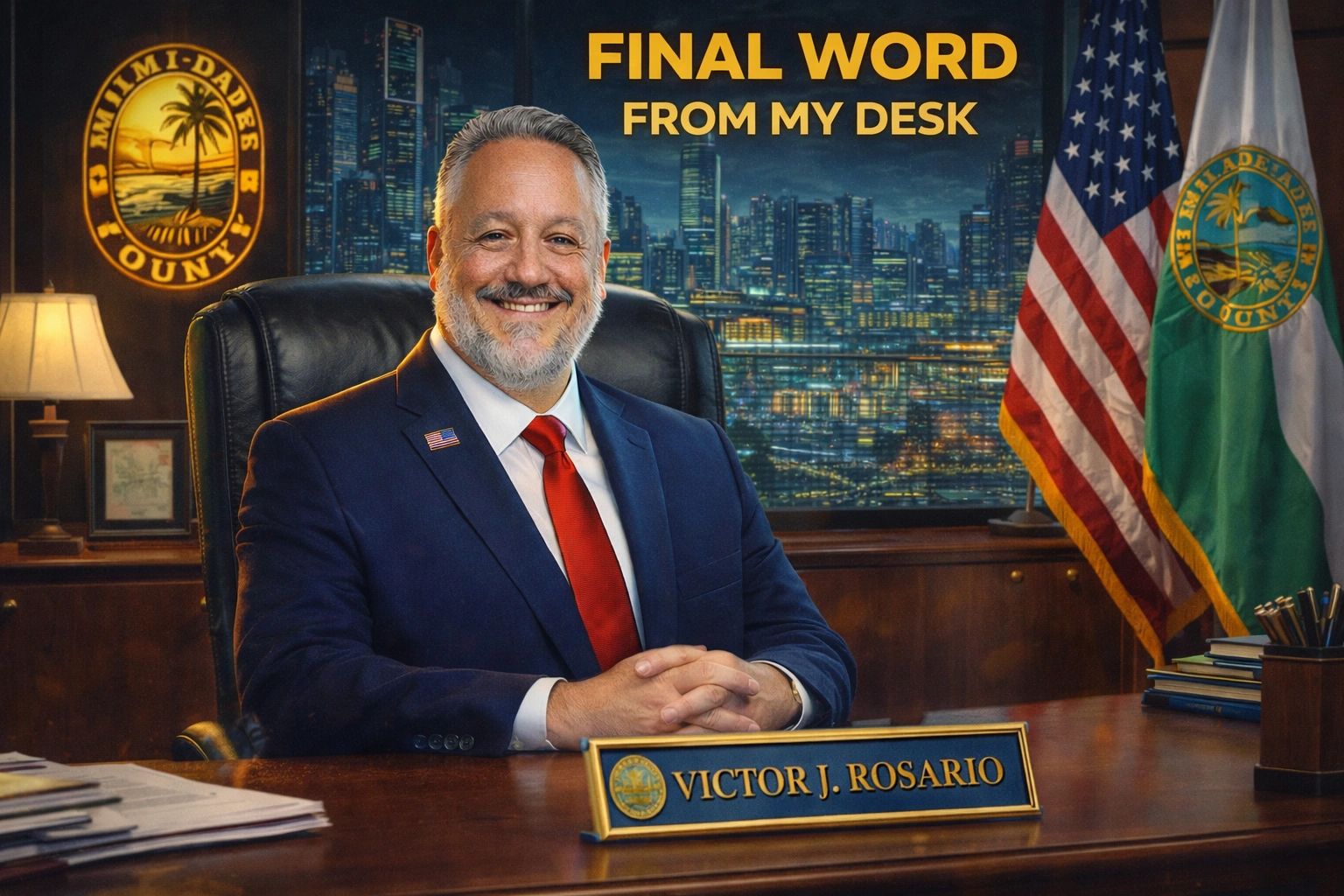
Final Word From My Desk
Miami-Dade County doesn’t need another administration that manages decline.
We need an administration that builds systems strong enough to outlast politics.
Project Fund is simple for a reason:
Because simplicity is strength.
Equality is unity.
Unity is protection.
When everyone gets the same, residents defend it together.
When no one is ranked, no one is divided.
When the future arrives—AI, automation, robotics—Miami-Dade will be prepared, educated, and united.
That is what resident-first means.
Victor J. Rosario
Future Mayor of Miami-Dade County
#UnleashingMiamiDadeCounty #VictorImpactWrench #AllSystemsOnline #TeamVictor
About Victor J. Rosario
Victor J. Rosario is the Residents-First candidate for Miami-Dade County Mayor 2028. A U.S. Coast Guard veteran, entrepreneur, technologist, and artist, Victor brings a track record of building real solutions — from AI tools to campaign policy — that serve Miami-Dade's 2.8 million residents.
Learn More About Victor