By Victor J. Rosario
Candidate for Mayor of Miami-Dade County — Election Day: November 7, 2028
Residents-First Administration
A mi residentes se respetan.
Let Me Talk to You Straight
Before I explain the plan, I want to talk to you the way I talk to neighbors — not the way politicians talk at press conferences.
Something is happening right now, in this country, in this county, that most elected officials either do not understand or do not want to touch. Technology companies and institutions are building systems that can estimate what you are feeling, predict what you are thinking, measure your stress and attention and emotional vulnerability — and use that information to influence your behavior, your access to services, and your daily life.
And almost none of it requires your permission.
I know that sounds like science fiction. I know that some people reading this are already skeptical. That is exactly why I am going to take the time in this post to explain it carefully — not with fear, not with conspiracy, but with facts, science, and a concrete plan.
Because here is the truth: the greatest risk to your freedom in the coming decade is not a dramatic moment where someone announces they are taking your rights. It is a slow, invisible process where systems quietly model who you are, how you behave, and what makes you respond — and that information shapes your world in ways you never consented to and may never even know about.
Miami-Dade County will not let that happen without a fight. And I am proposing the office — the enforcement structure — that will draw the line.
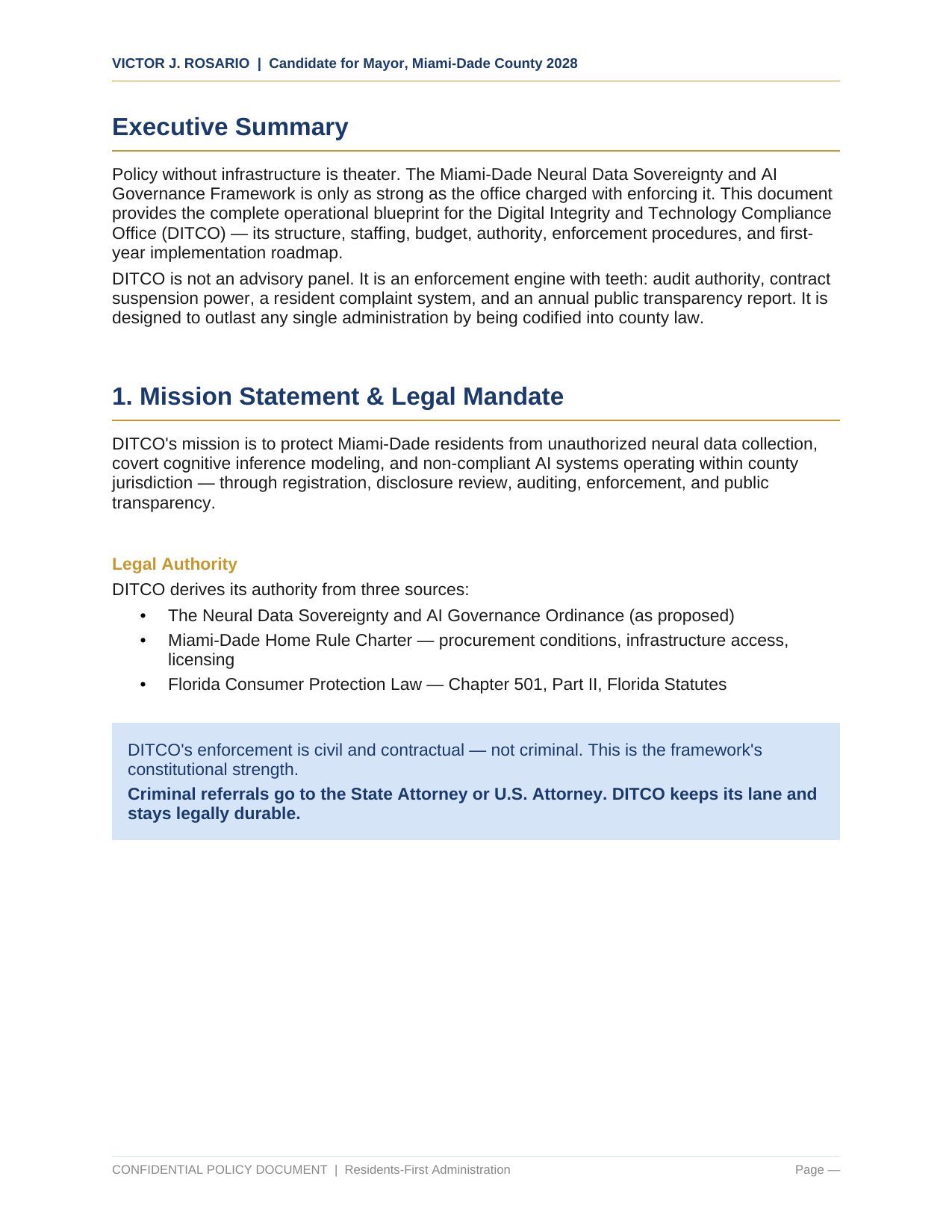
That office is called the Digital Integrity and Technology Compliance Office, or DITCO.
This post is about what it is, why it needs to exist, how it will work, what it will cost, who will run it, and most importantly: what it means for you as a resident of Miami-Dade County.
Part One: The World Has Changed. Government Hasn't Caught Up.
Let us start with the basics, because I believe residents deserve a real explanation — not a slogan.
For most of the history of privacy, the conversation was about three things: your physical space, your private papers, and your communications. The Fourth Amendment was written to protect against government intrusion into your home and your documents. Privacy law in the twentieth century expanded to cover your medical records, your financial data, your phone calls.
All of that still matters. But here is what has changed.
The technology that exists today — and is being deployed right now, in commercial products, in workplace systems, in public spaces — can do something that no previous technology could do. It can attempt to model the inside of your head using data that you never thought of as personal.
Let me give you three real examples that are not science fiction. These are documented, peer-reviewed, published capabilities:
Example One: Facial Emotion Inference. Artificial intelligence systems trained on millions of facial images can now analyze micro-expressions — tiny movements of facial muscles that happen in fractions of a second — and produce estimates of emotional state. These systems are already being used by retailers to gauge customer reactions to products, by employers to screen job candidates in video interviews, and by insurance companies to assess risk. You do not consent to this when you walk into a store or sit down for a remote job interview. It happens automatically.
Example Two: Voice Stress Analysis. AI systems can analyze the acoustic properties of your voice — frequency, cadence, micro-tremors — and produce estimates of stress levels, confidence, honesty, or emotional state. These systems are being used in call centers, in some courtroom settings, and in employment screening. Again: no informed consent is required in most jurisdictions.
Example Three: Brain Decoding Research. This is the one that most people dismiss as science fiction, but it is not. Research from Meta AI and the University of Texas at Austin has demonstrated that machine learning can be used to interpret patterns in brain activity related to language and meaning. The UT Austin team developed a semantic decoder using fMRI that can reconstruct the rough meaning of what a person is hearing or thinking, using only brain activity data. Meta has published research on non-invasive brain recordings using EEG and MEG that can map neural signals to typed output.
These systems are currently research-grade. They require specialized hardware and controlled environments. They are not being deployed on street corners today. But the trajectory is clear, the research is real, and the regulatory framework to address them does not yet exist at the county level anywhere in the United States.
The question for Miami-Dade is not: is this happening to residents right now in its most advanced form? The question is: will Miami-Dade have the governance structure in place when these capabilities become more accessible — or will we be scrambling to catch up after harm has already been done?
I choose to lead before the harm is normalized. That is what governance means.
Part Two: Why Most of the Danger Is Already Here
Here is what I need every resident to understand: you do not need a brain scanner pointed at your head for your cognitive privacy to be at risk.
The most widespread and immediate threat is what we call AI-based cognitive inference — and it is already operating in the systems around you.
Here is how it works. Modern artificial intelligence systems are trained on enormous datasets where human behaviors, expressions, and physiological signals are labeled with corresponding mental or emotional states. Over millions of examples, the model learns statistical correlations. Once trained, it can take new inputs — your face, your voice, your typing patterns, your scrolling behavior, your purchase history — and produce a probability estimate of your likely cognitive or emotional state.
The output is not a direct reading of your mind. It is a probabilistic model of your mind. But probabilistic models of your mind, at scale, with AI power behind them, are extraordinarily useful for anyone who wants to predict your behavior, manipulate your decisions, or assess your vulnerability.
Think about what that means in practice.
When you apply for a job and submit to an AI-powered video interview, the system is not just reading your resume. It may be analyzing your facial expressions, your vocal patterns, your response time, your eye contact — and producing an estimate of your personality, your emotional stability, your confidence level. That estimate feeds into whether you get called back. You never consented to a psychological profile. You thought you were just answering questions.
When you walk through a retail space with facial recognition cameras, the system may be logging not just your identity but your emotional responses to products, your attention patterns, your stress indicators. That data feeds into how the store prices things, how it places products, and how it targets you with advertising when you leave.
When you scroll through social media, the algorithm is not just tracking what you click. It is building a behavioral model that includes estimates of your emotional state, your susceptibility to different kinds of content, your likely responses to different messages. That model is used to decide what you see — and what you do not see.
None of this is secret. It is documented in research papers, in company patents, in congressional testimony. What is missing is a local government that takes it seriously and builds enforceable protections.
In Miami-Dade, that changes under my administration.
Part Three: Why Miami-Dade Has the Power to Act
I have heard the dismissal: "This is a federal issue. Counties cannot regulate Big Tech."
That argument is wrong, and it is usually made by people who benefit from counties doing nothing.
Miami-Dade County does not need to regulate Silicon Valley from a distance. We do not need to rewrite federal law. What we control is substantial and sufficient.
We control county contracts. Every company that wants a county contract — to build our infrastructure, to provide software for county services, to operate systems that touch residents through county channels — must comply with the conditions we set. If a vendor wants to integrate AI systems into county operations, those systems must meet our disclosure, consent, and compliance standards. Period.
We control county infrastructure access. Want access to county networks, county facilities, county data pathways? You follow Miami-Dade's rules. Counties condition infrastructure access on compliance with safety standards, environmental standards, and licensing requirements every day. Cognitive privacy standards are no different.
We control procurement. When we require compliance certification as a condition of contract award, every company that wants to do business in one of the largest, wealthiest counties in the Southeast United States has an incentive to meet our standards.
We have consumer protection authority. Under Florida law and the Miami-Dade Home Rule Charter, the county has authority to enforce consumer protection standards against deceptive and unfair business practices. Covert cognitive inference without disclosure qualifies.
We can create civil enforcement pathways. The county can establish civil penalties for violations within county jurisdiction, seek injunctive relief through the courts, and refer suspected criminal violations to state and federal prosecutors.
This is not symbolic. This is operational leverage. Illinois enacted the Biometric Information Privacy Act at the state level. New York City enacted Local Law 144 requiring bias audits for AI hiring tools. Miami-Dade will lead at the county level on the broader question of cognitive privacy.
Part Four: The Neural Data Sovereignty Doctrine
Before I explain the enforcement office, you need to understand the core principle that drives everything.
I call it the Neural Data Sovereignty Doctrine, and it rests on one non-negotiable statement: Miami-Dade residents own their neural data and cognitive identity.
Your mind is not corporate inventory. Your cognitive patterns are not a product to be harvested and sold. Your emotional responses, your stress indicators, your behavioral tendencies — these are not raw material for profit extraction.
When any system wants to collect, analyze, or infer information about your cognitive state, you have the right to know about it, the right to consent to it explicitly, and the right to refuse without being punished.
This sounds simple. And in principle, it is. But the current reality is that almost none of it is guaranteed.
Today, companies can bury cognitive inference capabilities in terms of service that no one reads. They can update their AI systems to expand what they collect without notifying you. They can share your cognitive profile with third parties through subcontractor chains that are invisible to you. They can use your data to make decisions about your access to housing, employment, credit, and services — and there is no local mechanism to audit, challenge, or stop them.
The Neural Data Sovereignty Doctrine says: not in Miami-Dade.
Under this doctrine, neural data and AI-generated cognitive inference data are classified as the highest tier of protected human data within county jurisdiction. This classification carries strict obligations: explicit consent, full disclosure, retention limits, deletion rights, and accountability when things go wrong.
Why the highest tier? Because the harm potential is uniquely irreversible. If your credit card number is stolen, you get a new card. If your password is compromised, you reset it. But if your cognitive profile is harvested and circulated, you cannot change it. It is you. The harm is permanent.
Part Five: The Miami-Dade Cognitive Privacy Bill of Rights
Under my administration, Miami-Dade will adopt a Cognitive Privacy Bill of Rights — a clear, plain-language statement of what every resident is guaranteed.
The Right to Cognitive Transparency. Any system operating in Miami-Dade that collects biometric data or performs cognitive inference must clearly disclose what it is doing, in plain language, before or at the moment of interaction. No hidden clauses. No buried footnotes.
The Right to Refuse Without Retaliation. You cannot be punished for refusing to submit to cognitive data collection. You cannot be denied access to public services, priced out of housing, blocked from employment, or removed from transit systems because you refused to allow a system to model your mind.
The Right to Algorithmic Explanation and Human Review. If an AI system makes a decision that materially affects your life — denying your housing application, flagging you in an employment screen, changing your insurance rate — you have the right to request an explanation and to have a human being review that decision.
The Right to Data Minimization. Systems cannot collect everything about you on the theory that it might be useful someday. Collection must be tied to a specific, disclosed purpose. Retention must be time-limited. When the purpose is served, the data must be deleted through pathways that are real and verifiable.
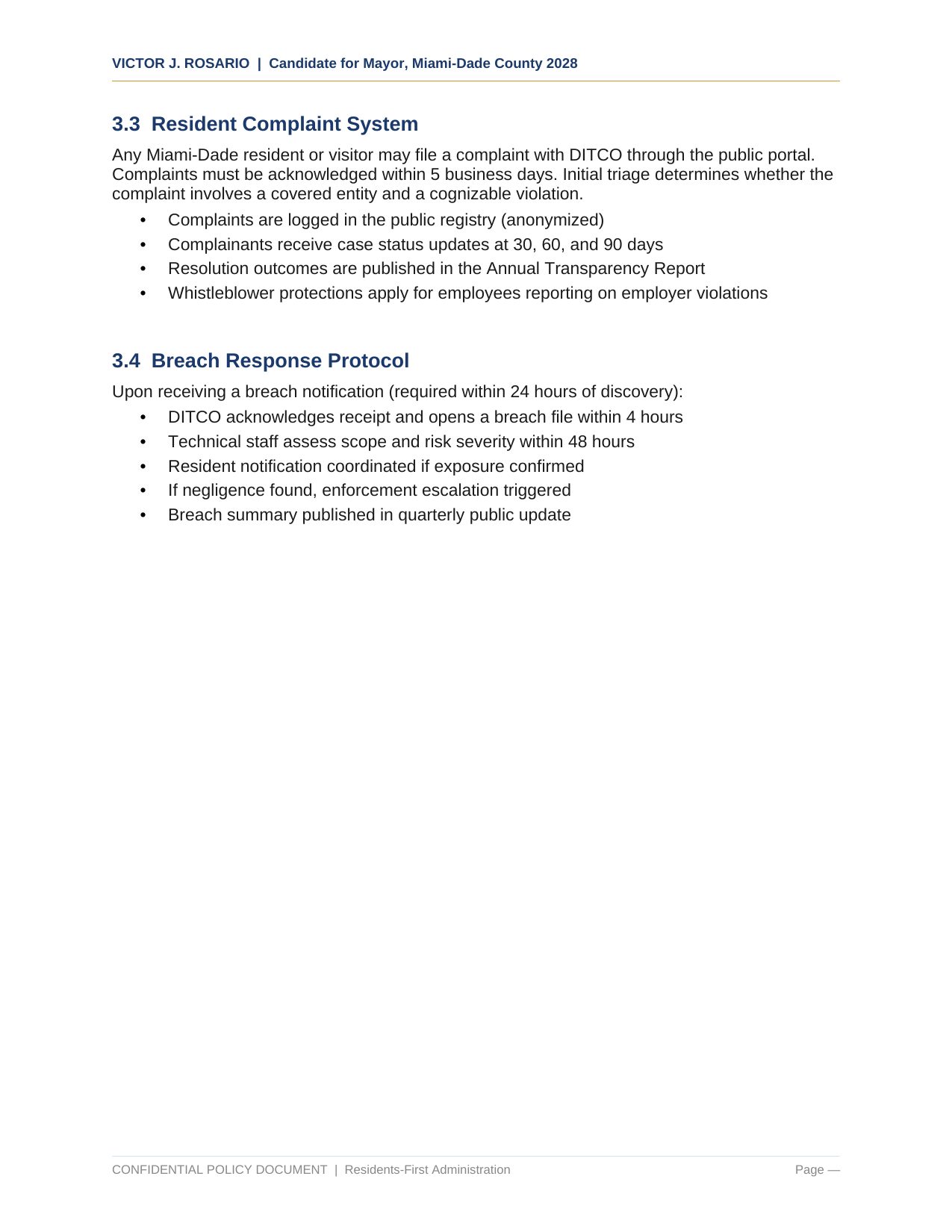
The Right to Breach Notification. If a system holding your cognitive or biometric data is compromised, you have the right to know promptly. When your most sensitive data is at risk, speed is respect.
These rights are not aspirational. They are enforceable. Which brings me to the most important part of this post.

Part Six: DITCO — The Office That Makes It Real
Here is the honest truth about every policy framework that fails: it fails because there is no one whose job it is to enforce it.
Beautiful language in an ordinance means nothing if there is no office, no staff, no budget, no authority, and no accountability mechanism behind it. That is how residents get fooled by political theater — it looks like protection from a distance, but when you need it, there is nothing there.
I am not interested in theater. I am interested in protection.
That is why the centerpiece of my AI governance plan is the Digital Integrity and Technology Compliance Office — DITCO.
DITCO is a dedicated county enforcement office. Not a committee. Not an advisory panel. Not a working group that meets quarterly and produces recommendations that sit in a drawer. An office with staff, authority, a public-facing complaint system, audit power, enforcement tools, and a legal mandate to protect Miami-Dade residents.
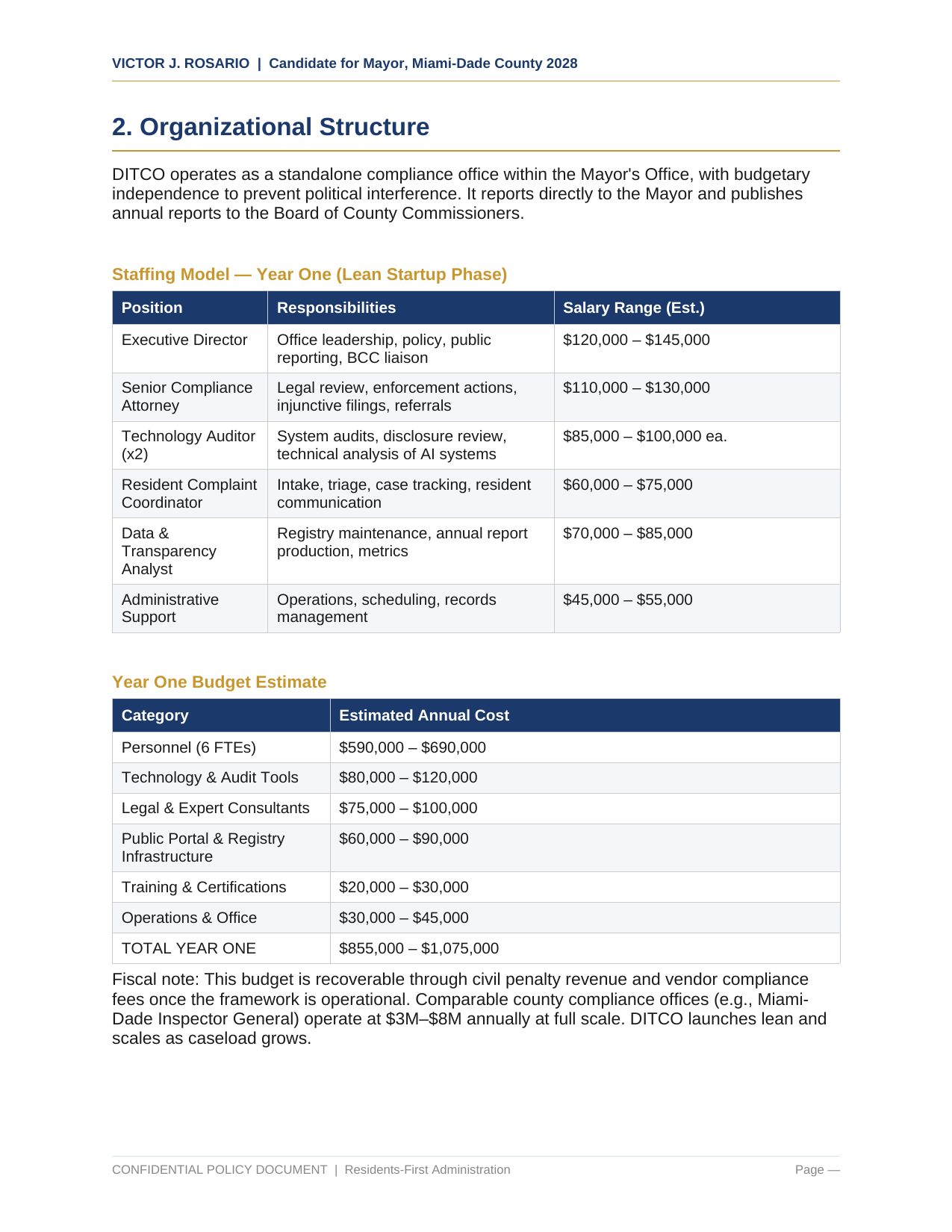
Who runs it: DITCO is led by an Executive Director appointed by the Mayor and accountable to the Board of County Commissioners. The office has six roles in its first year: a Senior Compliance Attorney, two Technology Auditors, a Resident Complaint Coordinator, a Data and Transparency Analyst, and administrative support. Six professionals, lean and focused.
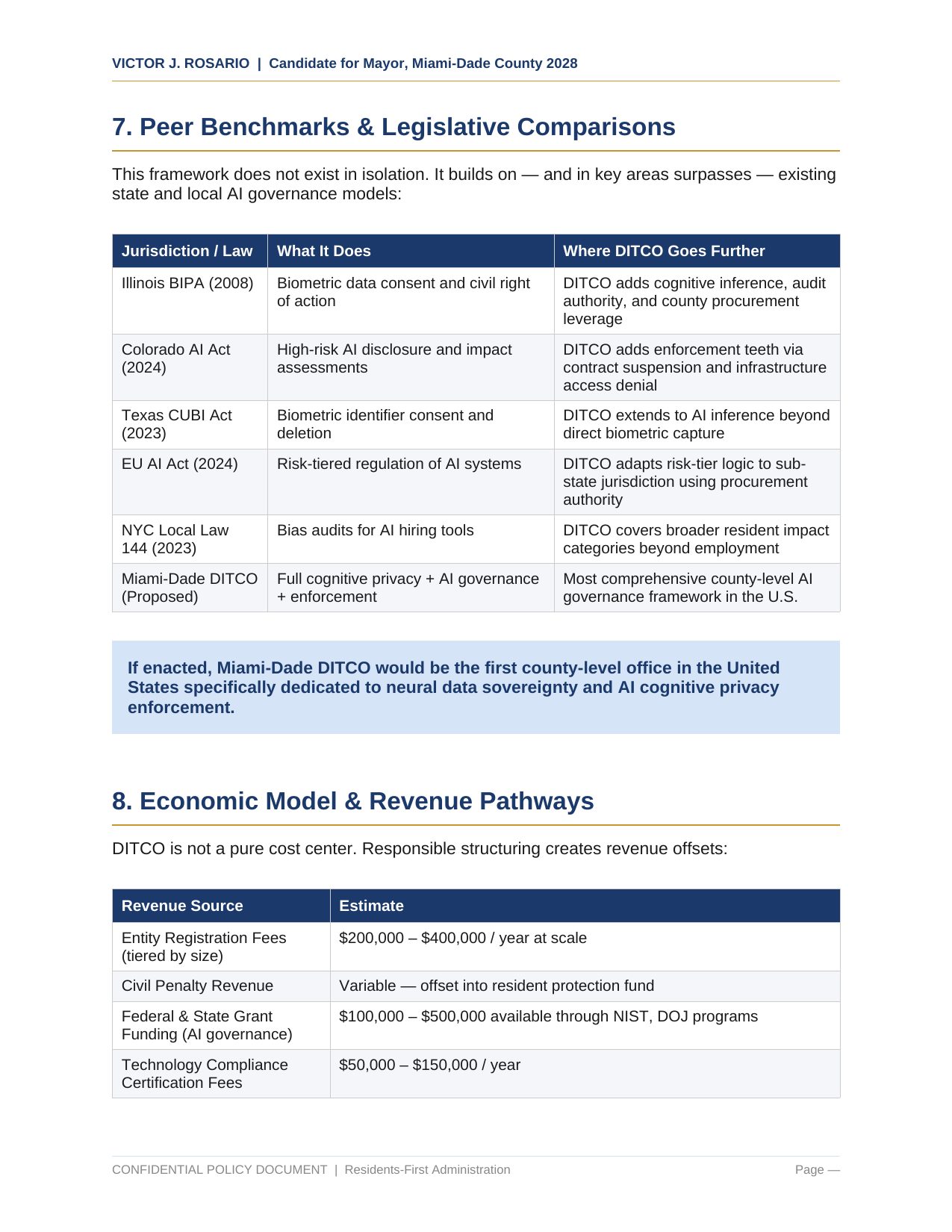
What it costs: Year one budget: $855,000 to $1,075,000. That covers all personnel, technology and audit tools, legal consultants, the public portal and registry, training, and office operations. By Year 3, the office projects near-zero net cost to the county — offset by entity registration fees, civil penalty revenue, and federal AI governance grants.
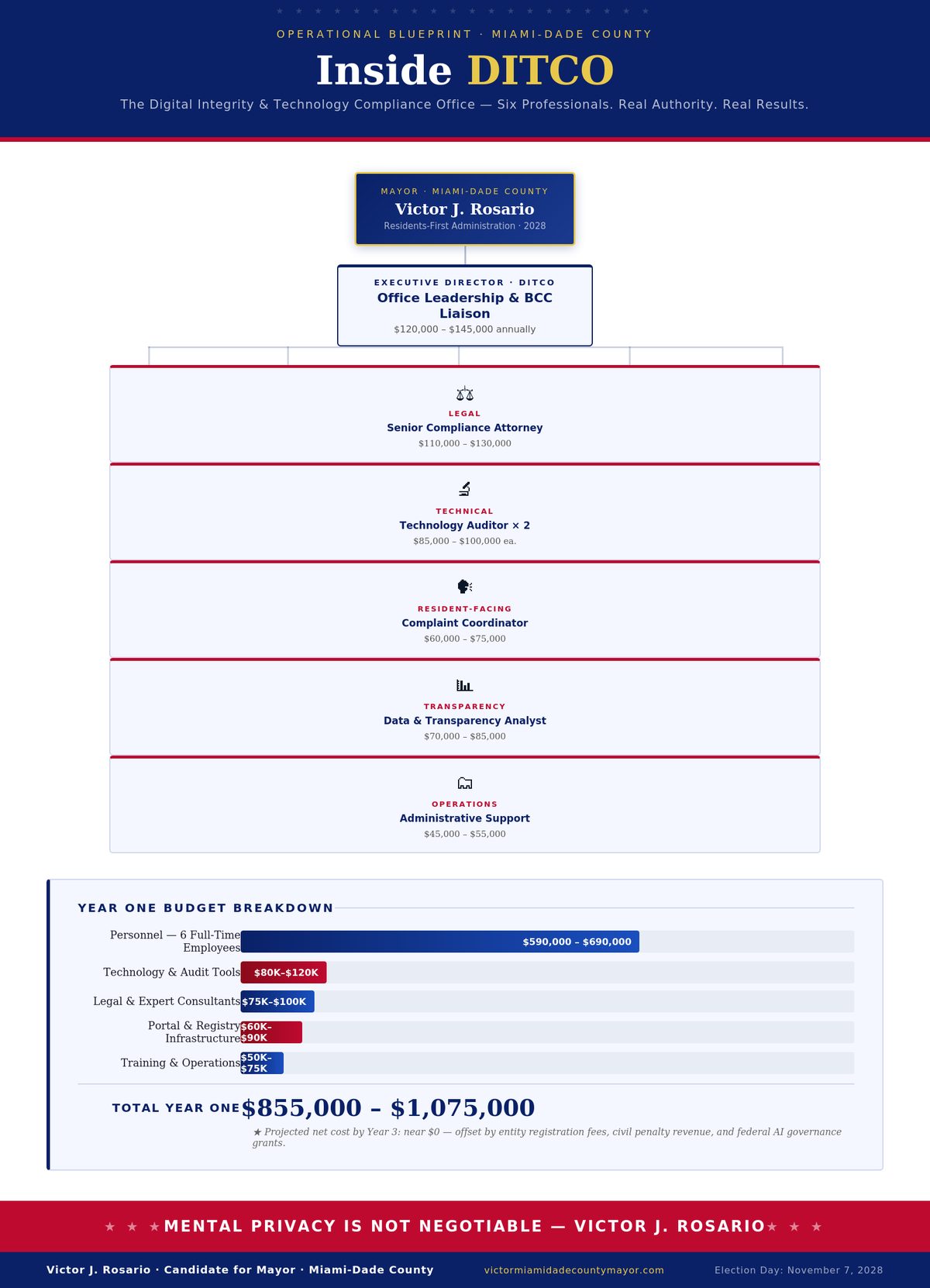
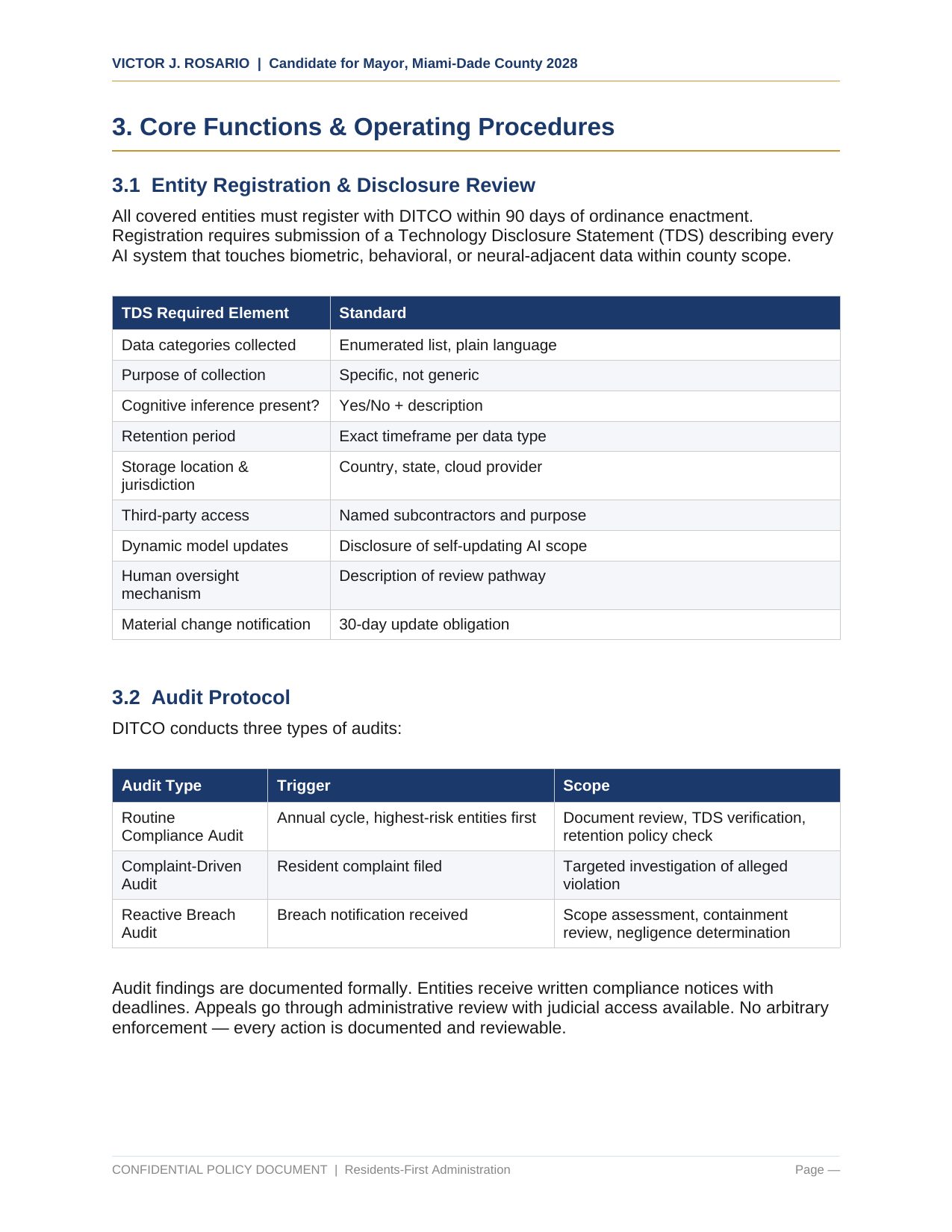
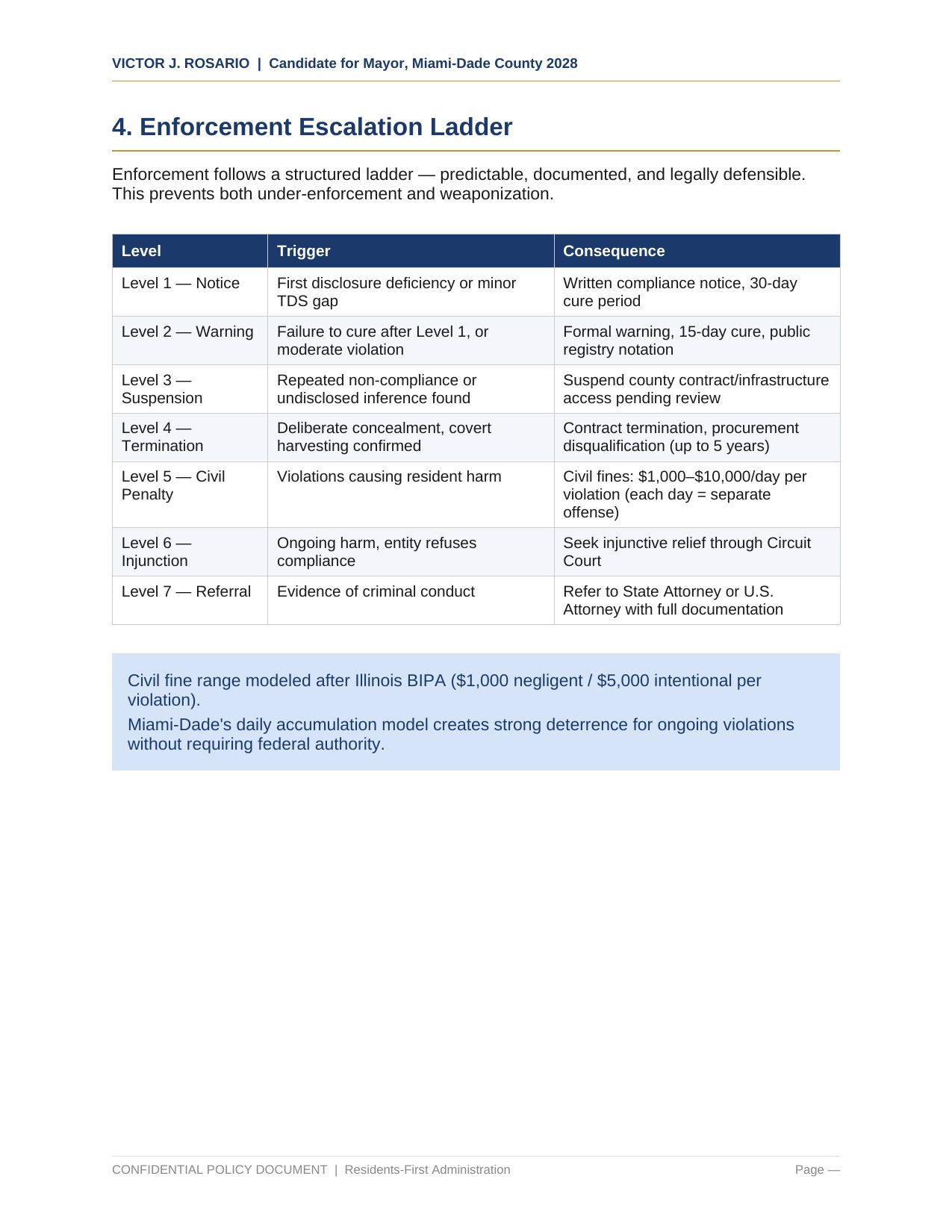
What it can do: DITCO has real authority. It can require registration and disclosure from every covered entity. It can conduct audits. It runs a resident complaint system where any Miami-Dade resident can file a complaint and receive a case update within five business days. It can impose civil penalties of $1,000 to $10,000 per violation per day. It can suspend county contracts. It can seek injunctive relief through Circuit Court. And when evidence points to criminal conduct, it refers the full documentation package to the State Attorney or U.S. Attorney.
The Enforcement Ladder: Every consequence is structured. Level One is a compliance notice with a 30-day cure period. Level Two is a formal warning with public registry notation. Level Three is operational suspension. Level Four is contract termination and procurement disqualification for up to five years. Level Five is civil penalties per day. Level Six is a court injunction. Level Seven is criminal referral. Every level has a defined trigger. Every action is documented. Every decision is reviewable.

Part Seven: How We Compare to the World
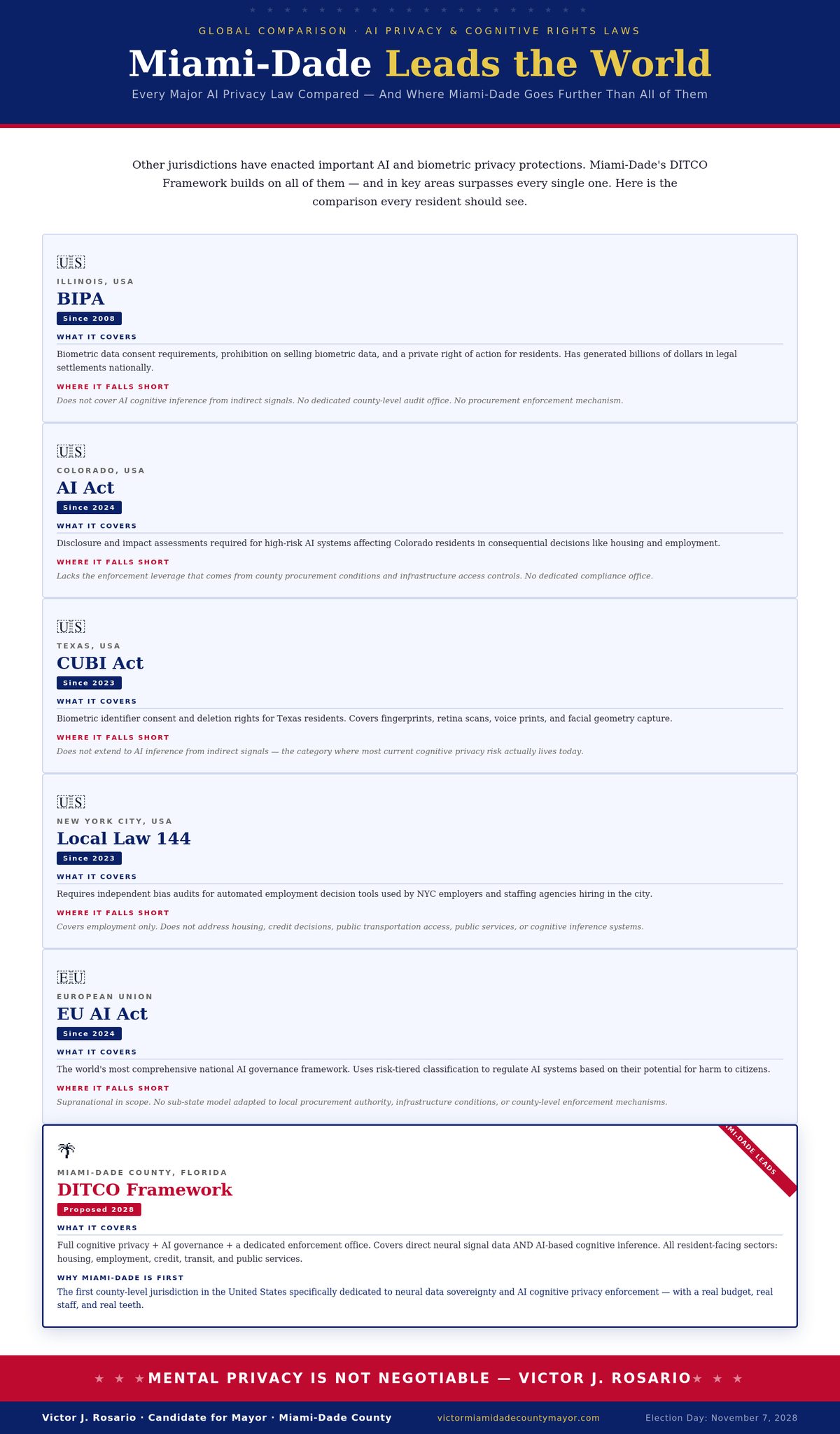
Other jurisdictions have enacted AI and biometric privacy protections. Here is how Miami-Dade compares to all of them — and where we go further.
Illinois BIPA from 2008 was the first major biometric privacy law in the United States. It requires consent before biometric data collection and gives individuals a private right of action. It has generated billions in settlements. Miami-Dade builds on BIPA by adding cognitive inference protections, county-level audit authority, and procurement leverage that state law does not provide.
Colorado's AI Act from 2024 requires disclosure and impact assessments for high-risk AI systems. Miami-Dade adds enforcement teeth through contract suspension and infrastructure access denial.
Texas's CUBI Act covers biometric identifier consent and deletion. It does not cover AI inference beyond direct biometric capture — where most of the current risk lives. Miami-Dade covers both.
New York City's Local Law 144 requires bias audits for AI hiring tools in one sector. Miami-Dade covers all resident-facing AI impact across housing, employment, credit, transportation, and public services.
The European Union's AI Act is the most comprehensive AI governance framework in the world. Miami-Dade adapts the risk-tier logic to sub-state jurisdiction using procurement and infrastructure authority as the enforcement mechanism.
If the DITCO framework is enacted, Miami-Dade becomes the first county-level jurisdiction in the United States specifically dedicated to neural data sovereignty and AI cognitive privacy enforcement.
Part Eight: This Is Not Anti-Technology
Some will argue that strong privacy protections discourage innovation. The opposite is true.
Responsible companies prefer clear rules. Predictability reduces litigation risk and reputational harm. Transparency builds consumer trust. Trust drives adoption.
Miami-Dade's framework does not ban AI. It sets boundaries. Innovation thrives when trust exists.
A structured AI governance model attracts responsible technology firms. It reduces regulatory uncertainty. It protects residents from exploitation. It enhances long-term economic stability. And it positions Miami-Dade as a national leader.
Counties that ignore AI governance risk becoming testing grounds without oversight. Miami-Dade will not be a passive environment where residents are treated as raw material for corporate AI experiments.
Part Nine: The Implementation — What Happens From Day One
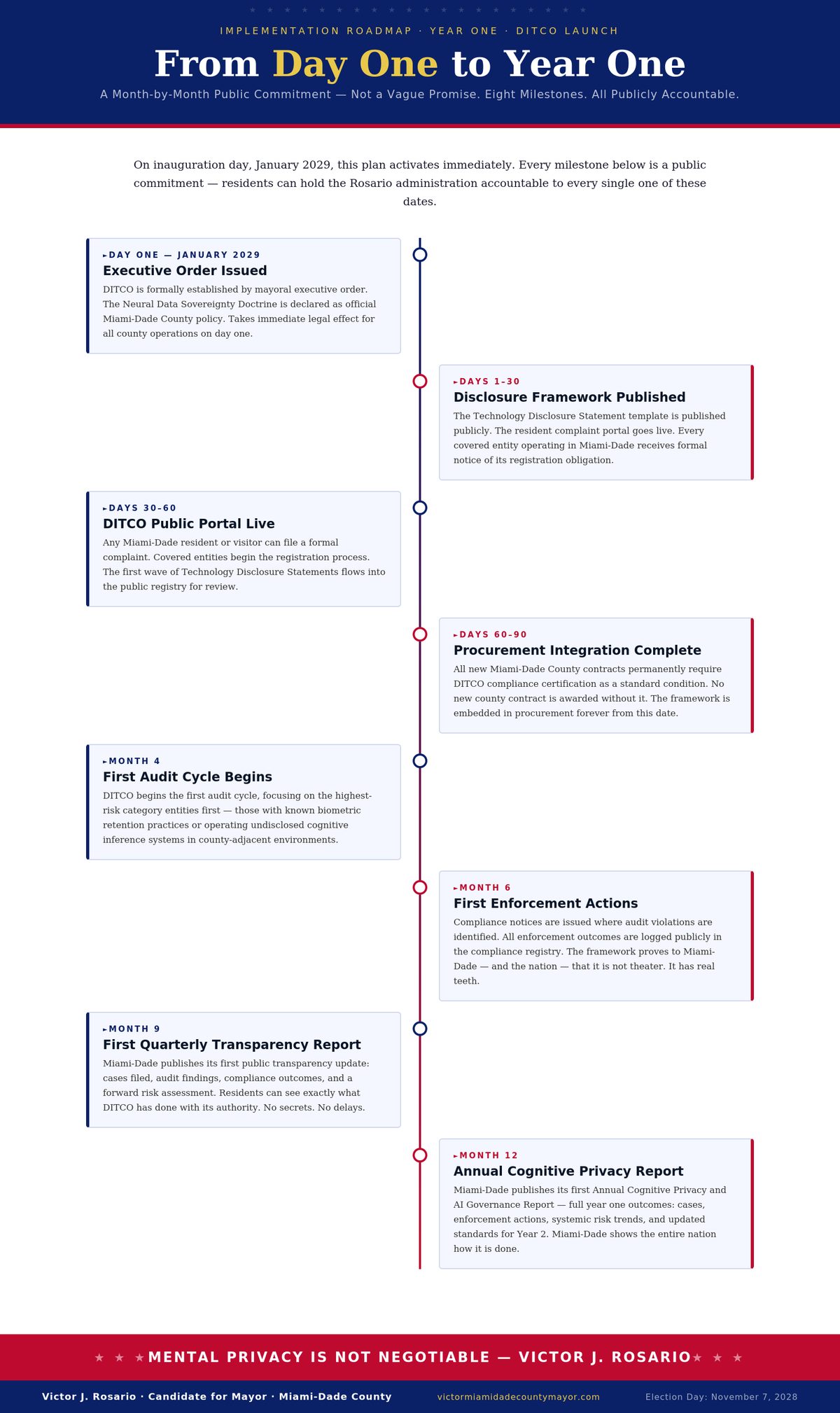
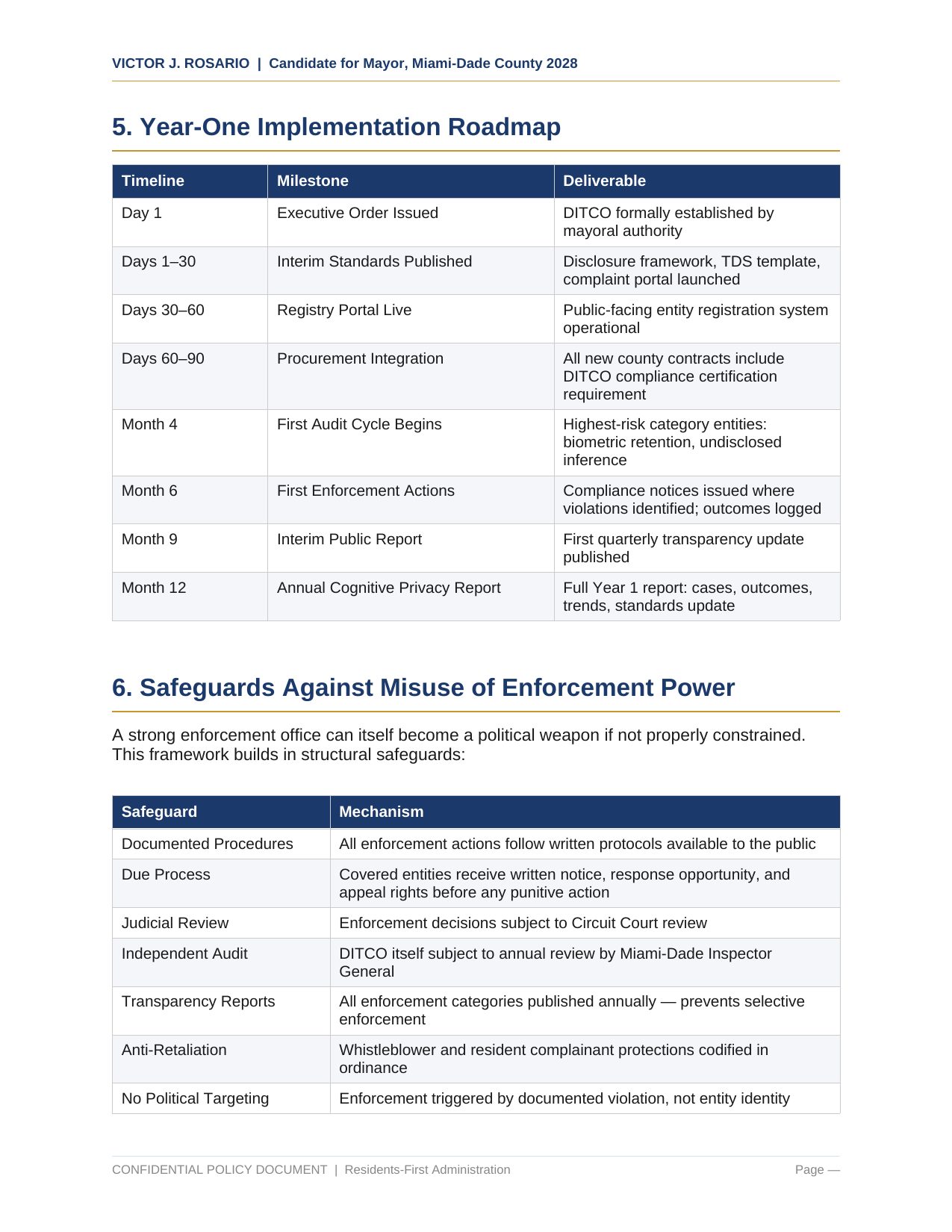
Day One, January 2029: Executive Order establishing DITCO issued. Neural Data Sovereignty Doctrine declared as official county policy. Takes immediate effect.
Days One through Thirty: Disclosure framework published. Technology Disclosure Statement template released. Complaint portal launched. Every covered entity notified of registration obligation.
Days Thirty through Sixty: DITCO public portal live. Residents can file complaints. Covered entities begin registration. First wave of disclosure statements flows in.
Days Sixty through Ninety: All new county contracts require DITCO compliance certification permanently embedded in procurement.
Month Four: First audit cycle begins, focusing on highest-risk entities — biometric retention and undisclosed cognitive inference systems.
Month Six: First enforcement actions issued where violations are identified. Outcomes logged publicly.
Month Nine: First quarterly transparency report published. Residents see exactly what DITCO has accomplished.
Month Twelve: Miami-Dade publishes its first Annual Cognitive Privacy and AI Governance Report — cases, outcomes, trends, and updated standards for Year 2.
Conclusion: The Line Is Drawn Here
Residents of Miami-Dade, I want to end this post the same way I began it — talking to you straight.
We are at a moment where the decisions government makes in the next few years will determine whether AI becomes a tool that serves humanity or a mechanism for extracting it. The window for drawing boundaries is open right now. It will not stay open forever. Once the practices of covert cognitive profiling become normalized — once residents accept that it is just "how things work" — rolling them back becomes exponentially harder.
That is why this cannot wait for federal legislation that has been debated for years without resolution. It cannot wait for state action that may not come in time. It must happen at the county level, with the tools we have, right now.
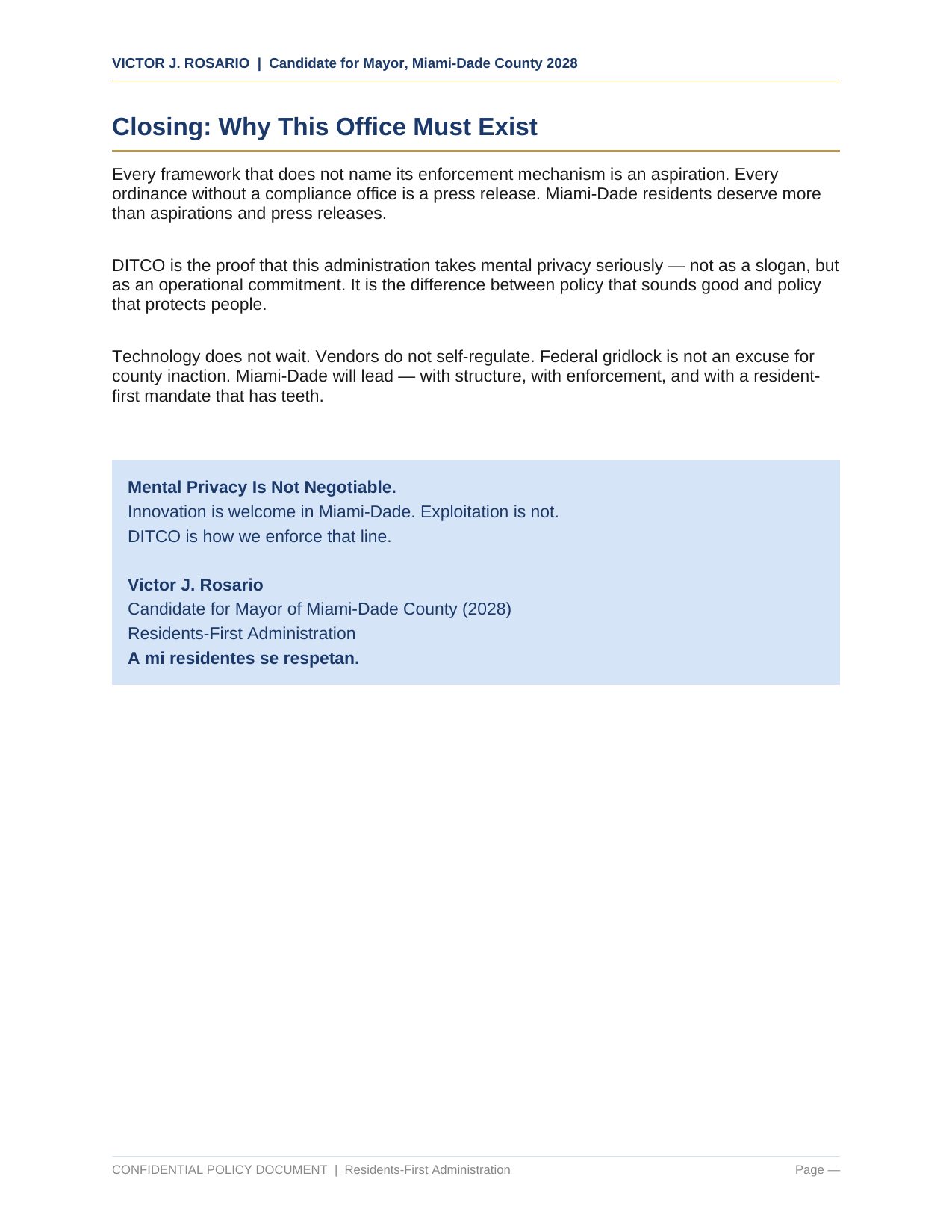
DITCO is not a symbolic gesture. It is a funded office with staff, authority, an enforcement ladder, a public complaint system, and a legal mandate. It is backed by real consequences — contract termination, civil penalties, injunctive relief, criminal referral — for entities that violate residents' cognitive privacy within our jurisdiction.
And it is grounded in a principle that every resident of Miami-Dade County shares, regardless of political affiliation:
Your mind belongs to you.
Not to the company whose app you downloaded. Not to the vendor running facial recognition in the building lobby. Not to the AI system screening your job application. Not to the algorithm deciding what you see and what you are denied. Yours.
Miami-Dade County will enforce that principle. DITCO will be the mechanism. And on November 7, 2028, I am asking for your vote to make it real.
Because in Miami-Dade County, the way it has always been and the way it always will be under my administration:
A mi residentes se respetan.
Victor J. Rosario
Candidate for Mayor of Miami-Dade County
Election Day: November 7, 2028
Residents-First Administration
Want to learn more? Visit victormiamidadecountymayor.com
#UnleashingMiamiDadeCounty #VictorImpactWrench #AllSystemsOnline #TeamVictor
The DITCO Blueprint
The complete DITCO Blueprint, page by page. Tap any page to open it full size, or download the whole document.


About Victor J. Rosario
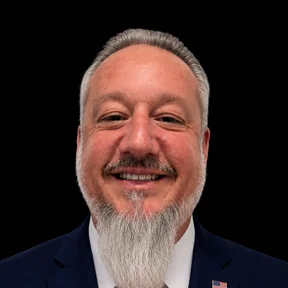
Victor J. Rosario is the Residents-First candidate for Miami-Dade County Mayor 2028. A U.S. Coast Guard veteran, entrepreneur, technologist, and artist, Victor brings a track record of building real solutions — from AI tools to campaign policy — that serve Miami-Dade's 2.8 million residents.
Learn More About Victor