
✍️ By Victor J. Rosario
Your Next Miami Dade County Mayor
Blockchain Transparency, Anti-Fraud Procurement, and Resident-First Accountability
Introduction: Miami-Dade Doesn’t Have a Spending Problem — It Has a Visibility Problem
Miami-Dade County doesn’t just need new programs or new promises. It needs something more basic and more powerful: proof.
When residents cannot easily see the full lifecycle of public spending—who was awarded, what changed after award, how payments were released, what was delivered, and who approved it—trust collapses. And when trust collapses, costs rise. Waste becomes easier to hide. Process complexity becomes a shield. Accountability becomes selective.
That is why the Truth Ledger exists.
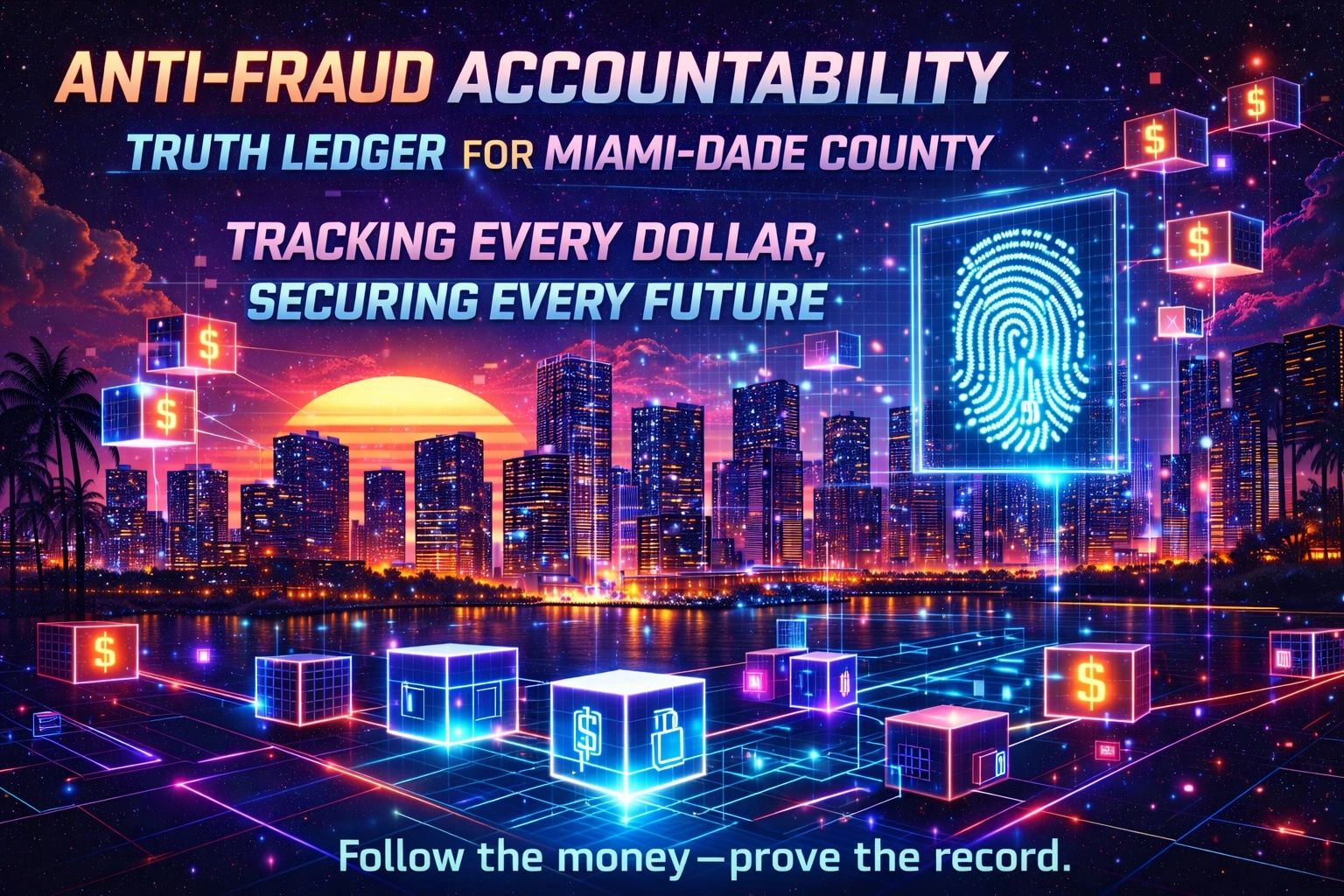
The Truth Ledger is a County-controlled transparency and integrity framework designed to make qualifying government transactions tamper-evident, searchable, and audit-ready—so residents can follow the money, verify the record, and understand decisions without needing special access, insider connections, or weeks of public records requests.
This is not “future tech.” It’s modern governance discipline: structured records, public proofs, and enforceable standards.
The Core Idea: Truth Must Be Verifiable, Not “Explained”
Most public systems rely on trust that is fragile because it is not verifiable. Residents are asked to trust summaries, press releases, and after-the-fact narratives.
The Truth Ledger flips the model.
Instead of “trust us.”
It becomes: “verify it.”
Verification is not a political argument. It is a system design decision.
The Truth Ledger is built around a simple concept: when the County publishes a record package, it also publishes a cryptographic fingerprint of that package. That fingerprint makes later manipulation detectable. It does not magically remove corruption by itself—but it makes hiding corruption harder, and it makes oversight faster, cheaper, and more honest.
What a Blockchain-Style Ledger Actually Means (Plain English)
A ledger is simply a record of events.
A blockchain-style ledger is a record of events with three governance upgrades:
- Time-stamped entries that create a durable timeline
- Cryptographic proof (hashing) that creates tamper-evidence
- Linked history that prevents quiet overwrites
A “hash” is the easiest piece to understand. It is a unique digital fingerprint generated from a record package. If the record package changes, the fingerprint changes. That means if someone tries to “fix” history later, the mismatch becomes visible.
The Truth Ledger is not about cryptocurrency. It is not about speculation. It is about audit-grade transparency, where the County’s public story has a verifiable backbone.
What the Truth Ledger Tracks in Miami-Dade County
The Truth Ledger focuses on the areas where residents most deserve clarity and where waste most commonly hides.
County Contracts, Amendments, and Payments
Vendor legal name and business identifiers
Contract amount (base amount and full amendment history)
Scope of work, deliverables, and performance milestones
Execution timeline and required completion dates
Department owner and designated contract manager
Procurement method used (RFP, ITB, RFQ, etc.)
Payment milestones and totals paid-to-date
Supporting documents and public attachments where publishable
Hash ID (tamper-evident fingerprint) and publishing timestamp
A contract is not a single document. It is a living series of decisions. The Truth Ledger ensures that series remains visible and cannot be quietly rewritten.
Procurement Lifecycle (Not Just the Final Award)
When the solicitation was posted
What addenda changed midstream
How vendor Q&A influenced scope
How evaluation scoring summaries were produced
What milestones occurred and when
Whether protests were filed and how they were resolved
The Truth Ledger standardizes how these milestones are tracked so the public can understand the “why,” not just the “who.”
High-Impact Public Funds and Allocations
Allocations to funds and programs
Awarded grant totals and recipients
Disbursement timelines
Outputs tied to funding categories
Documentation trails that show where the money went and why
Governance Records Residents Need for Trust
Key policy actions and recorded votes
Meeting agendas, minutes, and attachments
Executive-level approvals
Departmental accountability updates
Integrity reporting and outcomes where lawfully publishable
A County that expects trust must make truth easy to find.
The Threshold Rule: $25,000 and Above Must Be Ledgered
All Miami-Dade County transactions equal to or exceeding $25,000 must be recorded on the Truth Ledger as a standardized record package.
This includes awards, renewals, amendments, and change orders. The public must be able to see not just the starting price—but the final price and the path that led there.
The Record Package Standard: What Each Ledger Entry Must Contain
Vendor name and identifying details
Contract amount, including amendment totals
Scope summary and deliverables
Timeline, milestones, and completion requirements
Owning department and contract manager
Procurement method used
Links to supporting public documents where known and publishable
Hash ID and timestamp that prove tamper-evidence
Change log history that lists every amendment and its reason
Eliminating Ghost Vendors: Real People Must Stand Behind Public Contracts
For all awards $25,000 and above, vendors must meet an enhanced accountability standard consistent with law, including:
Verified controlling principals and authorized signers
Government-issued identification for controlling parties where lawfully required
Business standing verification
Human contact audit (real people, real addresses, real accountability)
Beneficial control review (who truly controls the entity)
No faceless entity collects Miami-Dade County money.
Transparency Without Privacy Violations: Publish What’s Public, Protect What’s Protected
Miami-Dade must publish what is lawfully publishable and redact what must be protected, including:
Personally identifiable information (PII)
Protected addresses and sensitive security details
Legally exempt records
Operational details that could compromise public safety
Public Ledger View: searchable, publishable records with proof
Permissioned Internal View: sensitive workflows protected by access controls and logs
The Resident Portal: A Ledger Is Useless Without Search
Residents will be able to:
Search by vendor name
Search by department
Search by keyword, location, or project label
See amendment history and totals clearly
See totals approved vs totals paid
Download public document packages where available
Verify hash proof to confirm tamper-evidence
Audit Readiness and Fraud Detection: The Ledger Doesn’t Just Publish — It Flags Patterns
Examples of automatic flags include:
Repeated awards clustered just under thresholds
Amendment spikes after award approval
Duplicated scopes across departments
Vendor concentration risk
Payment timing irregularities
Suspicious change order frequency and rationale patterns
Implementation Plan: Fast, Practical, and Enforceable
Phase 1 (0–90 Days): audit workflows, define standards, pilot departments, publish dashboard
Phase 2 (90–180 Days): launch core ledger for $25k+, portal v1, enforce compliance
Phase 3 (6–12 Months): expand countywide, integrate applicable workflows, publish reports
Measurable Results: The Dashboard That Proves Progress
Total dollar value ledgered by month
Top vendors by spend with context
Amendment totals and frequency
Procurement cycle time improvements
Fraud flags detected and resolved
Audit findings reduced over time
Portal usage and department compliance rates
EXECUTIVE ORDER NO. 2028-XX
(DRAFT)
MIAMI-DADE COUNTY OFFICE OF THE MAYOR
“TRUTH LEDGER” — OPEN LEDGER ACCOUNTABILITY, BLOCKCHAIN TRANSPARENCY, AND ANTI-FRAUD PROCUREMENT INTEGRITY
WHEREAS, Miami-Dade County residents deserve transparent, verifiable, audit-ready government spending; and
WHEREAS, procurement fraud, opaque amendments, and untraceable transactions weaken public trust and increase costs; and
WHEREAS, modern cryptographic recordkeeping can create tamper-evident accountability while preserving lawful privacy protections; and
WHEREAS, Miami-Dade County must modernize its financial transparency and contract governance to ensure every qualifying public dollar is traceable to a real party, a real scope, and a verifiable record;
NOW, THEREFORE, by the authority vested in me as Mayor of Miami-Dade County, I hereby issue the following Executive Order:
SECTION 1 — PURPOSE
To establish the Truth Ledger, a County-controlled transparency and integrity framework that records qualifying transactions and governance records in a tamper-evident, time-stamped system, improving public trust, deterring fraud, and strengthening procurement integrity.
SECTION 2 — ESTABLISHMENT OF THE TRUTH LEDGER TASK FORCE
A County advisory and implementation body, the Truth Ledger Task Force (TLTF), shall be established within 15 business days of this Order to design, pilot, and deploy the Truth Ledger across County departments.
The TLTF shall include:
- County Chief Information Officer / IT Director (Chair)
- County Clerk (or designee)
- County Finance Director / Comptroller-equivalent role (or designee)
- County Attorney representative
- Procurement Director representative
- Regulatory & Economic Resources representative (workflow coordination where applicable)
- Inspector General / Ethics & Compliance representative (or independent ethics advisor)
- Two resident appointees with technical, audit, or procurement experience
- One cybersecurity advisor (internal or independent)
SECTION 3 — SCOPE OF IMPLEMENTATION
The TLTF shall conduct a 90-day operational audit and publish a public implementation roadmap for phased adoption in:
A) Public Contract Management: ledger recording of qualifying contracts, amendments, and payments
B) Budget & Expenditure Transparency: publish spend categories, totals, and record proofs
C) Applicable Regulatory Workflows: track submissions, status changes, approvals where County authority applies
D) Public Records Integrity: searchable public portal for non-sensitive records tied to ledger hashes
E) Smart Contract Controls (Where Appropriate): automated compliance triggers, subject to legal review
SECTION 4 — LEDGER THRESHOLD REQUIREMENT ($25,000+)
All County transactions equal to or exceeding $25,000 shall be recorded in the Truth Ledger with a hash-based record package, including:
Vendor identity and contract ownership details
Scope and timeline
Procurement method used
Amendment history
Payment milestones and totals
Supporting public documentation links where lawfully publishable
SECTION 5 — VENDOR VERIFICATION AND ANTI–GHOST VENDOR STANDARD
For awards of $25,000 or more, the County shall require enhanced vendor verification consistent with law, including:
Verified controlling principals and authorized signers
Business standing validation and beneficial control review
Human contact verification (real accountable points of contact)
Risk-based escalation for higher-risk categories
Where lawful and properly authorized through policy, the County may require fingerprint-based identity verification for controlling principals, with strict privacy controls, retention limits, and access logging.
SECTION 6 — SECURITY, PRIVACY, AND DATA GOVERNANCE
The Truth Ledger infrastructure shall:
Be cryptographically secure and tamper-evident
Use role-based access controls for internal workflows
Provide public access to non-sensitive, publishable records
Apply lawful redactions and exemptions consistently
Maintain access logs and operational integrity controls
Comply with applicable state and federal privacy requirements
SECTION 7 — INTERAGENCY COORDINATION
All County departments shall cooperate with the TLTF and provide timely access to workflows, records, and systems necessary to implement the Truth Ledger.
Failure to cooperate may trigger administrative review consistent with County policy.
SECTION 8 — FUNDING AND RESOURCE ALLOCATION
An initial implementation and pilot budget shall be established through the appropriate budget process using County-controlled resources to support:
Infrastructure, cybersecurity, and hosting
Integration and indexing
Public portal development
Legal and compliance review
Training and operational rollout
SECTION 9 — PUBLIC DASHBOARD AND TIMELINE
A public dashboard shall be published with monthly progress updates.
The first operational ledger deployment shall be targeted within 180 days of this Order, subject to procurement and technical readiness.
Annual audits and performance reviews shall be published to measure cost savings, fraud reduction, and public usability.
SECTION 10 — ENFORCEMENT
This Executive Order is binding upon all Miami-Dade County departments and personnel, subject to applicable law and collective bargaining requirements.
SIGNED:
Victor J. Rosario
Mayor, Miami-Dade County
Date: ____________
Future Mayor of Miami-Dade County

Conclusion: Miami-Dade Deserves Truth You Can Verify
The Truth Ledger is how Miami-Dade County becomes a national model for transparent procurement, accountable spending, and resident-visible governance—without relying on politics or promises.
We are not waiting for someone else to fix it.
We are fixing it now—County-built, County-controlled, resident-first.
✍️ Victor J. Rosario
Candidate for Mayor of Miami-Dade County (2028)
#UnleashingMiamiDadeCounty #VictorImpactWrench #AllSystemsOnline #TeamVictor
About Victor J. Rosario
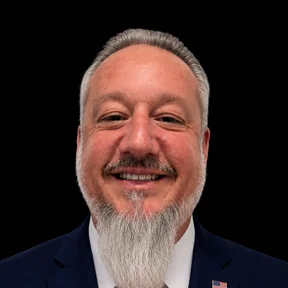
Victor J. Rosario is the Residents-First candidate for Miami-Dade County Mayor 2028. A U.S. Coast Guard veteran, entrepreneur, technologist, and artist, Victor brings a track record of building real solutions — from AI tools to campaign policy — that serve Miami-Dade's 2.8 million residents.
Learn More About Victor