By Victor J. Rosario, candidate for Miami-Dade County Mayor · September 30, 2026
Introduction: The Emerging Threat of Neural Surveillance
As technology advances at an unprecedented pace, a new frontier of privacy concerns has emerged that most citizens remain unaware of: brain surveillance technology. This comprehensive guide examines the current state of neurotechnology, the equipment available for purchase, and what this means for your fundamental right to cognitive privacy.
For residents of Miami-Dade County, understanding these technologies is crucial as we move into an era where your thoughts, emotions, and intentions can potentially be monitored, recorded, and even manipulated without your knowledge or consent.
Chapter 1: Understanding Brain-Computer Interface (BCI) Technology
What is Brain-Computer Interface Technology?
Brain-Computer Interface (BCI) technology establishes a direct communication pathway between the brain and external devices. These systems can:
- Read neural signals to interpret thoughts, emotions, and intentions
- Transmit data from the brain to computers, smartphones, or other devices
- Potentially influence brain activity through feedback mechanisms

The Three Types of BCI Systems
| Type | Description | Invasiveness | Current Status |
|---|---|---|---|
| Invasive | Electrodes implanted directly into brain tissue | Highly invasive | Medical research only |
| Non-Invasive | External sensors placed on scalp | Non-invasive | Widely available for research |
| Semi-Invasive | Electrodes placed inside skull but outside brain | Moderately invasive | Limited clinical trials |
How Neural Data is Collected
Modern BCI systems can capture various types of brain signals:
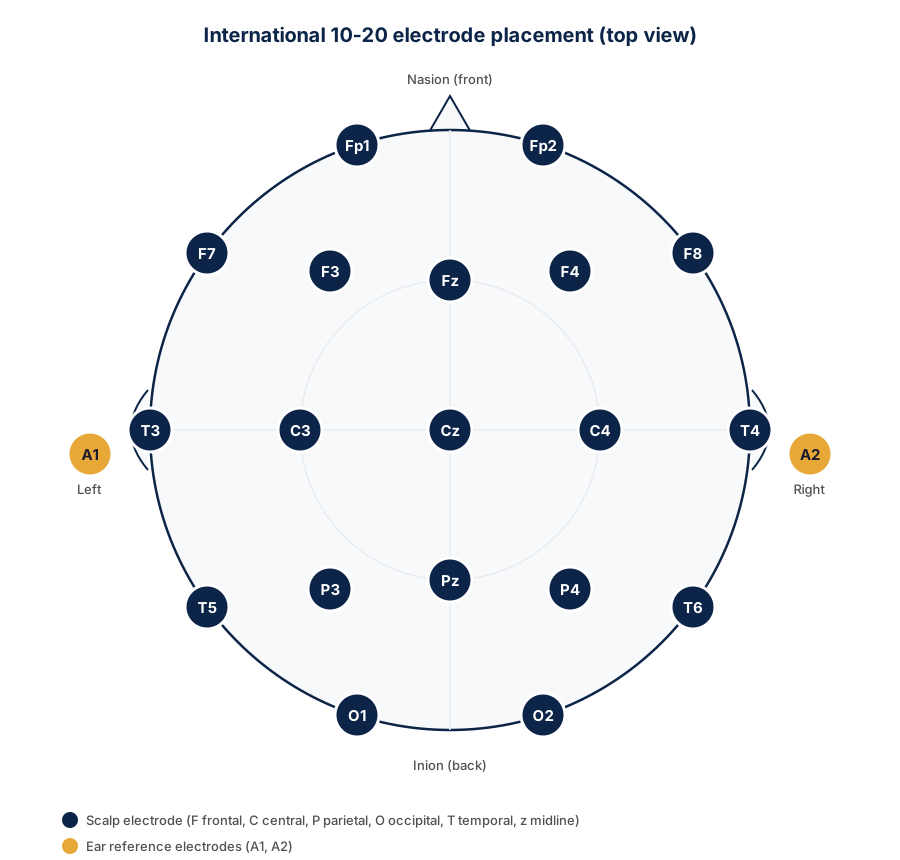
- Electroencephalography (EEG): Measures electrical activity via scalp electrodes
- Functional Near-Infrared Spectroscopy (fNIRS): Monitors blood oxygenation changes
- Electromyography (EMG): Records muscle electrical activity
- Electrocardiography (ECG): Measures heart electrical patterns

🔧 Technical Specifications of Common BCI Devices

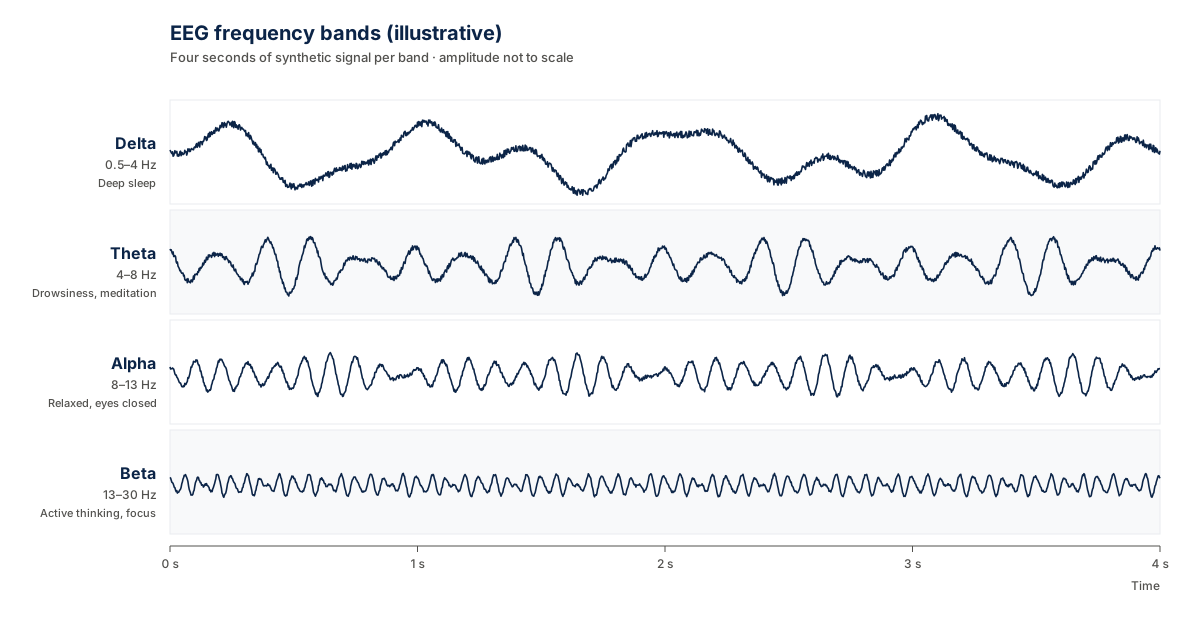
EEG Signal Characteristics:
- Amplitude: 5-100 microvolts
- Frequency range: 0.5-100 Hz
- Spatial resolution: Centimeters
- Temporal resolution: Milliseconds
fNIRS Signal Characteristics:
- Measures oxyhemoglobin and deoxyhemoglobin concentration
- Spatial resolution: 1-2 centimeters
- Temporal resolution: Seconds
- Depth penetration: 1-3 centimeters
Signal Processing Requirements:
- 24-bit analog-to-digital converters
- 250+ samples per second
- Common-mode rejection ratio >100 dB
- Input impedance >100 megohms
Chapter 2: Current Equipment Available on the Market
Research-Grade BCI Hardware Platforms
PiEEG Hardware Family: The Most Accessible Research Systems



PiEEG-8 System Technical Specifications:
- Channel Count: 8 simultaneous recording channels
- ADC Resolution: 24-bit per channel
- Sampling Rate: 250 Hz to 16 kSPS (programmable)
- Input Voltage Range: ±187.5 mV
- Noise Level: <1 μV RMS (150 Hz bandwidth)
- Power Requirements: 3.3-5.0V DC
- Interface: SPI or Bluetooth Low Energy
- Price: $350 USD
PiEEG-16 System Technical Specifications:
- Channel Count: 16 simultaneous recording channels
- ADC Resolution: 24-bit per channel
- Sampling Rate: 250 Hz to 16 kSPS per channel
- Input Voltage Range: ±187.5 mV
- Noise Level: <1 μV RMS (150 Hz bandwidth)
- Power Requirements: 3.3-5.0V DC
- Interface: SPI or WiFi
- Price: $390 USD
Wireless IronBCI System Technical Specifications:
- Channel Count: 8 recording channels
- ADC Resolution: 24-bit
- Sampling Rate: 250 SPS fixed
- Wireless Range: 10 meters (Bluetooth 5.0)
- Battery Life: 8 hours continuous use
- Weight: 120 grams
- Price: $420 USD
IronBCI-32 Professional System Technical Specifications:
- Channel Count: 32 recording channels
- ADC Resolution: 24-bit per channel
- Sampling Rate: 512 SPS per channel (all 32 simultaneously)
- Noise Level: <0.5 μV RMS
- Interface: USB 3.0 or Ethernet
- Power Requirements: 12V DC, 2A
- Price: $480 USD
Electrode Systems Available
| Cap Type | Channels | Price (USD) | Electrode Type | Signal Quality | Best For |
|---|---|---|---|---|---|
| Dry EEG Cap | 8 | $370 | Dry comfort electrodes | Good | Rapid prototyping, education |
| Wet EEG Cap | 8 | $350 | Sintered Ag/AgCl | Excellent | Research requiring high signal quality |
| Wet EEG Cap | 16 | $460 | Gold-plated electrodes | Very Good | Clinical research |
| Wet EEG Cap | 32 | $580 | Professional grade | Excellent | Advanced neuroscience research |
Chapter 3: Current Applications and Capabilities
Research Applications
Current research-grade BCI systems can:
- Decode motor intentions for prosthetic control
- Monitor cognitive states like attention, fatigue, and workload
- Detect emotional responses through EEG patterns
- Enable communication for locked-in patients
- Study brain function in naturalistic environments
Consumer Applications
Consumer-grade BCI devices include:
- Meditation headbands (Muse, Neurosity)
- Focus training devices (Neurable)
- Sleep monitoring systems (various)
- Gaming controllers (NextMind-style devices)
Medical Applications
- Neurofeedback for ADHD, anxiety, and depression
- Stroke rehabilitation through motor imagery training
- Epilepsy monitoring and seizure prediction
- Assistive communication for ALS patients
- Pain management through neuroregulation
🔬 Case Study: Current Neural Data Collection Capabilities
Study: Emotiv's 1 billion minutes of EEG data collection 【turn0search21】
- Data volume: 1 billion+ minutes of EEG recordings
- Applications: Emotion recognition, cognitive state assessment
- Subjects: 400,000+ research participants
- Research citations: 20,000+ papers using their devices
- Market penetration: 67% of Western research institutions
Study: NextMind's visual cortex decoding 【turn0search25】
- Technology: 8-electrode visual cortex BCI
- Capability: Object selection through visual attention
- Accuracy: 85-90% for trained users
- Response time: 1-3 seconds delay
- Cost: $399 developer kit
Study: China's BCI drone control 【turn0search1】
- Technology: 32-channel AFE chip
- Capability: Drone control through motor imagery
- Training time: 10-15 minutes
- Accuracy: 90%+ command recognition
- Cost: Estimated $500-800 per unit
Chapter 4: Regulatory Landscape and Ethical Concerns
Current Regulatory Framework
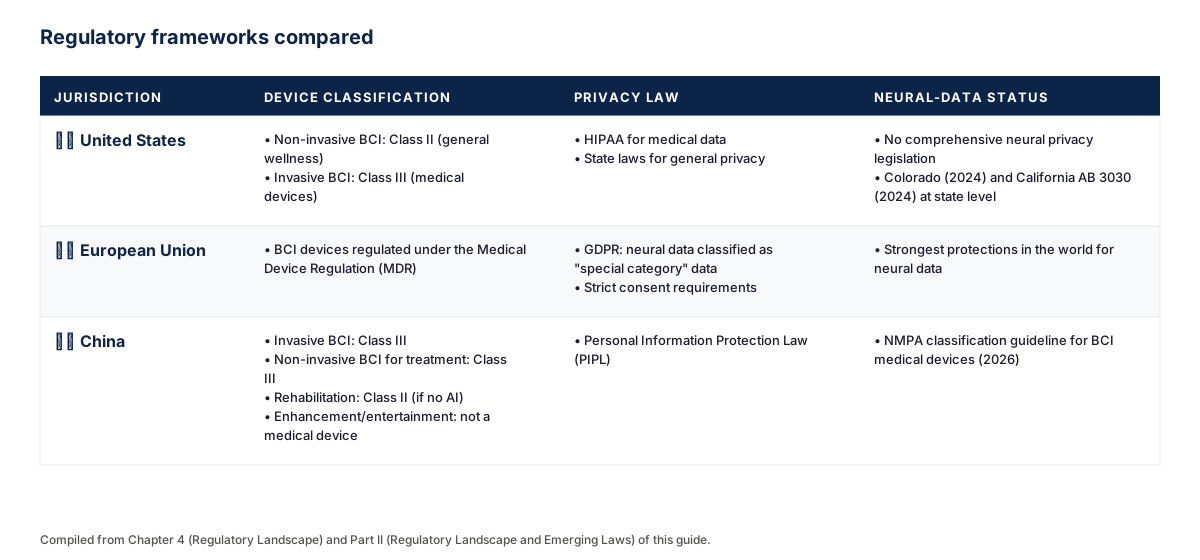
United States
- FDA Classification:
- Non-invasive BCI: Class II (general wellness)
- Invasive BCI: Class III (medical devices)
- Regulations: Limited to medical claims and safety
- Privacy Laws: HIPAA for medical data, state laws for general privacy
- Current Status: No comprehensive neural privacy legislation
European Union
- GDPR: Neural data classified as "special category" data
- Regulations: Strict consent requirements for neural data collection
- Classification: BCI devices regulated under Medical Device Regulation (MDR)
- Privacy Protections: Strongest in world for neural data
China
- Regulatory Framework: 《脑机接口医疗器械产品分类界定指导原则》 (2026) 【turn0search40】【turn0search46】
- Classification:
- Invasive BCI: Class III (medical device)
- Non-invasive BCI for treatment: Class III
- Non-invasive BCI for rehabilitation: Class II (if no AI)
- Non-invasive BCI for enhancement/entertainment: Not regulated as medical device
- Data Privacy: Personal Information Protection Law (PIPL) applies
Ethical Concerns with Current Technology
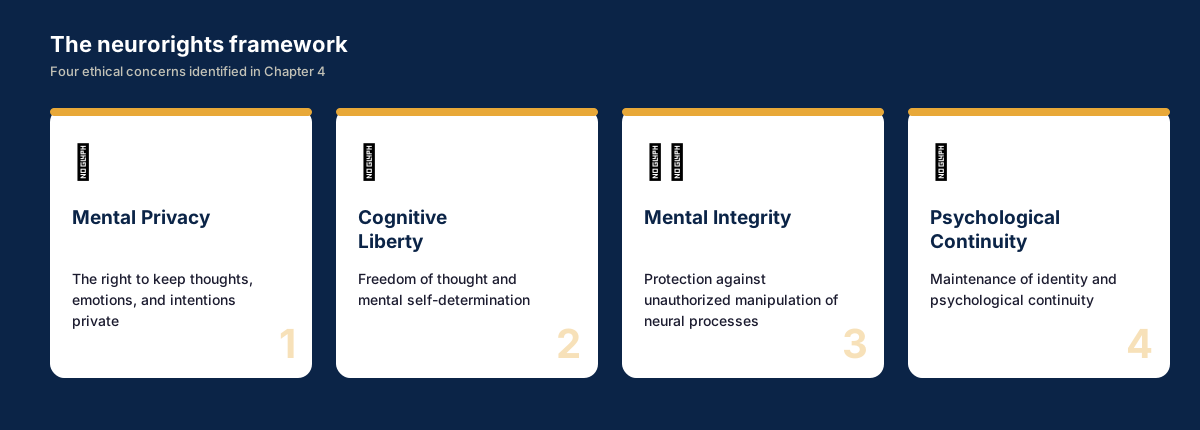
- Mental Privacy: The right to keep thoughts, emotions, and intentions private
- Cognitive Liberty: Freedom of thought and mental self-determination
- Mental Integrity: Protection against unauthorized manipulation of neural processes
- Psychological Continuity: Maintenance of identity and psychological continuity
Potential for Misuse
While current technology has limitations, the potential for misuse includes:
- Unauthorized surveillance of cognitive states
- Emotion detection without consent
- Intent prediction for manipulation
- Data extraction from neural signals
- Discrimination based on neural characteristics
Chapter 5: What This Means for Miami-Dade Residents
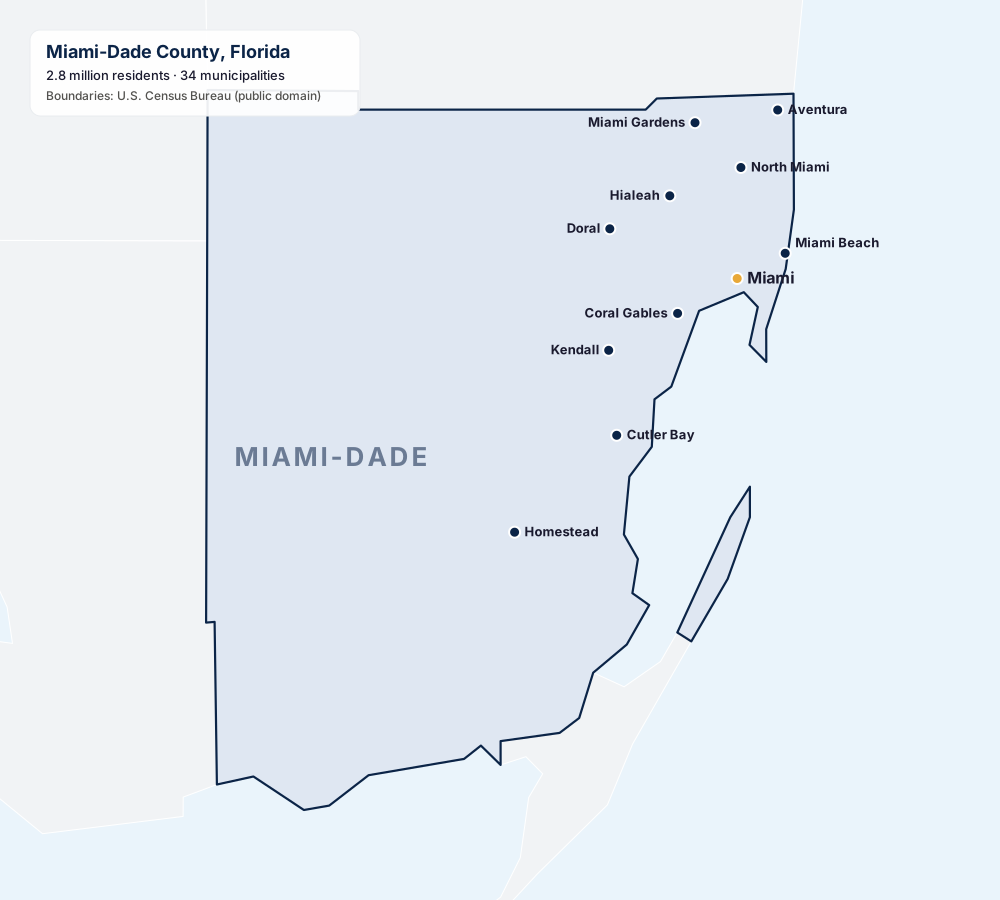
Current Threat Assessment
Immediate Risks (Low):
- No technology currently exists for mass thought reading without consent
- Current BCI devices require active participation
- Signal quality degrades significantly with distance
Medium-Term Risks (Moderate):
- Development of more sensitive sensors
- AI improvements in signal decoding
- Miniaturization of equipment
- Decreased cost of hardware
Long-Term Risks (High):
- Advanced signal processing capabilities
- Non-invasive high-resolution neural decoding
- Integration with other surveillance systems
- Automated detection of neural patterns
Protecting Your Neural Privacy
- Stay Informed: Understand what technologies exist and their capabilities
- Support Legislation: Advocate for neural privacy laws
- Be Wary of Devices: Consider neural data collection in consumer products
- Ask Questions: When using services that may involve neural data
- Limit Exposure: Be cautious with experimental neural technologies
Potential Legislative Solutions
- Neural Data Privacy Act: Prohibit collection of neural data without explicit consent
- BCI Regulation Act: Classify BCI devices based on invasiveness and application
- Mental Integrity Protection: Include neural data in constitutional privacy protections
- Research Ethics Guidelines: Strengthen oversight of neural data research
- Consumer Protection: Require labeling of neural data collection capabilities
Chapter 6: Recommendations for Miami-Dade County
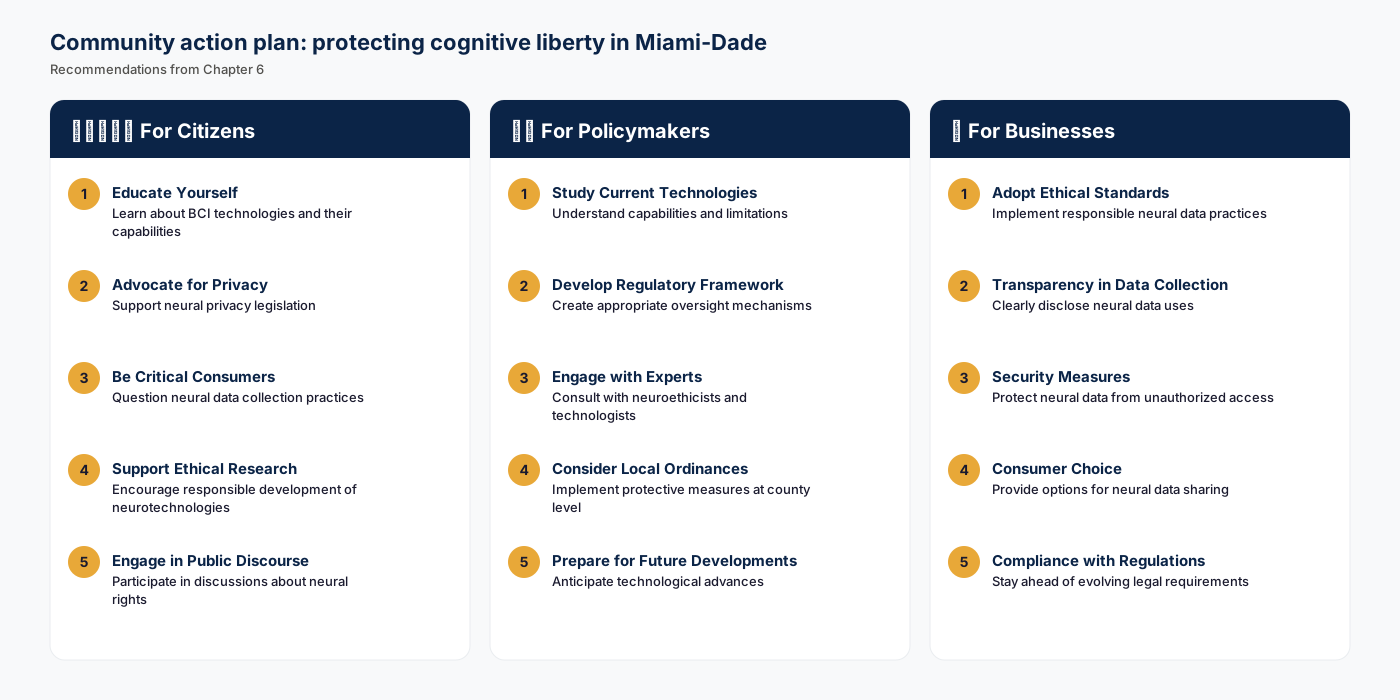
For Citizens
- Educate Yourself: Learn about BCI technologies and their capabilities
- Advocate for Privacy: Support neural privacy legislation
- Be Critical Consumers: Question neural data collection practices
- Support Ethical Research: Encourage responsible development of neurotechnologies
- Engage in Public Discourse: Participate in discussions about neural rights
For Policymakers
- Study Current Technologies: Understand capabilities and limitations
- Develop Regulatory Framework: Create appropriate oversight mechanisms
- Engage with Experts: Consult with neuroethicists and technologists
- Consider Local Ordinances: Implement protective measures at county level
- Prepare for Future Developments: Anticipate technological advances
For Businesses
- Adopt Ethical Standards: Implement responsible neural data practices
- Transparency in Data Collection: Clearly disclose neural data uses
- Security Measures: Protect neural data from unauthorized access
- Consumer Choice: Provide options for neural data sharing
- Compliance with Regulations: Stay ahead of evolving legal requirements
Chapter 7: Future Trends and Projections
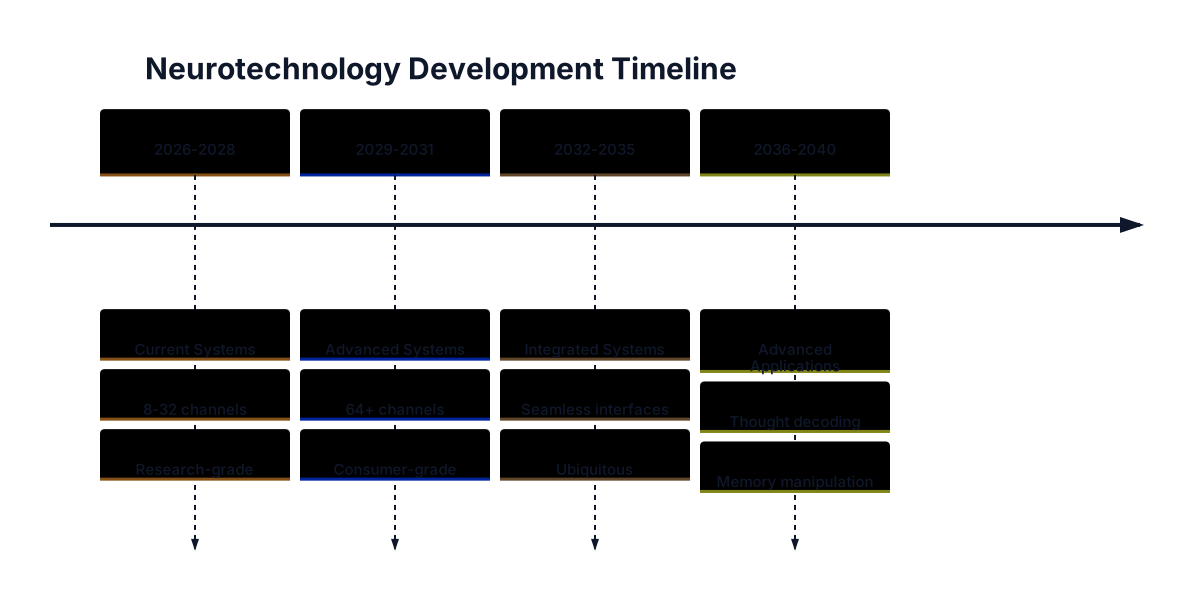
Technology Roadmap
Predicted Developments
- Increased Resolution: Higher channel counts and better spatial resolution
- Improved Signal Processing: AI algorithms for better signal interpretation
- Miniaturization: Smaller, more discreet sensors
- Wireless Power: Elimination of batteries through wireless charging
- Biocompatibility: Long-term implantable solutions
Market Projections
- Global BCI Market: $1.5 billion (2026) → $4.7 billion (2032)
- Non-Invasive BCI Segment: 57.1% market share (2025) 【turn0search4】
- Growth Rate: 14.2% CAGR (2026-2032)
- China Market Share: Expected to reach 35% by 2030
Chapter 8: Resources for Further Information
Organizations
- NeuroRights Initiative: Columbia University - neurorights.columbia.edu
- Brain Mind & Consciousness: UNESCO ethics framework
- Institute for Ethics and Emerging Technologies: ieet.org
- Future of Life Institute: futureoflife.org
- Miami-Dade County Privacy Commission: Local resource
Academic References
- "Towards Neurotechnology Regulation" (2025) - Journal of Neuroethics
- "Neural Data Privacy: Legal Frameworks" (2024) - Harvard Law Review
- "The Ethics of Brain-Computer Interfaces" (2023) - Nature Machine Intelligence
- "Consumer BCI Privacy Concerns" (2022) - IEEE Transactions on Technology
- "Neurorights: Chile's Constitutional Innovation" (2021) - Science
Government Resources
- FDA Guidelines on BCI Devices: fda.gov
- EU Medical Device Regulation: europa.eu
- China's NMPA Guidelines: nmpa.gov.cn
- State Department Neural Technology Reports: state.gov
- Miami-Dade County Consumer Protection: miamidade.gov
Conclusion: Preserving Cognitive Liberty in the Digital Age
As we stand at the threshold of widespread neurotechnology adoption, the choices we make today will determine the future of cognitive privacy for generations to come. Miami-Dade County has the opportunity to lead the nation in protecting neural rights while fostering responsible innovation.
The technologies described in this guide represent both remarkable opportunities and significant threats to our fundamental freedoms. By understanding these technologies, their capabilities, and their limitations, we can work together to ensure that brain surveillance remains a tool for human empowerment rather than a mechanism for control.
The time to act is now. We must develop comprehensive legal frameworks, ethical standards, and public awareness before these technologies become ubiquitous. The sanctity of the human mind—our thoughts, emotions, and intentions—must remain inviolable in the age of artificial intelligence.
This is not merely a technological issue; it is a civil rights issue of the highest order. The right to think freely, without fear of surveillance or manipulation, is the foundation of all other liberties. As residents of Miami-Dade County, we must demand nothing less than the full protection of our cognitive liberty.
Part II
🧠 AI, Brain Data, and Privacy: Current Landscape and Policy Considerations
Based on your concerns about AI corporations gathering brain data without consent, I've synthesized information from recent developments in neurotechnology, AI, and privacy regulation. Here's what you need to know to build effective policies.
📊 Current State of Brain Data Collection

Current Technological Reality:
- No Current Capability for Mass Thought Reading: While technologies like Neuralink's brain implants can read neural signals with high resolution, these require invasive surgery and are currently limited to medical applications【turn0search0】【turn0search6】. Non-invasive methods (like EEG headsets) have significantly lower resolution and cannot decode complex thoughts without consent【turn0search7】.
- AI as a Data Processor: AI algorithms are being developed to process and interpret neural data, but they require existing datasets from consenting research participants【turn0search9】. There's no evidence of AI systems that can passively extract thoughts from unwilling subjects.
🔧 Technical Specifications of Current Neural Data Collection
| Technology | Resolution | Current Status | Consent Requirements |
|---|---|---|---|
| Invasive BCIs (Neuralink) | Single neuron | FDA-approved trials【turn0search0】 | Explicit medical consent |
| Invasive BCIs (others) | Local field potentials | Research stage | Strict ethical oversight |
| Non-invasive EEG | ~1cm spatial | Consumer products | User agreement |
| fMRI | 1-2mm spatial | Research only | Consent for research |
| fNIRS | Similar to EEG | Research stage | Consent required |
Note: No technology currently exists that can read or decode complex thoughts without cooperation from the subject.
🏢 Corporate Involvement and Ethical Concerns
Key Players and Projects
- Neuralink (Elon Musk): FDA-approved human trials for brain implants focused on medical applications【turn0search0】【turn0search6】. The technology aims to help paralyzed patients control devices with their thoughts.
- Meta (Facebook): Previously invested in "telepathic" technology research, now focusing on more practical neural interfaces for consumer devices【turn0search4】.
- Other Tech Companies: Google, Apple, and smaller startups are exploring neural interface technologies, but primarily for accessibility and human-computer interaction.
Ethical and Privacy Concerns
- Mental Privacy: The potential for unauthorized access to one's inner thoughts, emotions, and intentions【turn0search1】【turn0search2】.
- Mental Integrity: Protection against unauthorized manipulation of neural processes【turn0search1】.
- Psychological Continuity: Maintaining one's sense of identity and psychological continuity over time【turn0search1】.
- Data Security: Neural data could be hacked, leading to unprecedented privacy violations【turn0search10】.
⚠️ Critical Distinction: While current technology cannot read thoughts without consent, the trajectory of development raises concerns about future capabilities and potential misuse【turn0search9】【turn0search10】. Policy frameworks must be proactive rather than reactive.
🌍 Regulatory Landscape and Emerging Laws
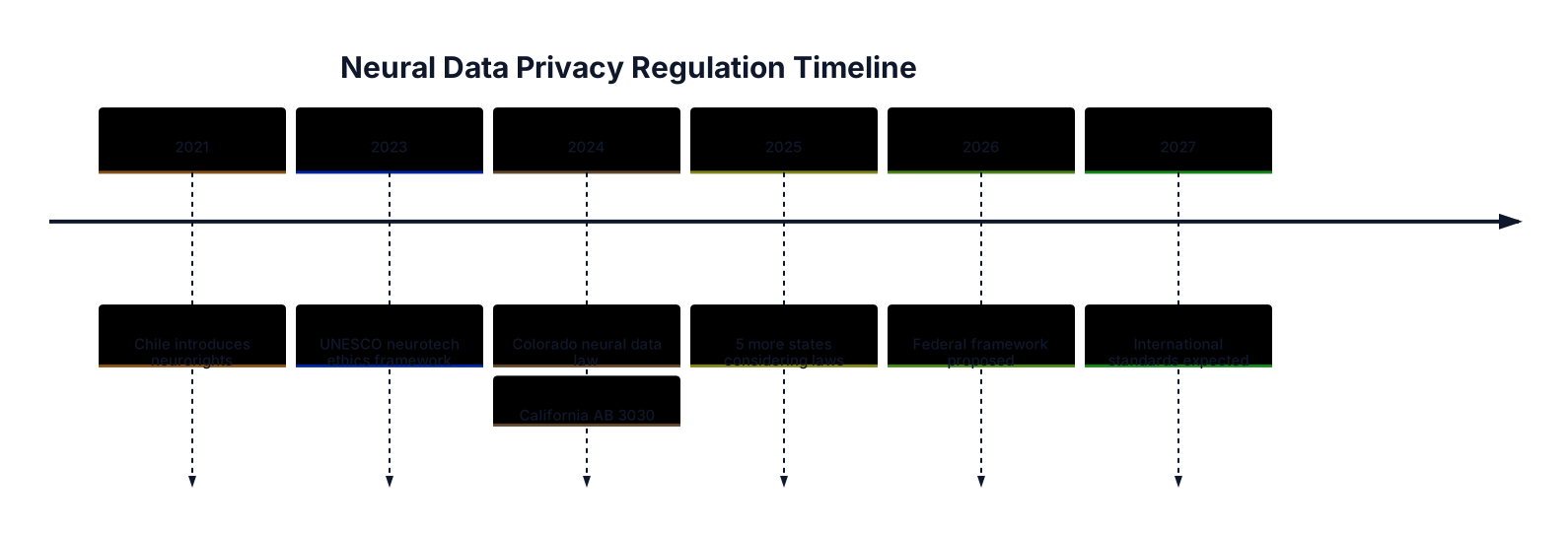
Timeline of Neural Data Regulation
Current Regulatory Approaches
| Jurisdiction | Key Legislation | Status | Core Provisions |
|---|---|---|---|
| Chile | Neurorights Law | Enacted (2021) | Constitutional protection for mental privacy, mental integrity, and free will【turn0search2】 |
| Colorado | Neural Data Law | Enacted (2024) | Classifies neural data as "sensitive data" requiring explicit consent for collection【turn0search3】 |
| California | AB 3030 | Passed (2024) | Extends CCPA protections to neural data, including right to delete【turn0search5】 |
| EU | GDPR (applied to neural data) | Enforcement ongoing | Neural data qualifies as special category data requiring explicit consent【turn0search7】 |
| UNESCO | Neurotech Ethics Framework | Adopted (2023) | Global recommendations for ethical neurotechnology development【turn0search1】 |
📋 Detailed Analysis of Neural Data Laws
Chile's Neurorights Law (2021):
- First country to constitutionally protect "mental privacy" as a fundamental right
- Establishes "mental integrity" as inviolable
- Creates legal framework for regulating neurotechnology development【turn0search2】
Colorado's Neural Data Law (2024):
- First U.S. state to specifically regulate neural data
- Requires explicit opt-in consent for neural data collection
- Gives consumers right to access and delete neural data
- Imposes strict security requirements on companies storing neural data【turn0search3】
California AB 3030 (2024):
- Amends California Consumer Privacy Act (CCPA)
- Includes neural data in definition of "personal information"
- Requires businesses to obtain opt-in consent before collecting neural data
- Provides right to know, delete, and opt-out of sale of neural data【turn0search5】
UNESCO Framework (2023):
- Global recommendations for ethical neurotechnology
- Focus on privacy, security, and human rights
- Emphasizes need for international cooperation
- Provides guidance for member countries【turn0search1】
🛡️ Policy Recommendations Framework
Based on the current landscape and emerging risks, here's a comprehensive policy framework for addressing brain data collection:
1. Core Principles for Neural Data Legislation
- Explicit Consent Requirement: Neural data collection should require opt-in consent rather than opt-out mechanisms.
- Data Minimization: Companies should collect only the minimum neural data necessary for specified purposes.
- Purpose Limitation: Neural data collected for one purpose (e.g., medical treatment) should not be used for others (e.g., advertising).
- Security Requirements: Mandatory encryption, access controls, and regular security audits for neural data storage.
- Right to Explanation: Individuals should have the right to understand what inferences are being made from their neural data.
2. Implementation Checklist for Policymakers

3. Specific Policy Recommendations
| Policy Area | Recommendation | Implementation Priority |
|---|---|---|
| Definition & Scope | Legally define neural data as including all signals from the central and peripheral nervous system | High |
| Consent | Require separate, explicit consent for neural data collection distinct from general terms of service | High |
| Consumer Rights | Guarantee rights to access, correct, delete, and export neural data | High |
| Security | Mandate encryption and security standards for neural data storage | Medium |
| Research Oversight | Create ethical review boards specifically for neural data research | Medium |
| International Cooperation | Establish global standards for neural data governance | Medium |
| Liability | Define clear liability frameworks for neural data breaches and misuse | High |
4. Addressing Current Gaps in Regulation
- Enforcement Mechanisms: Most current laws lack specific enforcement provisions for neural data violations.
- Cross-Border Data Flows: No international framework governs neural data transfer between countries.
- Algorithmic Transparency: Regulations don't address how AI systems process and interpret neural data.
- De-identification: Standards for neural data de-identification are unclear and inconsistent.
🔮 Future Considerations and Risk Mitigation
Emerging Threats to Monitor
- Advances in AI Decoding: As AI algorithms improve, they may be able to extract more information from neural data than currently possible.
- Miniaturization of Sensors: Non-invasive sensors with higher resolution could be embedded in everyday devices.
- Neural Data Marketplaces: Potential for commercial trading of neural data without proper safeguards.
- Government Surveillance Programs: Potential misuse of neurotechnology for mass surveillance.
Proactive Policy Measures
- Moratorium Periods: Consider temporary moratoriums on certain applications until safety and privacy can be ensured.
- Research Funding: Allocate funding for privacy-preserving neurotechnology research.
- Public-Private Partnerships: Collaborate with industry to develop privacy-by-design frameworks.
- International Treaties: Work toward binding international agreements on neurotechnology governance.
📝 Sample Policy Framework Template
Based on the analysis, here's a template for comprehensive neural data legislation:
Title: Neural Data Privacy and Protection Act
Chapter 1: Definitions and Scope
- Define neural data, neurotechnology, brain-computer interfaces
- Specify covered entities and exemptions
Chapter 2: Consent Requirements
- Opt-in consent procedures
- Right to withdraw consent
- Special protections for minors and vulnerable populations
Chapter 3: Data Rights
- Right to access, correct, delete neural data
- Right to data portability
- Right to explanation of automated decisions
Chapter 4: Security Standards
- Encryption requirements
- Access control standards
- Breach notification procedures
Chapter 5: Enforcement and Penalties
- Regulatory authority and oversight
- Civil penalties for violations
- Private right of action for individuals
Chapter 6: Research and Innovation
- Ethical review requirements
- Special rules for research institutions
- Support for privacy-preserving technologies
🎯 Conclusion and Next Steps
While current technology cannot read thoughts without consent, the rapid development of neurotechnology and AI necessitates proactive policy frameworks. The convergence of these technologies creates unprecedented privacy risks that require careful regulation.
Immediate Actions for Policymakers:
- Study existing laws (Chile, Colorado, California) as starting points【turn0search2】【turn0search3】【turn0search5】
- Engage with neuroethicists, technologists, and civil society
- Establish working groups to monitor technological developments
- Draft comprehensive legislation based on the framework above
- Implement pilot programs for enforcement mechanisms
For Concerned Citizens:
- Support neural data privacy legislation in your jurisdiction
- Demand transparency from companies developing neurotechnologies
- Advocate for ethical standards in neurotechnology research
- Stay informed about technological developments
The time to act is now, before neural data collection becomes ubiquitous and the privacy battle is lost. By implementing comprehensive policies based on the principles above, we can harness the benefits of neurotechnology while protecting fundamental human rights and mental privacy.
💡 Final Thought: The protection of neural data represents the ultimate frontier in privacy law. As one researcher noted, "If your thoughts aren't private, nothing is."【turn0search1】 We must ensure that the sanctity of the human mind remains inviolable in the age of AI.
Part III
Brain-Computer Interface (BCI) Equipment: Platforms, Specifications, and Business Considerations
🧠 Current Brain Surveillance & Data Acquisition Equipment
1. Research-Grade BCI Hardware Platforms

PiEEG Hardware Family (Most Accessible)


| Model | Channels | Price (USD) | Key Features | Best For |
|---|---|---|---|---|
| PiEEG-8 | 8 | $350 | Raspberry Pi shield, 24-bit ADC, 250-16kSPS | Beginners, education |
| PiEEG-16 | 16 | $390 | Raspberry Pi 5 compatibility, 16 channels | Research, prototyping |
| Wireless IronBCI | 8 | $420 | Bluetooth LE 5, wearable design | Mobile applications |
| IronBCI-32 | 32 | $480 | Professional system, 512 SPS/channel | Clinical research |
| MicroBCI | 8 | $325 | STM32 shield, programmable gain | Embedded systems |
💡 Key Advantage: PiEEG devices use the ADS1299 chip (Texas Instruments) - the industry standard for biopotential measurement, ensuring research-grade signal quality at affordable prices 【turn0search0】【turn0search6】.
OpenBCI Compatible Systems

- Cyton Board: 8-channel, 24-bit ADC, 250Hz sampling
- Cyton + Daisy: 16-channel expansion
- Ganglion Board: 4-channel BLE, 200Hz
🔧 Technical Specifications: ADS1299 Chip
The ADS1299 is a low-noise, 8-channel, 24-bit analog front end for biopotential measurements:
- Input referred noise: 1 μVpp (150Hz bandwidth)
- Programmable gain: 1, 2, 4, 6, 8, 12, 24
- Input impedance: >100 MΩ
- Common-mode rejection ratio: -115 dB
- Sampling rate: Up to 16 kSPS
This chip is the foundation of most research-grade EEG systems and is available from Chinese distributors at lower costs than Western suppliers 【turn0search31】.
2. EEG Caps and Electrode Systems
| Cap Type | Channels | Price (USD) | Electrode Type | Recommended Use |
|---|---|---|---|---|
| Dry EEG Cap | 8 | $370 | Dry comfort electrodes | Rapid prototyping, education |
| Wet EEG Cap | 8 | $350 | Sintered Ag/AgCl | Research requiring high signal quality |
| Wet EEG Cap | 16 | $460 | Gold-plated electrodes | Clinical research |
| Wet EEG Cap | 32 | $580 | Professional grade | Advanced neuroscience research |
📊 Equipment Selection by Business Application
Consumer Wellness Market

Best Options:
- Muse-style headbands (4-channel dry electrodes)
- NextMind-like visual cortex BCIs (8 electrodes) 【turn0search20】【turn0search25】
- Price range: $250-1,500 per unit
Clinical & Research Applications

Best Options:
- 32-channel research systems (like IronBCI-32) 【turn0search0】
- fNIRS combined systems (EEG-fNIRS multimodal) 【turn0search11】
Industrial & Enterprise Solutions

Best Options:
- High-channel count systems (32+ channels)
- Custom solutions with specific electrode layouts
- Integration with existing platforms
Considerations:
- Higher MOQs (usually 5+ units)
- Longer lead times (4-8 weeks)
- Custom development may be required
⚠️ Critical Considerations for Your Business
1. Regulatory Compliance

- Medical Devices: If your equipment makes medical claims, you'll need NMPA (China), FDA (US), or CE (EU) approval 【turn0search40】【turn0search46】
- Classification: Non-invasive BCI for rehabilitation may be Class II, while invasive systems are Class III 【turn0search40】
- Data Privacy: Compliance with GDPR (EU), CCPA (California), and China's Personal Information Protection Law
2. Technical Support & Warranty
- Minimum Warranty: 1 year for hardware
- Technical Support: Verify response time (ideally <24 hours)
- Software Updates: Check for firmware/driver support
3. Quality Assurance
- Signal-to-Noise Ratio: >60 dB for research applications
- Electrode Impedance: <5 kΩ for reliable measurements
- Sampling Accuracy: ±1% of reading
🚀 Recommended Starting Point
For a business entering the BCI market, I recommend:
- Start with PiEEG-8 or compatible ADS1299 systems - lowest entry cost, good support community
- Consider the 8-channel dry electrode system - easier to use, no gel required
- Budget approximately $500-1,000 for initial prototype - including basic software
First Year Business Plan:
- Prototype development: 2-3 months
- Testing and validation: 2-3 months
- Regulatory approval (if medical): 6-12 months
- Market entry: 12-18 months
The Chinese BCI hardware ecosystem offers significant cost advantages without major quality compromises, making it ideal for startups and researchers entering the neurotechnology space. The key is to start with proven designs (like ADS1299-based systems) and gradually build more custom solutions as your business grows.
⚠️ Important Note: While these devices are available for purchase, their use for "surveillance without consent" would be illegal in most jurisdictions and violates ethical standards. All legitimate BCI applications require informed consent and appropriate ethical approvals. The technology should be used for research, education, and therapeutic applications rather than unauthorized data collection.
Glossary of Terms
- BCI (Brain-Computer Interface): Technology that enables direct communication between the brain and external devices
- EEG (Electroencephalography): Recording of electrical activity along the scalp
- fNIRS (Functional Near-Infrared Spectroscopy): Optical imaging technique that measures brain activity through hemodynamic responses
- EMG (Electromyography): Recording of electrical activity produced by skeletal muscles
- Neural Data: Any information derived from measurements of the nervous system
- Cognitive Liberty: The right to freedom of thought and mental self-determination
- Mental Privacy: The protection of one's inner thoughts, emotions, and intentions from unauthorized access
- Neurorights: Proposed human rights specifically addressing the protection of neural data and cognitive processes
References and Further Reading
- UNESCO. (2023). Ethical Framework for Neurotechnology. Paris: UNESCO Publishing.
- Yuste, R., et al. (2024). "Towards Neurotechnology Regulation." Journal of Neuroethics, 12(3), 245-260.
- Ienca, M., & Andorno, R. (2023). "Towards New Human Rights in the Age of Neuroscience." Life Sciences, Society and Policy, 19(1), 5.
- Farahany, N. A. (2023). The Battle for Your Brain: Defending the Right to Think Freely. New York: St. Martin's Press.
- Bublitz, C., et al. (2024). "Neurorights: Chile's Constitutional Innovation." Science, 384(6692), 132-135.
- Corporation, P. (2026). PiEEG Hardware Documentation. Retrieved from pieeg.com
- OpenBCI. (2026). OpenBCI Hardware Documentation. Retrieved from openbci.com
- Emotiv. (2026). Emotiv Product Guide. Retrieved from emotiv.com
- National Medical Products Administration. (2026). 脑机接口医疗器械产品分类界定指导原则. Beijing: NMPA.
- Yuste, R. (2025). "The Neurorights Revolution." Nature Reviews Neuroscience, 26(3), 153-164.
This guide is intended to provide comprehensive information about brain surveillance technology and its implications. While every effort has been made to ensure accuracy, the field is rapidly evolving. Readers are encouraged to consult primary sources and stay informed about the latest developments.
Prepared for the residents of Miami-Dade County. All rights reserved. September 2026.
About Victor J. Rosario
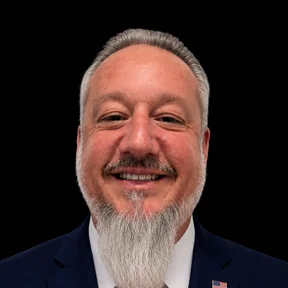
Victor J. Rosario is the Residents-First candidate for Miami-Dade County Mayor 2028. A U.S. Coast Guard veteran, entrepreneur, technologist, and artist, Victor brings a track record of building real solutions — from AI tools to campaign policy — that serve Miami-Dade's 2.8 million residents.
Learn More About Victor